
Battle at the Harzhorn
Traffic on the A7 pours north through a gap in the hills near Kalefeld without slowing for anything. It is the only easy way across this ridge, and it has been the only easy way for a very long time. Sometime around the middle of the third century, by the best current reading of the evidence, a Roman column came through that gap while under attack. Nobody knew it had happened. There is no chronicle, no inscription, no name for the fight — only the hardware it left in the ground, and that stayed there for roughly 1,800 years until two hobbyists went looking for a medieval castle and found the wrong century.
The Shoe That Was Not a Horseshoe
In 2000, Winfried Schütte and Rolf-Peter Dix were sweeping the Harzhorn hill with metal detectors, hoping for traces of a medieval fortress. What came up was iron of the wrong sort. One piece was a hipposandal — a shaped iron plate strapped under a hoof, standard Roman equipment, and centuries older than anything they had been looking for. They took it to the county archaeologist at Northeim.
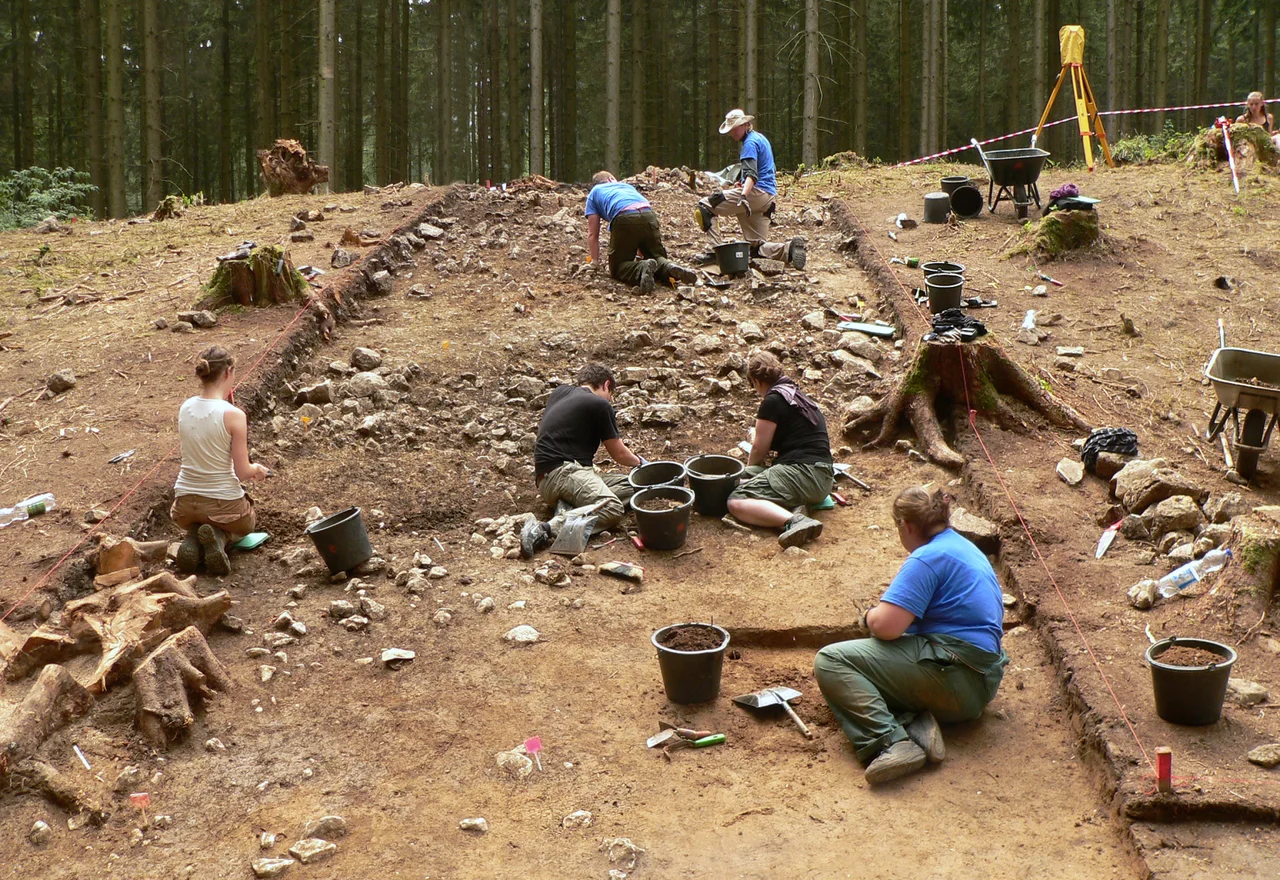
It took until 15 December 2008 for the site to be announced publicly, and by then the scale of it was obvious. The finds spread across several square kilometres in two concentrations about three kilometres apart; the second, on the Kahlberg, did not surface until November 2010. Northern Germany has almost nothing Roman in the ground. There is Kalkriese, where the Teutoburg Forest disaster is placed, and now there is this.
Nineteen Hundred Nails
By 2025 the site had given up roughly 2,700 objects, and the largest single category is also the least cinematic: more than 1,900 hobnails, shed from the soles of military boots as men walked and fought and ran. Nails do not make a good museum case. They make an excellent map.
Around them lies the rest of it — some 322 offensive weapons, including arrowheads, spearheads, a pilum and catapult bolts; 123 pieces of defensive gear, among them mail, helmet fragments and greaves; 53 items of horse and mule harness; 43 parts of wagons. The bolts settled the argument about who was here. They belong to the scorpio and the cheiroballistra, torsion artillery that only Roman armies fielded. Something substantial came through this pass, and it brought its guns and its baggage train with it.
The Sentence Editors Kept Correcting
The Historia Augusta, a late and famously unreliable set of imperial biographies, says that Maximinus Thrax marched north from Moguntiacum — Mainz — some three hundred to four hundred Roman miles. Editors long assumed a copyist had blundered, and quietly amended trecenta and quadringenta to triginta and quadraginta, thirty to forty, on the reasonable grounds that no third-century army went that far into the forest.
The Harzhorn sits at about the distance the manuscript actually claims. The coins narrow the date: among the earliest datable finds is a sestertius of Commodus from 188 or 189, but the series as a whole gives a terminus post quem of 225 and nothing at all after 238. The numismatist Frank Berger places the fight between 230 and 235, and the campaign Maximinus led into Germania in 235 is the usual attribution. Whatever happened here happened more than two hundred years after Rome supposedly stopped trying.
What the Ground Does Not Say
It is worth being precise about the limits. No human remains have been recovered — forty-five bones of a horse or mule, and nothing of the people who died here or of the people who did not. No legion has been identified. Only a single spearhead and a few arrowheads can be called Germanic with any confidence, which proves less than it sounds, because Germanic warriors of the period routinely carried Roman weapons.
The working reconstruction is that a Roman column returning from the North German Plain found the pass held, and shot its way through with artillery that the other side could not answer. That fits the terrain, where cliffs to the north make an ambush nearly free, and it fits where the finds cluster. It is still a reconstruction. Who blocked the road, what they called themselves, what they wanted, how many of them walked away — the soil has kept none of it, and the writers of the time did not consider a fight in the woods worth a name.
The Pass Is Still the Pass
The hill range runs east to west off the western flank of the Harz, and in the north–south direction there is one narrow crossing. It was part of an ancient trade route long before it carried an autobahn, and the modern road did what every road here has done: it took the only sensible line.
Today the battlefield is walkable, with an information building at the site and marked paths through beech woods that give no hint of what is under them. Stand on the slope above the pass and the logic assembles itself — the steep ground to the north, the funnel below, the long clear sightline down onto anyone trying to get through. Then a lorry changes gear on the grade, and you are back in the present.
From the Air
The Harzhorn battlefield lies at 51.8324°N, 10.1050°E on a wooded ridge between Kalefeld (6 km) and Bad Gandersheim (7 km), roughly 20 km west of the main Harz massif. Best examined between 1,500 and 3,000 ft AGL: the diagnostic feature is the A7 autobahn threading a narrow gap through an east–west wooded ridge, with open farmland to north and south and the Harz uplands filling the horizon to the east. Clausthal-Zellerfeld is 16 km east, Goslar 24 km north-east, and the Brocken makes the obvious large-scale reference 40 km to the east. Nearest airfields: Hildesheim (EDVM) about 40 km north, Braunschweig-Wolfsburg (EDVE) about 62 km north-east, Kassel-Calden (EDVK) about 69 km south-west, Hannover (EDDV) about 76 km north-west. Terrain here is gentle — the ridge rises only a couple of hundred metres above the surrounding country — but expect low stratus in autumn and winter mornings, when the ridge tops often stand above valley fog.
Nearby Stories
- Royal Palace of Werla 0.9 km away
- Princely Abbey of Corvey 5.8 km away
- Brocken 5.9 km away
- Reich Harvest Thanksgiving Festival 6.7 km away
- Hildesheim Cathedral 14 km away
- Bergpark Wilhelmshöhe 22 km away
- Kyffhäuser Monument 40 km away
- Kassel 42 km away