
Bergpark Wilhelmshöhe
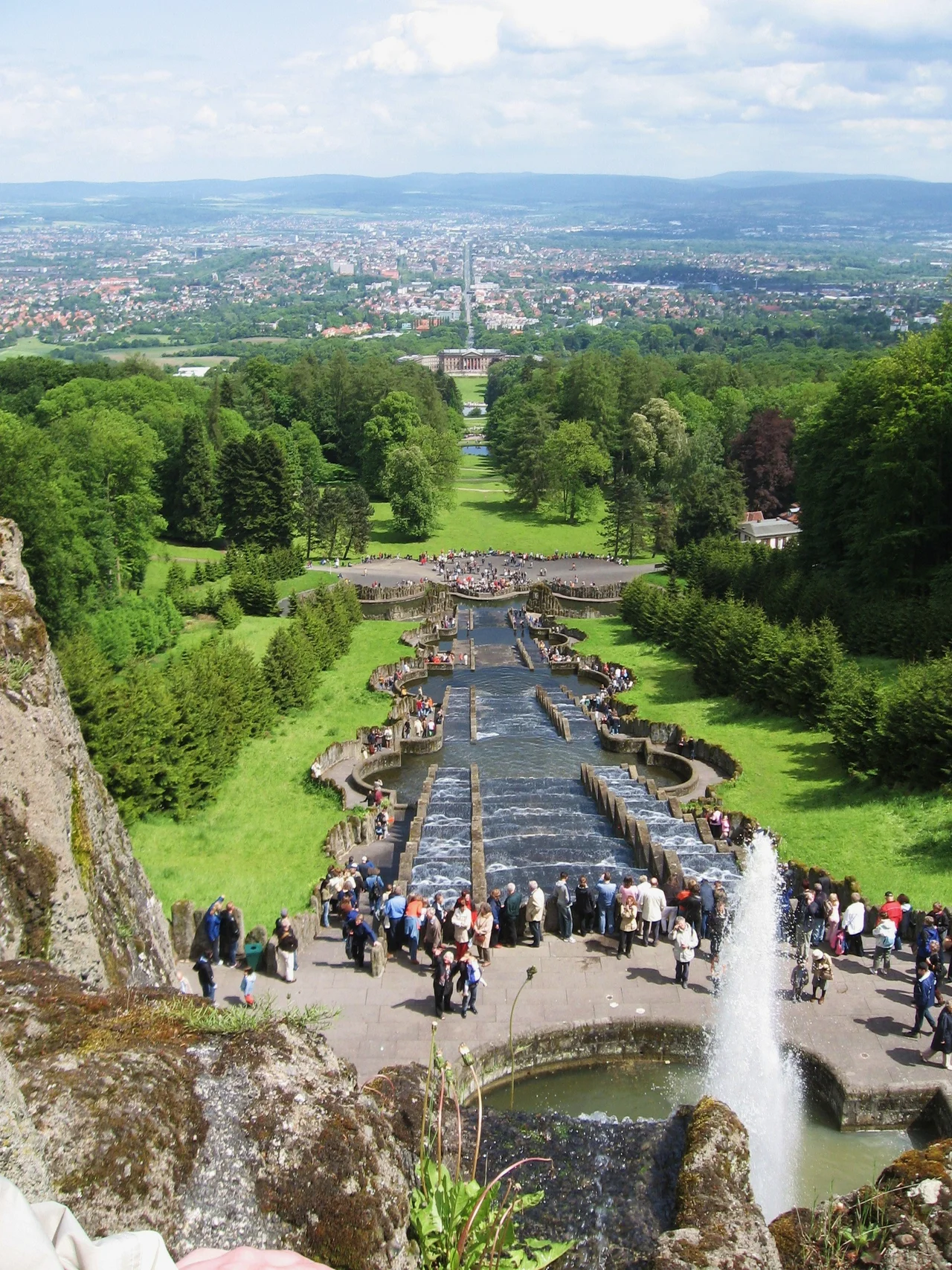
Nothing pumps the water. That is the first thing to understand about the Bergpark Wilhelmshöhe, and the reason people climb a wooded hill above Kassel on summer afternoons to stand and wait. At the appointed hour an attendant opens a lock by hand at the top of the slope, and more than 750,000 litres begin a journey that gravity alone will finish: down a 250-metre staircase of stone cascades, over the Steinhöfer Waterfall, under the Devil's Bridge, off the lip of an artificial Roman aqueduct, and at last into the lake at the bottom, where a jet throws itself fifty metres into the air and ends the performance. From the top of the monument to the foot of the cascades is 179 metres of fall. The oldest parts of this machinery went into the hill from 1701. None of it has ever needed an engine.
Monastery, Hunting Lodge, Palace
Canons Regular from Mainz put a monastery called Weißenstein on this slope in 1143. The Reformation dissolved it, Landgrave Philip I of Hesse kept the buildings as a hunting lodge, and his descendant Maurice largely rebuilt them between 1606 and 1610 - so the hill had been in princely use for five centuries before anyone thought of shaping the whole mountain. That idea belonged to Landgrave Charles I, who in the 1690s began turning the slope into a Baroque garden in the Italian and French manner, with water descending the hill in engineered stages. Extension followed extension for roughly 150 years. In 1785 Wilhelm IX launched the largest of them, and the following year his architect Simon Louis du Ry designed the neoclassical Schloss Wilhelmshöhe at the foot of the axis. The park now covers 2.4 square kilometres and climbs to the Karlsberg at 526 metres, which makes it the largest hillside park in Europe.
Water on a Timetable
The Wasserspiele run from May to October, every Wednesday and Sunday afternoon, and on the first Saturday of June, July, August and September they run in the evening with coloured light thrown across the falling water. Because the system is a chain of reservoirs and underground pipes whose gates are opened in sequence, the water arrives at each stage in turn - and the audience walks down the hill alongside it, reaching every basin and bridge as the water does. It is a spectacle you accompany rather than merely watch. There is a further trick built into the stonework: when the display is switched on, the change in pressure drives air through a set of horns, and the hillside makes a sound. Very little else in European garden design asks its visitors to keep up.
Ruins Built New
Halfway through the park's construction, taste changed underneath it. The formal French Baroque gave way to the English landscape garden, and instead of scrapping what existed, Wilhelm IX's designers grew the park outward in the new idiom - which in the late eighteenth century meant building ruins on purpose. The Löwenburg, the Lion's Castle, went up as an artificial medieval fortress, partly ruined from the day it was finished. The Roman aqueduct is Roman in the same sense: newly quarried stone, arranged to look two thousand years old, and it does its real work as a waterfall. The Teufelsbrücke, the Devil's Bridge, crosses the Höllenteich, Hell's Pond. Karl Steinhöfer added his waterfall to the chain in 1793. The last great addition came in 1826, when William II ordered the grosser Wasserfall, and nothing significant was added after it.
Emperors, a Prisoner, and Two Germanys
For a garden, this hill has hosted a remarkable amount of European history. Napoleon installed his brother Jérôme as King of Westphalia with Kassel as his capital, and from 1807 until 1813 Jérôme kept court in the palace, which was renamed Napoleonshöhe for the duration. In 1866 Hesse-Kassel backed Austria against Prussia, lost, and was annexed; the dynasty that had spent 150 years building the park simply ended. Four years later the wheel turned again, and Napoleon III arrived at Schloss Wilhelmshöhe as a prisoner of war after his defeat at Sedan, held here before going into exile in Britain. From 1899 Kaiser Wilhelm II, who had been to school in Kassel, made the palace his summer residence, and for two decades the park was a working centre of European politics. After the armistice of November 1918 the German high command under Hindenburg ran the withdrawal and demobilisation of the army from this address. In 1972, Willy Brandt and Willi Stoph met in the same building to negotiate between the two Germanys.
Rembrandt on the Hill
Allied bombs damaged the Schloss in the Second World War, and between 1968 and 1974 it was rebuilt as an art museum. The collections run to Graeco-Roman antiquities and a historic wallpaper collection, but the heart of it is the Old Masters gallery, weighted to the sixteenth and seventeenth centuries and holding the second-largest group of Rembrandts in Germany, including his Saskia, alongside Frans Hals's The Man with the Slouch Hat. The park joined the European Garden Heritage Network in 2009, and on 23 June 2013, at a UNESCO session in Phnom Penh, the whole hillside was inscribed as a World Heritage Site. The art historian Georg Dehio, who more or less invented modern German conservation, had reached his own verdict a century earlier: possibly the most grandiose combination of landscape and architecture, he wrote, that the Baroque dared anywhere.
From the Air
The Bergpark occupies the eastern flank of the Habichtswald ridge at 51.317°N, 9.400°E, immediately west of Kassel and rising to the Karlsberg at 526 metres. From the air it is one of the most legible designed landscapes in Germany: a 2.4 km² wedge of forest with a dead-straight axis cut through it, running downhill east from the Hercules monument on the crest, along the cascades, to the pale block of Schloss Wilhelmshöhe and on toward the city. Follow that line east and it delivers you to central Kassel; follow it west and it ends at the monument, which stands proud of the treeline and is visible from a long way out. The lake and its 50-metre fountain sit near the lower end of the axis on display days. Kassel-Calden (EDVK) lies roughly 10 km north; Frankfurt (EDDF) and Hanover (EDDV) are the major alternates. The ridge generates orographic cloud and turbulence in westerlies, and the park's own upper reaches can be in cloud while the city below is clear - allow height over the crest.
Nearby Stories
- Gänseliesel 7.1 km away
- Reinhardswald 14 km away
- Niederhagen concentration camp 15 km away
- Marburg 18 km away
- Stadtallendorf 26 km away
- Observation Post Alpha 29 km away
- University of Göttingen 33 km away
- Arnsberg Forest Nature Park 35 km away