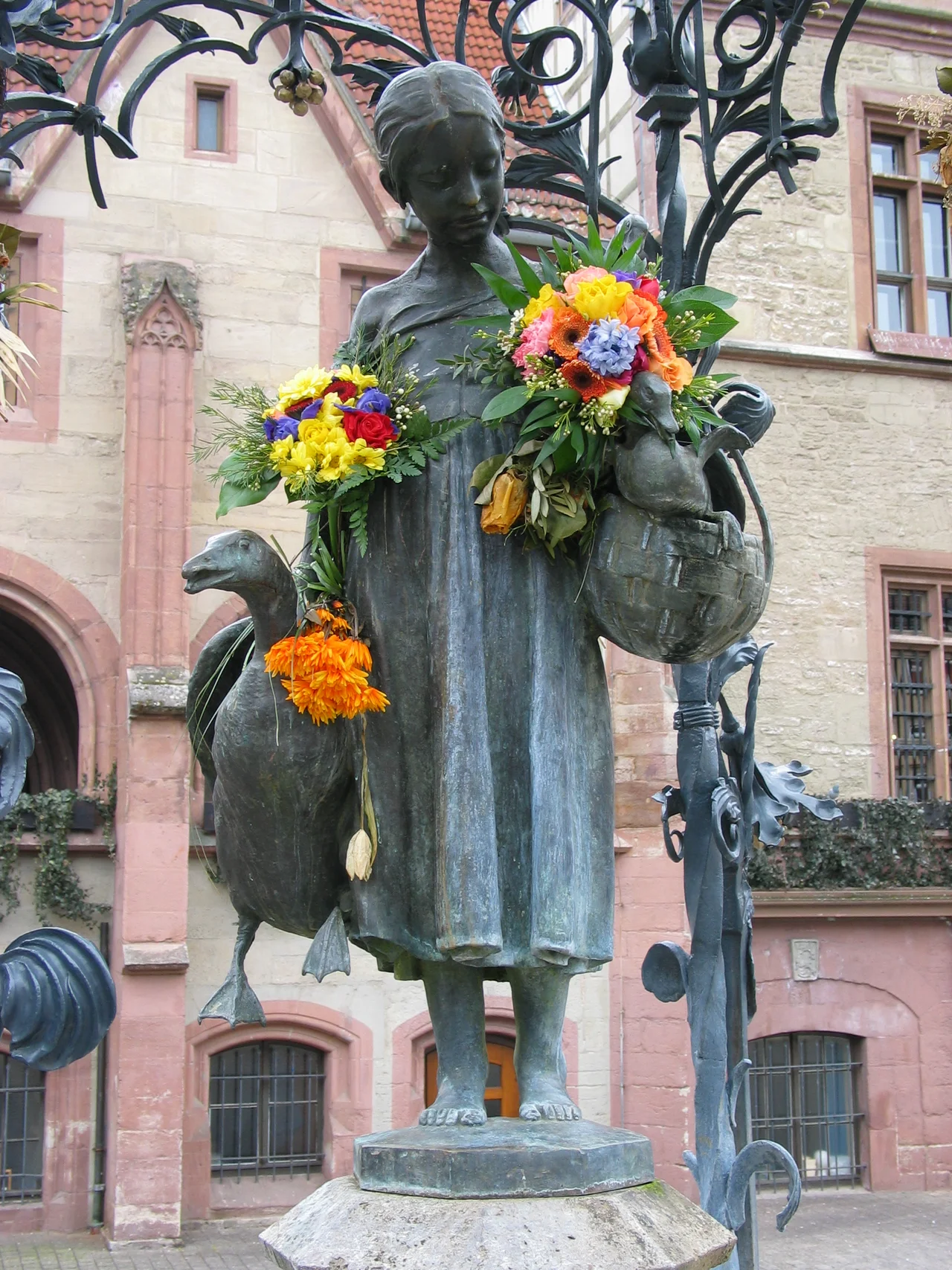

Gänseliesel
In 1926 the police in Goettingen made it an offence to kiss a bronze girl. A law student prosecuted under the decree that same year did the obvious thing and took his case to court, where the superior court in Berlin upheld the ban against him. The object of all this legal attention was a modest fountain figure standing in front of the medieval town hall: a girl carrying a basket of geese, roughly the size of a child, put up in 1901 with no ceremony whatsoever because the people who commissioned her had wanted something else entirely.
The Jury Lost
A fountain had stood on the spot since the eighteenth century, but it fell into disrepair and was partly pulled down early in the nineteenth. In 1898 the council resolved to replace it and invited proposals; sculptors from across Germany sent designs. The favourite was a neo-gothic composition grandly titled In the Spirit of the Ancients, or Fountain of Virtue, by the sculptors Mehs and Jehs. The goose girl, drawn up by the architect Heinrich Stoeckhardt and modelled by the sculptor Paul Nisse, was placed second. Then the three leading designs went on public display, and the citizens of Goettingen made their preference unmistakable. They wanted the girl. One reading of that, and it is hard to improve on, is that a town already crowded with bronze professors and scientists saw the chance to put up a statue of everybody else. After a long argument the fountain was installed in 1901, quietly, with no opening ceremony.
Illegal to Kiss
The tradition started almost at once and it started with the first-years. Newly enrolled students of the Georgia Augusta climbed the fountain and kissed the statue, generally with a great deal of alcohol involved and an appreciative crowd shouting encouragement. Student numbers rose sharply after the First World War, and so did the noise. The 1926 decree that followed forbade both the climbing and the kissing, and when the law student who had been prosecuted appealed, the judges in Berlin sided with the police. On paper the ban survived for decades. In practice a city full of students treated it as an entry on a list of things to have done at least once.
Flowers All Year
What changed was not the ban but who does the kissing. First-years mostly stopped; new doctors took over. Today a candidate who has just passed the oral examination or defended a dissertation is loaded into a handcart decked with flowers and balloons, pulled through the old town by friends and relatives, and delivered to the market square. There the freshly minted doctor climbs the fountain, kisses the goose girl and leaves a bouquet. This happens often enough that the fountain is banked with flowers most of the year, whatever the season. The city and the university both advertise themselves with photographs of graduates in the act, which for a long time sat oddly alongside the fact that the act was still technically illegal.
Bronze Does Not Heal
Affection has a cost. The statue took decades of climbing, kissing and outright vandalism, and in the winter of 2004 someone set fire to her. The damage was bad enough that the whole fountain had to be taken apart and put through a major restoration. The original bronze had already been moved into the municipal museum for safekeeping; what stands in the market square now is a copy, kissed by people who mostly know it is a copy and do it anyway. The original waits indoors, unkissed, in the condition that a century of enthusiasm left her in.
A Girl With No Story
The strangest thing about Goettingen's best-known landmark is that she means nothing in particular. The fountain has no connection to the town's history; goose girls stand in Monheim am Rhein, on Hanover's Steintor Square and on Nikolsburger Square in Berlin, and this one commemorates no local event or person. The Brothers Grimm taught in Goettingen in the 1830s, and their collection does contain a goose girl - a princess forced by a wicked woman to mind geese, who eventually gets her name back - but the fountain was not built to illustrate her. The town simply adopted the figure and then invented reasons. Since 1995 there has been a Gaenselieselfest on a September weekend, whose main event is the election of a young woman of Goettingen to be the Gaenseliesel for a year: a statue with no story that has now generated one, plus an annual festival and a great many kisses.
From the Air
The fountain stands at 51.5327 degrees north, 9.9351 degrees east, in the market square directly in front of Goettingen's old town hall. It is a metre or so of bronze and will not be seen from the air, but the square that holds it is easy to find. The old town is enclosed by the Wall, a continuous green earth rampart planted with lime trees that draws an unmistakable oval roughly a kilometre across; the market square sits near its centre, flanked by the twin west towers of St John's and the tall single spire of St James's. The Leine river runs along the western edge and the university's newer science quarter is the modern block to the north. Best viewed at 1,000 to 2,000 ft AGL. Kassel-Calden (EDVK) lies about 40 km south-west, Hannover (EDDV) roughly 105 km north, and Paderborn-Lippstadt (EDLP) some 90 km west. The Leine valley collects fog on autumn mornings and clears by mid-day.
Nearby Stories
- Bergpark Wilhelmshöhe 6.5 km away
- Irminsul 15 km away
- Mittelbau-Dora Concentration Camp 15 km away
- Royal Palace of Werla 20 km away
- Princely Abbey of Corvey 21 km away
- Reich Harvest Thanksgiving Festival 23 km away
- 1st German Bratwurst Museum 30 km away
- Memorial and Education Centre Andreasstraße 51 km away