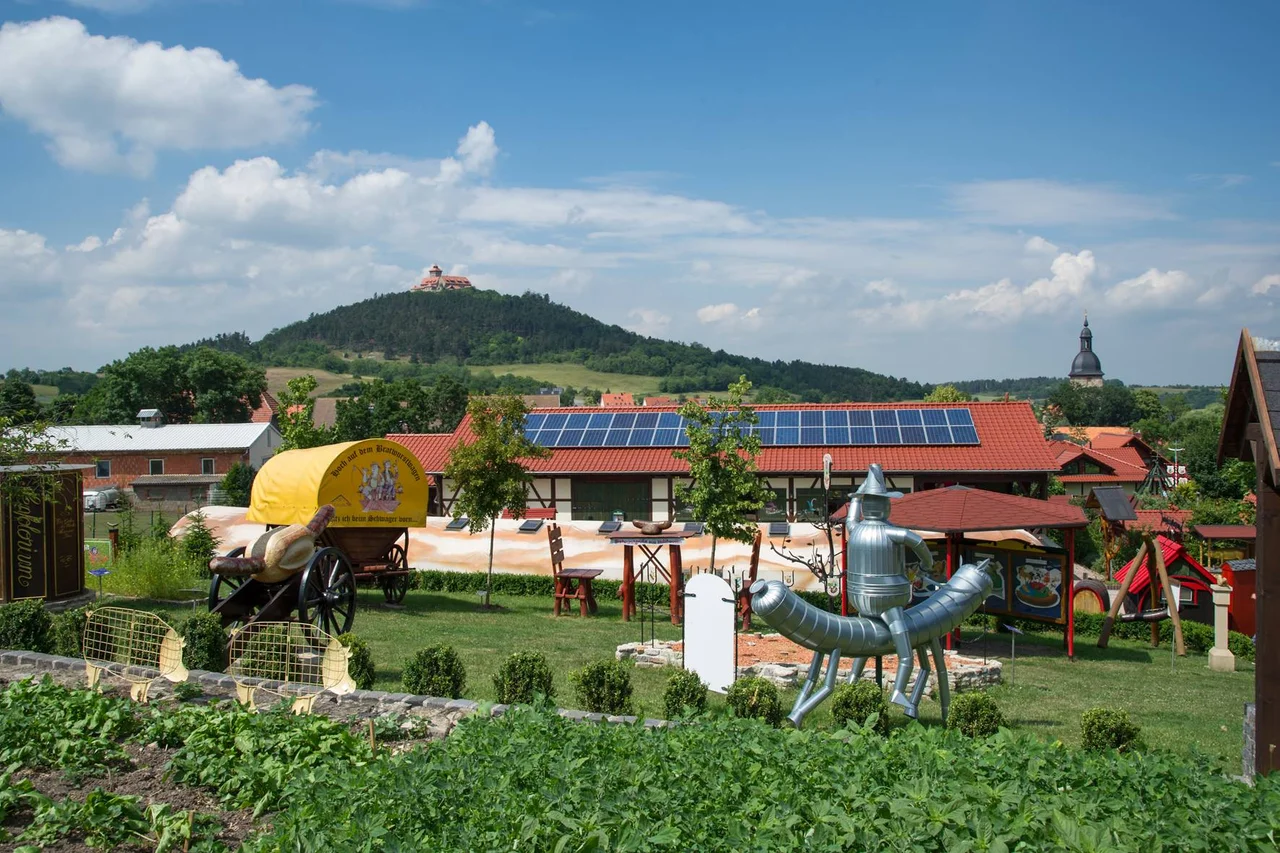

1st German Bratwurst Museum
The oldest known written mention of bratwurst is an expense line. On 20 January 1404, Johann von Siebeleben, provost of the Walpurgis monastery at Arnstadt, recorded that one groschen had gone out of the accounts "vor darme czu brotwurstin" - for casings for bratwurst. No recipe, no ceremony, just a purchase somebody bothered to write down. Six centuries later that entry is the centrepiece of a museum with a theme park attached, and knowing about it explains a great deal about how seriously Thuringia takes the subject.
A Museum About a Sausage
The 1st German Bratwurst Museum opened on 28 May 2006 at Holzhausen, a village in the Ilm-Kreis six kilometres from Arnstadt, in the shadow of the Wachsenburg. Behind it stood an association with an unimprovable name: the Friends of the Thuringian Bratwurst. The collection was not a joke. It gathered pig breeds, the mechanics of meat and sausage processing, recipes, and the physical equipment of slaughtering and production - the ordinary technology of a food that most people never think about as having a technology at all. Broadcasters could not resist the angle. In September 2006 the ARD network filed it under Germany's most bizarre museums, and MDR sent a crew out on 29 June 2007 for a programme on Central German museum night. The public came anyway, roughly fifty thousand of them a year, more than 800,000 in all.
A Fair Rebuilt in Miniature
In January 2008 the exhibition grew a wing. Curators built a replica of a monastic kitchen and a provost's office as they might have looked in Arnstadt in 1404, putting a room around the account book. Alongside it went a miniature reconstruction of the Thuringian Fair, an attraction at the 1910 World Exhibition in Brussels: a festival ground of half-timbered houses laid out over 72 square metres, presided over by a figure called the Bratwurst Eater. The original life-sized version, carved by the sculptor Reinhard Moeller, survives in the German Toy Museum at Sonneberg. That November the Thuringian ministry for economy and science handed the museum its 2008 tourism marketing award, worth 8,000 euros. A village of a few hundred people was now running a regional attraction, and the strain showed.
The Ground They Did Not Build On
By 2018 the museum had outgrown its infrastructure and was hunting for somewhere larger. The first site proposed at Muehlhausen was the ground of Martha II, a satellite camp of the Buchenwald concentration camp - one of the network of sites across Thuringia where camp prisoners were held and worked. Objections came quickly and from several directions, among them Josef Schuster, president of the Central Council of Jews in Germany. The plan was abandoned. The private investor and the city said afterwards that they had not known the history of the land, or had not properly weighed it. Both explanations are uncomfortable, and neither is really the point. What matters is that nobody now grills sausages on the place where those prisoners were held.
Waterlogged
The replacement site is 3.7 hectares of the Muehlhaeuser Stadtwald on the south-western edge of the city, four times the size of Holzhausen. The foundation stone went down on 20 January 2020 - by coincidence the same calendar date as the 1404 entry - and the doors were supposed to open that May. Then the ground turned out to hold water, and then the pandemic arrived. Holzhausen had already closed for good on 1 April 2020, which left a museum with no museum. The stopgap was a travelling exhibition installed in the Muehlhaeuser Hof hotel in the centre of town, the Bratwurst Museum on the Road, keeping the collection in front of people while the new site drained. It finally reopened on 16 August 2023, three years and three months late.
What Survived the Monastery
There is a quiet irony in the founding document. The Walpurgis monastery at Arnstadt, whose provost signed off that groschen, did not survive the Reformation; it was dissolved, and the community that kept the ledger dispersed. The ledger outlasted them. Institutions built to last centuries vanished, while a routine note about sausage skins came through six hundred years intact and now anchors a theme park thirty kilometres away. Food history is usually like this. The grand things are recorded on purpose and the ordinary things survive by accident, which is why a museum devoted to a grilled pork sausage ends up being a museum about record-keeping, monasteries, pigs, and the long habit of a region that decided this particular sausage was worth arguing about.
From the Air
The museum sits at 51.195 degrees north, 10.397 degrees east, in open ground on the south-western edge of Muehlhausen against the Muehlhaeuser Stadtwald. From the air the reference point is Muehlhausen itself - a compact medieval core with a surviving town wall and two large church towers, set in the broad farmland of the Unstrut basin, with the dark unbroken beech canopy of the Hainich rising a few kilometres to the south. The museum grounds read as a cleared 3.7-hectare rectangle at the treeline. Best viewed at 1,500 to 3,000 ft AGL; the terrain is gentle and the approach unobstructed from every direction except the Hainich ridge. Erfurt-Weimar (EDDE) lies about 50 km south-east, Kassel-Calden (EDVK) about 65 km west, and Leipzig/Halle (EDDP) roughly 130 km east. Morning fog forms readily over the Unstrut lowland in autumn and can sit until mid-morning.
Nearby Stories
- Dejudaization Institute Memorial 3 km away
- Unicorn Cave 15 km away
- Battle of Frankenhausen 19 km away
- Fulda Gap 20 km away
- Sababurg 22 km away
- Fridericianum 25 km away
- Bode Gorge 27 km away
- Bauhaus 30 km away