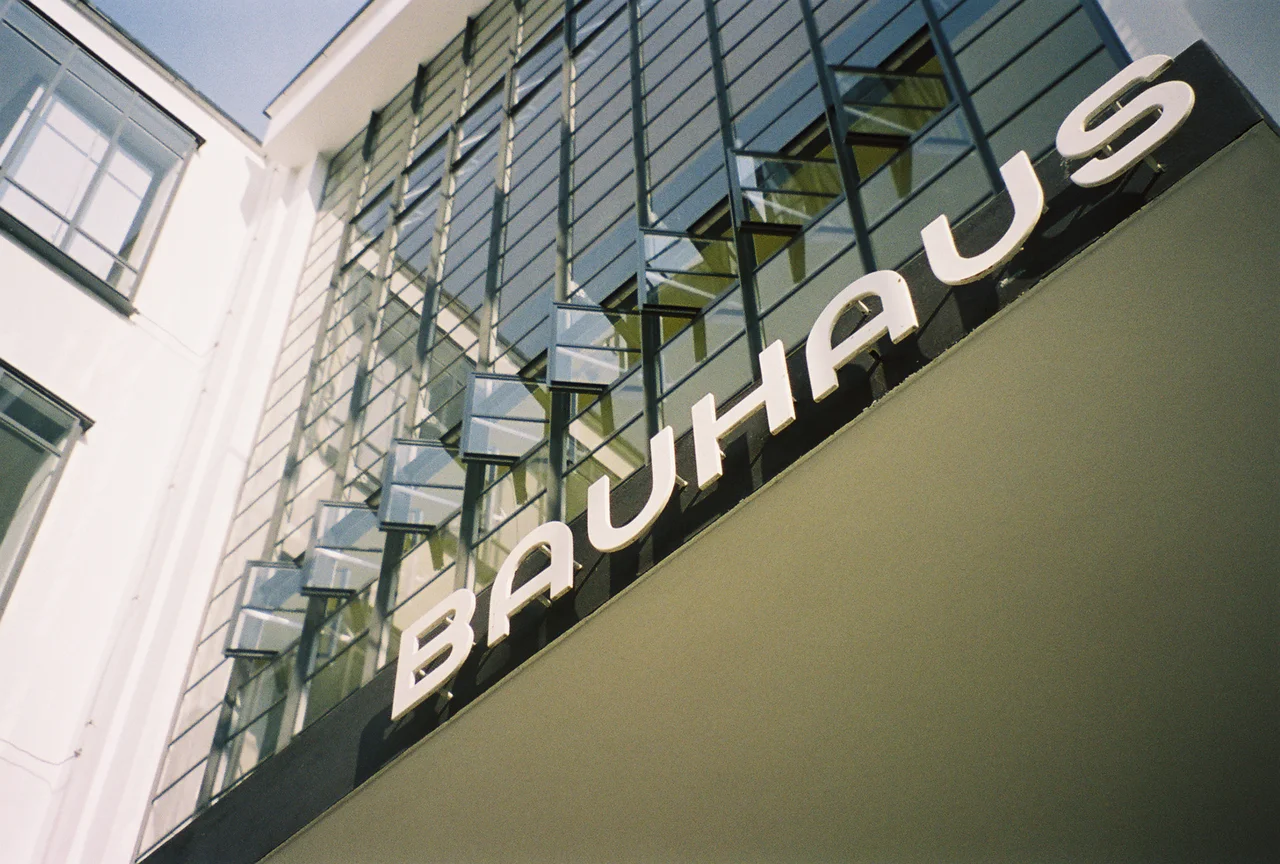

Bauhaus
The founding manifesto declared that the ultimate aim of all creative activity was the building. The school did not teach architecture for another eight years. That gap says a great deal about the Bauhaus, which existed from 1919 to 1933, occupied three cities, and ran through three directors who disagreed with one another profoundly. Walter Gropius founded it in Weimar on 1 April 1919 by merging the Grand Ducal Saxon Academy of Fine Art with the Grand Ducal Saxon School of Arts and Crafts. Fourteen years later the faculty voted to shut it down themselves rather than operate under the Gestapo. Between those two dates, a few hundred people worked out how mass production and artistic intention might be reconciled - and then, scattered across the world by the regime that closed them, taught the answer to everyone else.
A Guild Without the Barrier
Gropius took the job in a Germany that had just lost a war and acquired a republic, in a burst of liberalisation that made room for experiment the old order had suppressed. His name for the school pointed backwards as much as forwards: Bauhaus evokes both building and the Bauhütte, the premodern lodge of stonemasons. In an April 1919 exhibition pamphlet he set out the goal as creating "a new guild of craftsmen, without the class distinctions which raise an arrogant barrier between craftsman and artist." The first faculty was small - Johannes Itten, Lyonel Feininger, the sculptor Gerhard Marcks - and grew quickly to include Oskar Schlemmer on theatre, Paul Klee, and from 1922 Wassily Kandinsky. Itten shaped the school's pedagogy from 1919 to 1922 through the Vorkurs, the preliminary course in materials, colour and form that every student took and that art schools worldwide would copy.
The Women They Sent to the Looms
The Bauhaus declared equality between the sexes and accepted women from the start, and in its first year more women applied than men. Gropius's response was not what the manifesto implied. He announced that for the foreseeable future only women of extraordinary talent would be admitted, and the surplus were given a workshop of their own - which became the weaving workshop. Women who arrived intending to build, paint or sculpt found themselves at looms. Some of them made the looms into a triumph anyway. Gunta Stölzl returned to lead the weaving workshop in 1926, becoming the first woman to head a department and the only woman ever to hold the rank of master at the school. Marianne Brandt got into the metal workshop and succeeded László Moholy-Nagy as its studio director in 1928, designing lamps and metal vessels that remain among the school's most recognisable objects. Anni Albers arrived in 1922 and made textile design a serious modern discipline. Lucia Moholy photographed the buildings; the crisp black-and-white images through which almost everyone knows the Bauhaus are hers.
Dessau, and the Argument Over What a School Is For
Thuringia's conservative politicians moved against the school as tensions rose after 1923, halving its funding and putting staff on six-month contracts; on 26 December 1924 the Bauhaus announced its own closure for the following March. It reopened in Dessau in 1925, with Gropius's new buildings inaugurated late in 1926. Then came the arguments. Gropius resigned in February 1928 and was succeeded by Hannes Meyer, who swung the focus from aesthetics to function - five balcony-access apartment blocks for Dessau that are still lived in, and the ADGB Trade Union School at Bernau bei Berlin. Meyer also gave one day a week to sport and gymnastics, on the grounds that design suffered from too much brainwork. Ludwig Mies van der Rohe replaced him in 1930, interviewed every student individually, dismissed the ones he judged uncommitted, stopped the school manufacturing goods at all, and hired no new faculty except his collaborator Lilly Reich.
Ten Months in a Berlin Factory
When the Nazi Party took control of the Dessau city council in 1931, it moved to close the school. In late 1932 Mies rented a derelict factory on Birkbusch Street in Berlin with his own money; students and faculty rehabilitated the building themselves and painted the interior white. It ran for ten months. In 1933 the Gestapo shut it. Mies argued his way to the head of the Gestapo and secured a letter permitting it to reopen, and then he and the faculty closed it voluntarily anyway. The dispersal that followed is usually told as a triumph, and for the emigrants it largely was. The rest of the record is harder. Of the students enrolled when Hitler came to power, roughly 900 are thought to have stayed in Germany; of those, 188 joined the National Socialist Party, twelve joined the SS, and one worked on the design of the crematoria at Auschwitz. A school does not determine what its graduates become.
The Style That Outlived the School
Gropius, Marcel Breuer and Moholy-Nagy regrouped in London, in the Isokon flats on Lawn Road. Gropius and Breuer went on to the Harvard Graduate School of Design, where their students included Philip Johnson, I. M. Pei and Paul Rudolph. Mies settled in Chicago to run the architecture school at what is now the Illinois Institute of Technology, and Moholy-Nagy founded a New Bauhaus in the same city. German-Jewish architects fleeing the regime built more than 4,000 International Style buildings in Tel Aviv, whose White City UNESCO listed in 2003. Later critics were less reverent, complaining of a utopia built on a mechanical view of human nature - "home hygiene without home atmosphere." And the single most profitable product the school ever sold, after all its radical theorising about form and function, was wallpaper.
From the Air
The Bauhaus began at 50.97 degrees N, 11.33 degrees E, in the buildings Henry van de Velde designed in Weimar between 1904 and 1911, which now house the Bauhaus-University Weimar and were inscribed as a UNESCO World Heritage Site in 1996. From the air Weimar reads as a compact town in the Thuringian basin, with the wooded ridge of the Ettersberg rising to the northwest. The school's second and most famous home, the Gropius building at Dessau, lies about 110 km north-northeast near the confluence of the Mulde and the Elbe. Nearest airports: EDDE (Erfurt-Weimar) about 26 km west, EDDP (Leipzig/Halle) about 80 km northeast, and EDDB (Berlin Brandenburg) roughly 250 km northeast. Recommended viewing altitude 2,500 to 4,000 feet over Weimar; the flat white roofs and glass curtain walls of Bauhaus buildings are easiest to pick out in low, raking light.
Nearby Stories
- Memleben Abbey 14 km away
- Bad Dürrenberg burial 18 km away
- Opfermoor Vogtei 32 km away
- Horch 41 km away
- Dejudaization Institute Memorial 41 km away
- The Defenestration of Prague: The Thrown Men Who Started a Thirty Years' War 184 km away
- Zwingenberg Castle 189 km away
- The Anschluss: When Austria Vanished Overnight 320 km away