
Opfermoor Vogtei
Half a kilometre north of Niederdorla stands a linden tree planted in 1991, with a stone beside it, marking one of the calculated geographical centres of Germany. Walk a few minutes from the marker and you reach a shallow lake in a natural hollow. Between roughly the sixth century BC and the fifth century AD, people came to that water to leave things in it: cattle, horses, harvest bundles, weapons, carved wooden figures, and at least forty human beings. The peat held all of it. Germany's midpoint, as it happens, sits almost exactly on top of the most important pagan sanctuary ever excavated in Central Europe.
What the Peat Kept
The site is a depression where groundwater gathered into marsh and open water, a sheet of it roughly 700 metres by 200. From about 100 BC, silt and peat began closing the water in - the sediment layers record it - and by the late Migration Age the lake had shrunk considerably. Nobody knew any of this until men came to cut peat here in 1947 and turned up archaeological material the following year. From 1957 to 1964 Guenter Behm-Blancke, director of the museum of prehistory in Weimar, excavated the hollow. What emerged were rings of woven hazel branches with altars at their centres, wooden cult figures standing where they had been set, and in the end at least 86 distinct cult locations layered across one another. It is the largest known Iron Age cult site in Central Europe. The objects come from all over Roman Germania and belong to no single tribe, which means people travelled to get here.
At Least Forty People
Among the bones were human remains from a minimum of forty individuals, and the damage to them makes their deaths unambiguous. In one case the head and the limbs had been cut from the body and sunk in the bog under weighted branches; the tools used had been broken and sunk as well, as though they could not be allowed to go back into ordinary life. This is the clearest archaeological evidence of Germanic human sacrifice anywhere. It is worth staying with the arithmetic for a moment: forty people, each one somebody's child, whose names and languages and reasons for being chosen are gone beyond any hope of recovery. The museum displays the skeleton of a woman as she was found, skull raised on a stake. There is no gentle way to present that, and the museum does not attempt one.
The Gods Kept Changing
What makes the bog extraordinary is that the worship at it never stood still. The earliest centre was a rectangular limestone altar backed by a semicircular wall of rock and earth, where food was set out and a fire lit; buds preserved in the charcoal date the burning to spring, probably for a deity of growing things. Celtic fashions arrived in the La Tene period, bringing enclosures like those in the temple quarter at Trier and altars of stacked sod braced with wickerwork. Later the Hermunduri built a great circular precinct with swords driven upright into the ground beside human skulls. By the third century AD a single shrine held one carved goddess with Gallo-Roman styling, and a vessel scratched with a sowilo rune may preserve part of her name. In the fifth century they built two shrines shaped like ships out of bent branches. The larger had a gap for a steering oar and a tall post idol crowned with a horse's head; the smaller received a sacrifice of cattle and belonged to a goddess. Neither was ever meant to leave the bog.
Pike, Cats and a Weaving Tablet
The bog also preserved the everyday, which is often the more useful haul. Cattle dominate the animal bones, alongside horses, sheep, goats and pigs, plus deer, bison, wolves, wild boar, otters, a fox, a turtle, at least 27 pike and thirty-five species of bird. One domestic cat turned up, quietly recording how house cats spread out of Roman territory into lands that were never Roman. Inland European sites rarely yield fish remains at all, so the pike and tench here matter, and so do the fish trap fragments, hand nets, harpoons, and hooks made from a sharpened stick that turned crosswise when the line was tugged. There is one of the earliest Germanic bows known, and a weaving tablet with five holes. Sacrifice was the reason people came, but they arrived carrying the contents of their ordinary lives.
The Village They Built Back
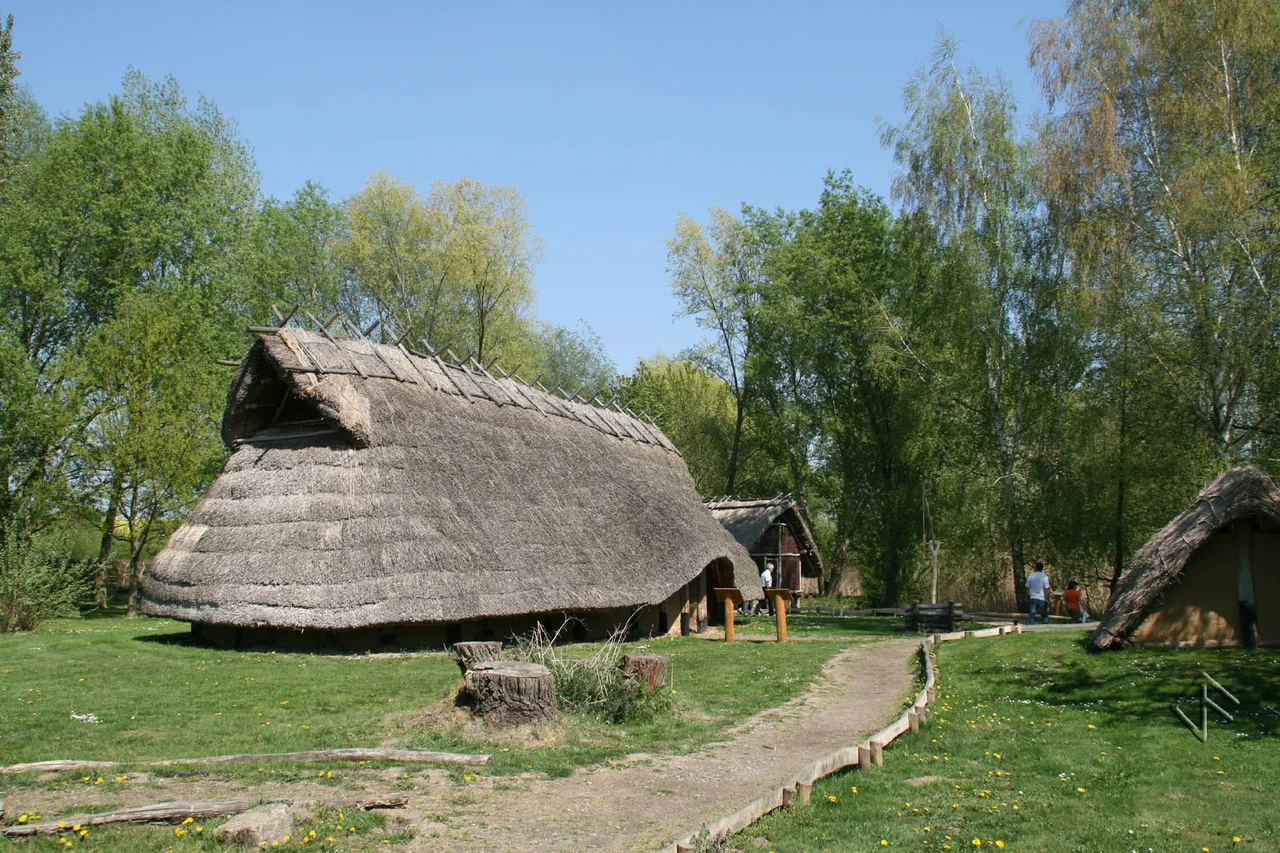
Christianity did not end it cleanly. Tenth and eleventh-century pottery and dog bones show offerings still going into the water, and the heathen observances seem only to have faded after an archdiaconate was established at Oberdorla - a church posting that looks very much like a response to the problem. The open-air museum opened in July 1992 on the site itself: a longhouse sheltering people and livestock together, three sunken-floored Grubenhaeuser and a barn, modelled on the excavated settlement at the nearby Mallinden, the largest prehistoric settlement found in Thuringia. Visitors can learn to cook, bake, spin, weave and shoot as the inhabitants did. In 2012, on the museum's twentieth anniversary and in the hundredth year after Behm-Blancke's birth, a memorial stone to him was set up among the reconstructed houses.
From the Air
The Opfermoor lies at 51.165 degrees north, 10.445 degrees east, in the municipality of Vogtei between the villages of Oberdorla and Niederdorla, about 5 km south of Muehlhausen. From the air the giveaway is the water: a small bright sheet of open lake in flat farmland, with the reconstructed thatched village on its western edge and cut peat ground around it. The dark unbroken beech canopy of the Hainich fills the horizon to the south, and the Unstrut basin opens to the north. Best viewed at 1,000 to 2,000 ft AGL, low enough to make out the longhouse and the pit dwellings; the surrounding terrain is gentle with no obstructions. Erfurt-Weimar (EDDE) is roughly 45 km south-east, Kassel-Calden (EDVK) about 70 km west, and Leipzig/Halle (EDDP) some 130 km east. Low cloud and morning fog are common over the wet ground in autumn; light is best in the long shadows of early evening, when the earthworks read clearly.
Nearby Stories
- Dejudaization Institute Memorial 3 km away
- Unicorn Cave 15 km away
- Battle of Frankenhausen 19 km away
- Fulda Gap 20 km away
- Sababurg 22 km away
- Fridericianum 25 km away
- Bode Gorge 27 km away
- Bauhaus 30 km away