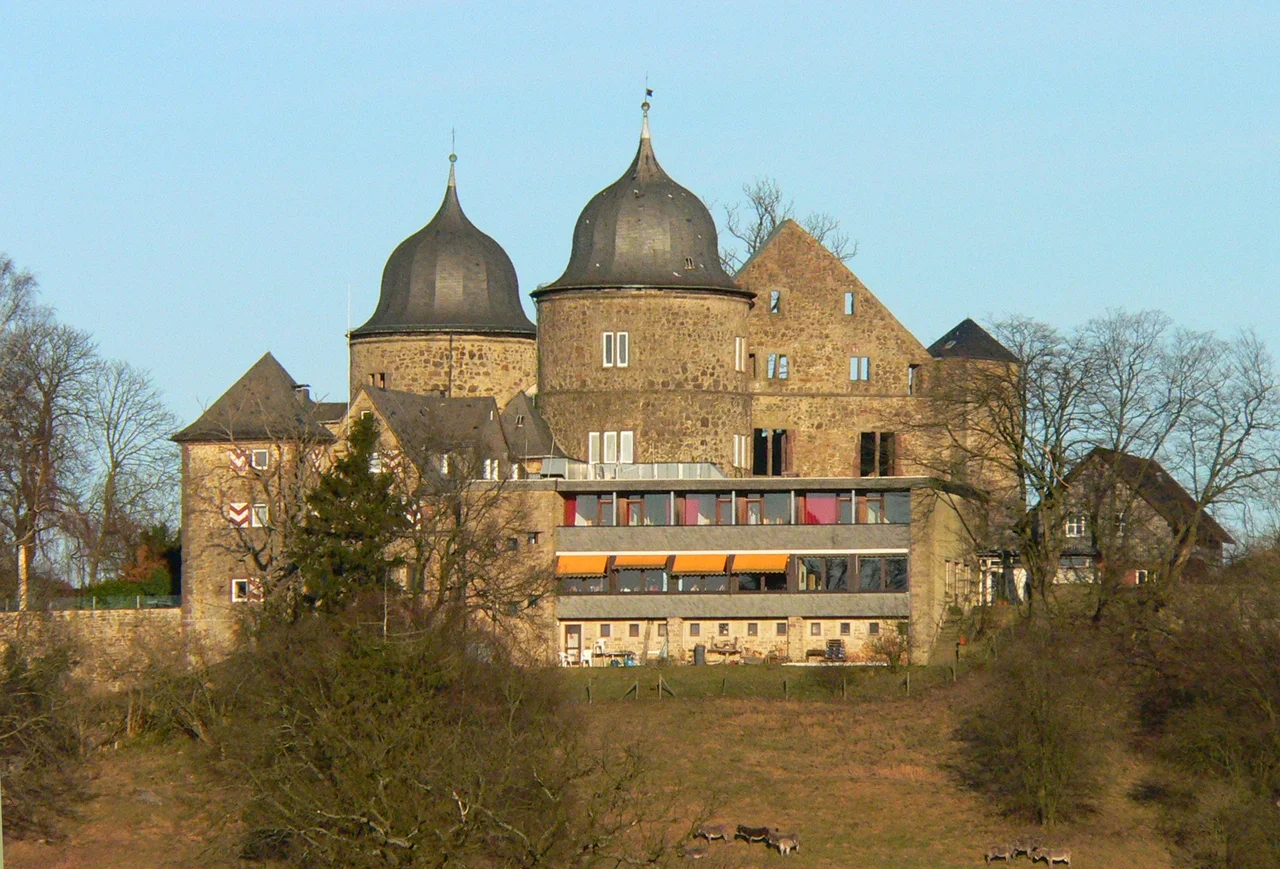

Sababurg
The Grimms never said where Sleeping Beauty slept. Their telling of Dornröschen gives no county, no castle, no map reference - only a hedge of thorns that grew until it swallowed the walls and everyone behind them. The identification with the Sababurg came later, from people who looked at a ruined hilltop in the Reinhardswald with brambles working through the window openings and decided the fit was too good to argue with. The castle has been playing the part ever since. Hofgeismar, the town it belongs to, now calls itself the Dornröschenstadt am Reinhardswald.
Zappenburg, 1334
Construction began on 19 April 1334, and the fairy tale had nothing to do with it. The place was called the Zappenburg, and the Bishopric of Mainz put it on that basalt outcrop for two reasons: to protect pilgrims walking to the shrine at nearby Gottsbüren, and to hold ground in a corner of Germany where Mainz, Hesse, Paderborn and Brunswick all pressed up against one another. It was a working border castle in a contested forest. The name shifted over the centuries - Zappenburg to Zapfenburg to Sababurg - and the borders it was built to defend dissolved long before its walls did.
Three Hundred Years of Parties
From 1490, Landgrave Wilhelm I raised a hunting lodge on the old castle's foundations, and his grandson Philip I finished the Palas - the great hall - in 1519. For roughly three centuries the Sababurg was where the landgraves of Hesse came to hunt, eat and be seen doing both. The Reinhardswald supplied the game, the hilltop supplied the view, and the building supplied a stage. The engraving Matthäus Merian published in his Topographia Hassiae in 1645 shows the place at something close to its full height, towers and roofs and all, standing above the trees.
The Oldest Menagerie in Europe
In 1571 Landgrave Wilhelm IV enclosed 130 hectares of forest below the castle and stocked it, creating the Thiergarten Sababurg - among the earliest animal parks anywhere in Europe. The records list aurochs, fallow deer, white stags, chamois, elk and reindeer, kept for hunting and for study. It is still a wildlife park, and the forest around it holds something rarer than any of the animals. The Urwald Sababurg, protected since 1907, is a fragment of roughly ninety hectares where oaks have been left alone for so long that the oldest of them are reckoned at four hundred to six hundred years, though local lore inflates that to a thousand. They are hollow, half-collapsed, propped on their own dead limbs, and they look precisely like what a fairy-tale forest is supposed to look like.
Thorns
The ruin arrived by way of the Thirty Years' War. Catholic forces occupied and badly damaged the castle in 1628, and afterwards nobody rebuilt it properly. Roofs went, floors went, the walls stayed. Two centuries of weather and undergrowth did the rest, and by the time the Brothers Grimm began publishing their collected tales in 1812 there was a broken hilltop castle in North Hesse with vegetation climbing it - close enough to the story that readers made the connection on their own. Whether the Grimms had it in mind is beside the point. Reinhardswald is called legendary now partly because the Sababurg gave a shapeless folk tale somewhere to happen.
Rebuilding Inside a Ruin
Restoration began in 1957 and the castle opened as a hotel in 1960, running for fifty-eight years before it closed in 2018. Demolition of the old hotel started in 2020, and the plan that replaced it is unusual: a new four-star hotel of forty rooms built into the historic ruin, spread across the towers, the old office building and a new structure meant to echo the castle's horizontal edges and sloping roofs. The restaurant sits below with a terrace looking out at the wildlife park, and there are conference rooms for two hundred. Ground was originally meant to be broken in 2024, but permitting delays and shifting designs have pushed the start back repeatedly; as of the most recent projections a construction start isn't expected before 2028. The costs tell their own story. Twelve million euros at first estimate; then the design changed to build largely in wood, and the figure rose to forty-three million.
From the Air
The Sababurg stands at 51.544°N, 9.538°E, on a basalt rise about 315 m above sea level in the middle of the Reinhardswald, a forested upland north of Kassel. From the air it is a small stone silhouette in an otherwise unbroken canopy - the clearing of the wildlife park immediately below it is often the easier target, a distinct open patch of about 130 hectares in the forest. The Weser valley runs along the eastern and northern edge of the woodland, and the town of Hofgeismar lies roughly 10 km west. Best viewed at 1,000-2,500 ft AGL; below the treeline the castle disappears entirely. Kassel-Calden (EDVK) is about 19 km southwest, so expect its traffic pattern nearby. Autumn mist collects in the Weser valley and can spill over the forest edge; expect a fenced, partially cleared building site rather than active construction, with the rebuild now not expected to break ground before 2028.
Nearby Stories
- Kassel 12 km away
- Unicorn Cave 15 km away
- Externsteine 15 km away
- Rammelsberg 17 km away
- Edersee Dam 17 km away
- Fagus Factory 17 km away
- 1st German Bratwurst Museum 20 km away
- Arolsen Archives 25 km away