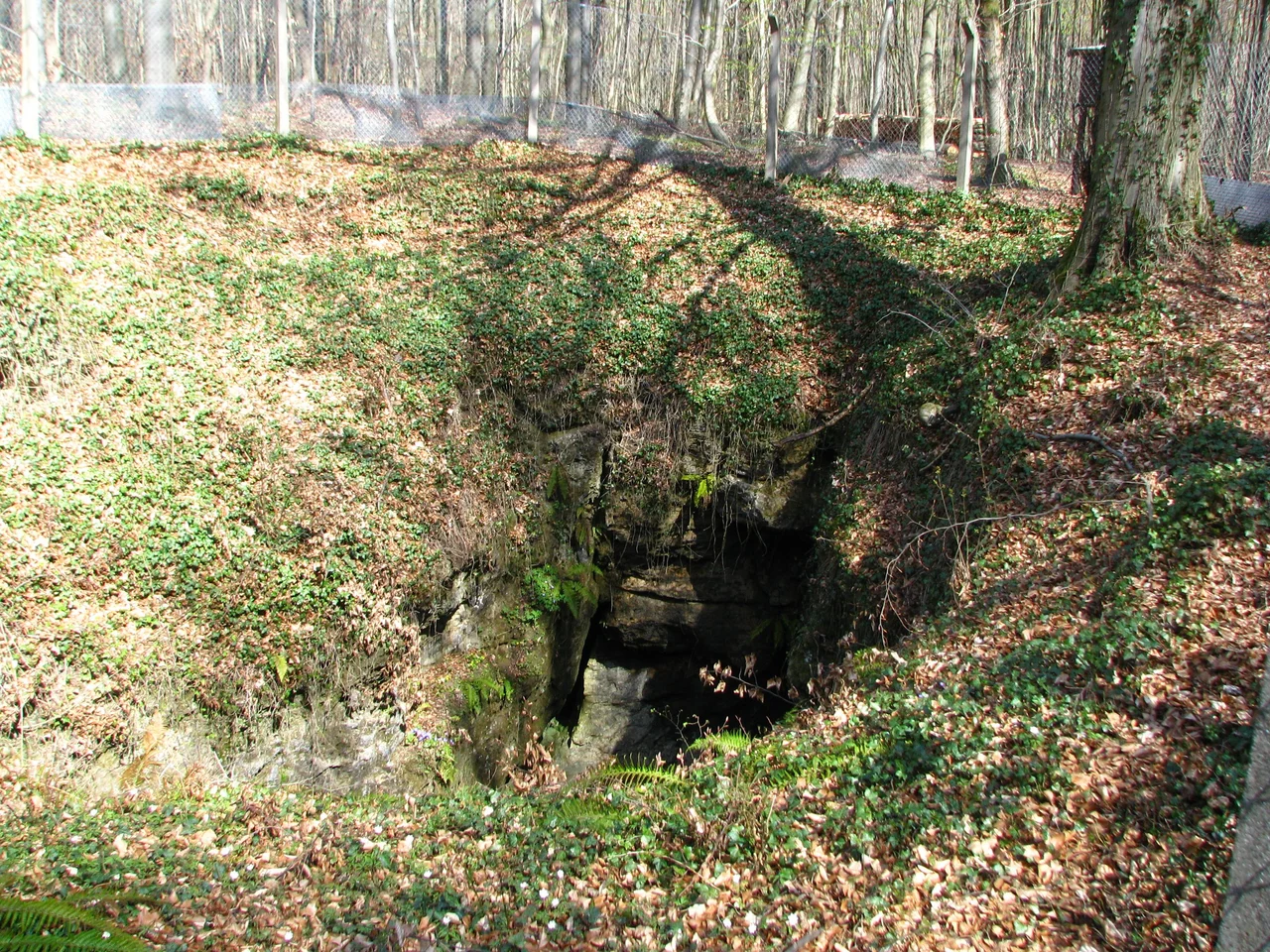

Unicorn Cave
You could buy unicorn in early modern Germany. Apothecaries sold it as a powder, ground from fossil bone and prescribed against fever, poison, and whatever else had resisted the other remedies on the shelf. Some of that powder was quarried out of a dolomite hill above Scharzfeld in the West Harz, where villagers dug bones out of the dark and sold them by weight. The cave took its name from the trade and has kept it ever since: Einhornhöhle, the Unicorn Cave. The bones were real. The animal was not.
The Pharmacy in the Rock
The cave first appears in the written record in 1541, already known and already being worked. It runs 610 metres through the dolomite of the Zechstein, a karst system dissolved out of stone laid down when a shallow sea evaporated across northern Europe. What made it valuable was what had died in it. Ice-age animals fell in, sheltered in it, or were dragged in by predators, and their bones accumulated in the sediment for tens of thousands of years. To a seventeenth-century digger, a fossil that large and that strange could only belong to one creature. Unicorn horn was among the most expensive substances in European medicine, and here was a hillside full of it, waiting for a shovel.
Leibniz Builds an Animal
In 1686 Gottfried Wilhelm Leibniz came to see the cave for himself and wrote a report noting the local trade in unicorn artefacts. He was not merely a tourist. Otto von Guericke, the mayor of Magdeburg better known for proving the force of a vacuum with two hemispheres and a team of horses, had published an account of ancient bones dug from a Harz hill near Quedlinburg. Working from Guericke's description and from the material coming out of the cave, Leibniz produced a reconstruction of the unicorn's skeleton and included the drawing in his geological treatise Protogaea, which appeared after his death in 1749. The result is one of the great wrong pictures in the history of science: a hunched, hornless-bodied beast with a single enormous spike jutting from its skull, assembled with perfect logic from parts that never belonged together.
Virchow Takes the Horn Away
The correction came in 1872, when Rudolf Virchow excavated in the cave and identified the bones for what they were. No unicorns. Mammoths, cave bears, and a menagerie of other extinct and vanished animals. Over the years more than 70 species have been recognised in the deposits, including some 60 mammals, among them the cave lion and the wolf. Leibniz's skeleton turned out to be a cave bear and a mammoth pressed into service as a single creature, with a tusk for a horn. It is easy to laugh at, and harder to do better. Before comparative anatomy had matured, a pile of unfamiliar bones was a genuinely open question, and Leibniz answered it with the best framework available to him.
Three Chevrons on a Toe Bone
Then, in 2019, excavation at the cave's former natural entrance turned up something the seventeenth century would have found far stranger than a unicorn. A toe bone from a giant deer, boiled to soften it and then carved with three stacked chevrons and four short parallel lines, dated to roughly 51,000 years ago. That places it firmly in the Neanderthal world, before modern humans reached this part of Europe. The find was published in 2021 and is among the oldest known deliberate designs made in Europe. Giant deer were rare in the Harz and carried antlers spanning nearly four metres; the choice of bone looks like a choice, not a convenience. Somebody sat in this hillside and made a pattern for no practical reason at all.
Walking In
An entrance gallery was cut in 1905 to let visitors in, and 270 of the cave's 610 metres are now open as the largest show cave in the West Harz. It serves as one of three information centres for the Harz - Brunswick Land - Eastphalia National Geopark and carries checkpoint 101 on the Harzer Wandernadel hiking network, so a steady traffic of walkers arrives with stamp books in hand. Local folklore supplies the ending the geology cannot. A pagan woman living near Scharzfeld was pursued by Frankish warriors under a monk in a black habit; a unicorn appeared, drove off the pursuers, and let her escape to join the witches on the Brocken. The monk, still running, fell into a deep hole. The hole, the story says, leads here.
From the Air
The Unicorn Cave lies at 51.635°N, 10.404°E, about 1.5 km northwest of Scharzfeld in the borough of Herzberg am Harz, Lower Saxony. It sits on the southwestern flank of the Harz where the uplands break down toward the Leine basin, so the terrain cue is the edge itself: forested Harz ridges to the northeast, open farmland to the southwest. The Brocken, at 1,141 m the highest point in the range, stands about 23 km to the north-northeast and is the best long-range reference. The cave entrance is under tree cover and effectively invisible from the air; navigate to Scharzfeld and Herzberg am Harz instead. Best viewed at 2,500-5,000 ft AGL. Nearest fields are Kassel Calden (EDVK) about 70 km southwest, Erfurt-Weimar (EDDE) about 80 km southeast, and Hannover (EDDV) about 100 km northwest. The Harz generates its own weather and orographic cloud on the ridges is common; expect turbulence downwind of the massif.
Nearby Stories
- Rammelsberg 5.5 km away
- Ströbeck 7.7 km away
- Fagus Factory 14 km away
- 1st German Bratwurst Museum 15 km away
- Bode Gorge 18 km away
- Sababurg 22 km away
- Kassel 24 km away
- St. Augustine's Monastery (Erfurt) 40 km away