
St. Augustine's Monastery (Erfurt)
The friary that housed Martin Luther was paid for, in part, by indulgences. Building began in 1277 on donations and on the sale of remissions for sin - precisely the trade that, two and a half centuries later, the house's most famous resident would attack in a way that split the Western church. Luther arrived in July 1505 as a twenty-one-year-old law student who had abandoned his career, and left for good in September 1511. The complex covers almost a hectare in the middle of Erfurt, and the rooms he knew are still there, along with a hole where the library used to be.
Blue Money and a School
Augustinian friars had been in Erfurt since 1266. A quarrel with the city got them expelled in 1273; three years later they were allowed back for good, and construction of the church and friary started in 1277. It went on for generations - St Katherine's chapel, the chapter house, the tower, the cloister, a new priory - and between 1310 and 1340 the church acquired the stained glass that is still the first thing visitors are told to look at. Money came from an unlikely source. In 1482 the friars built two Waidhaeuser, one to store grain and the other to process woad into the blue dye that made Erfurt rich, and they traded in it to support themselves. The house also ran a studium generale, an early form of university, led in its early years by the philosopher Henry of Friemar the Elder. At its height in the early sixteenth century about 74 ordained and 70 lay brothers lived here.
Six Years and One Storm
Luther's decision was made outdoors, on 2 July 1505, when a violent thunderstorm caught him near Stotternheim as he walked back to Erfurt from visiting his parents. He entered the friary within weeks. The dates of what followed are unusually well recorded: ordained priest in Erfurt Cathedral on 3 April 1507, first mass sung in this church on 2 May 1507, sent to teach at Wittenberg in September 1508, back in Erfurt a year later. In November 1510 he and another friar set out for Rome on foot and covered more than 1,300 kilometres in roughly four weeks, arriving in early December. He was back at his desk here by March 1511. That September he left for Wittenberg permanently, and the argument that started in this cloister went out into the world without him.
The Friars Ran Out
The Reformation dismantled the house from the inside. In 1525 the church was taken away from the friary and handed to the congregation of the new Lutheran church, so that the building where Luther had said his first mass as a Catholic priest became a Protestant parish while some of his former brothers were still alive in it. No novices replaced them. When the last friar died in 1556 the whole property passed to Erfurt city council, and in 1559 it was formally secularised - nearly three centuries of religious life ending not by suppression but by simple arithmetic. The church was reconsecrated in 1854, and the complex now belongs to the Evangelical Church in Central Germany.
25 February 1945
The cellar beneath the friary library was a public air raid shelter, thick-walled and old, the kind of place a neighbourhood trusts. On the night of 25 February 1945 a British raid hit the monastery. The library above was destroyed, and 267 people died in the cellar underneath it, among them the pastor of the church. They were not soldiers or targets in any meaningful sense; they were Erfurt families who had gone to the safest hole they knew about. A library four centuries old was gone by morning, and the number that survives from that night counts people rather than stones.
Rebuilding Around an Absence
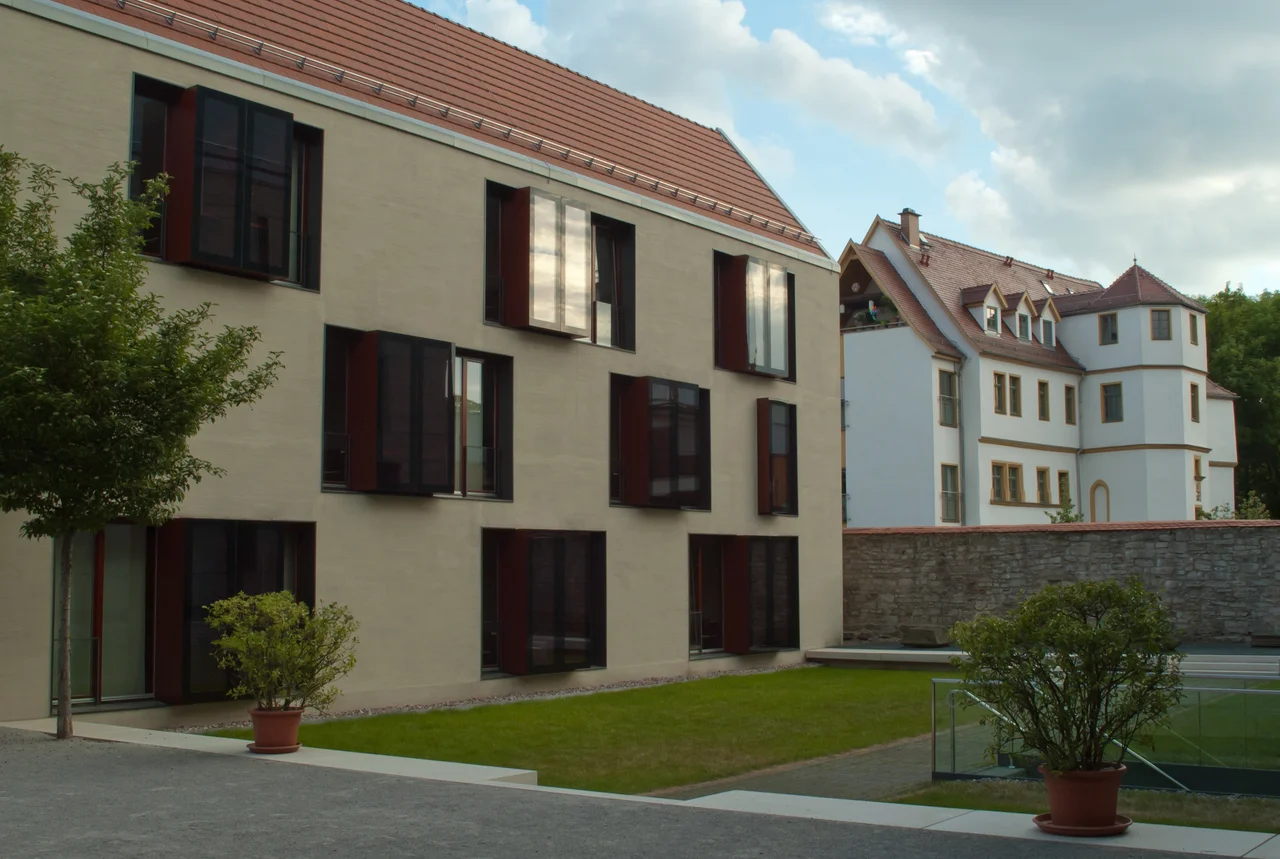
Restoration began almost immediately and ran from 1946 to 1957, covering the church, the cloister, the east wing and the old dormitory. Four medieval windows went back into the church in 1947, and the organ was pieced together with parts sent from West Germany. Serious reconstruction waited another half-century: a foundation was set up in November 2003, and from 2006 crews dug out the cellars of the buildings lost in 1945. A new Waidhaus opened on 14 September 2008 above the medieval woad cellars, with seventeen guest rooms. The new library, costing five million euros, opened on 27 August 2010 and holds the 60,000-volume Library of the Evangelical Ministry, one of the most important church collections in Germany. In its basement is a room of silence for the 267. In February 2016 the monastery was put forward, with eleven other places, to join the Luther Sites in Central Germany on the World Heritage list.
From the Air
St Augustine's stands at 50.9812 degrees north, 11.0302 degrees east, in the northern half of Erfurt's old town, roughly 400 metres north-east of the cathedral square and a short walk from the Kraemerbruecke. From the air it reads as a walled block of courtyards and steep tiled roofs with a single church tower, distinctly larger and greener than the dense burgher housing around it - almost a hectare of enclosure inside a medieval street grid. Set up on the two unmistakable anchors first: the cathedral and St Severus paired on their terrace, and the star-shaped Petersberg Citadel on the hill behind them, then track north-east across the Gera. Best viewed at 1,200 to 2,500 ft AGL. Erfurt-Weimar Airport (EDDE) is about 5 km west with controlled airspace over the city, Leipzig/Halle (EDDP) roughly 100 km north-east. Winter haze in the Thuringian basin often lingers past noon; summer mornings give the cleanest light on the east-facing church front.
Nearby Stories
- Battle of Frankenhausen 3.6 km away
- Opfermoor Vogtei 13 km away
- Naumburg Cathedral 17 km away
- Saalfeld Fairy Grottoes 26 km away
- Francke Foundations 31 km away
- Unicorn Cave 36 km away
- Observation Post Alpha 44 km away
- Horch 62 km away