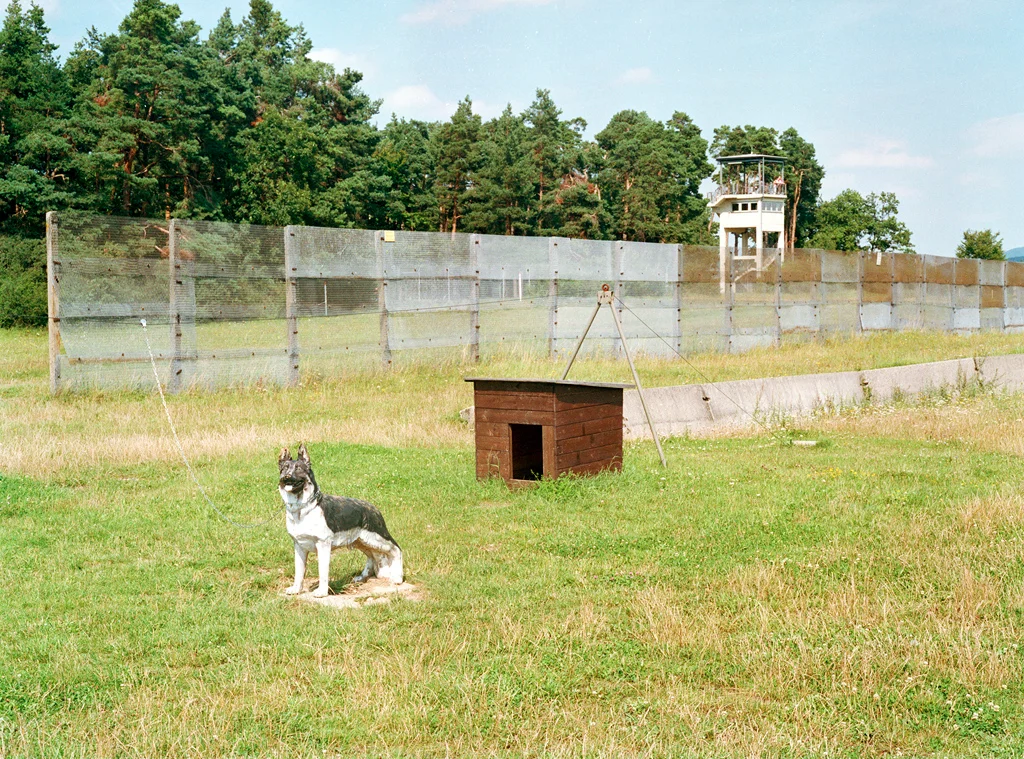

Observation Post Alpha
The men on the hill were not there to fight. Their standing task was to watch, and at the first genuine sign of a Warsaw Pact advance they were to pull back, because the ground where NATO intended to meet that advance lay a couple of kilometres to the west. Everything about Observation Post Alpha followed from that: a small crew, a tower, a radar set, and a job description that ended with leaving. From 1965 until 1991 that was the arrangement on the Rasdorfer Berg, on a 411-metre rise in the Rhön hills where Hesse ran into Thuringia and the Western world simply stopped.
The Gap
The Fulda Gap earned its reputation from terrain. Of the possible routes west through the German uplands, this one offered Soviet armour the easiest going toward Frankfurt and then the Rhine, which made the country around it the most closely studied landscape in Cold War Europe.
OP Alpha sat in the centre of that stretch of the NATO line, one of four American observation posts along the Hessian portion of the inner German border. It was manned by the 1st Squadron of the 14th Armored Cavalry Regiment out of Fulda, re-flagged as the 11th Armored Cavalry in 1972. Northward lay OP Romeo, OP India and OP Oscar, worked by the 3rd Squadron from Bad Hersfeld; to the south, the 2nd Squadron at Bad Kissingen held OP Tennessee. Jeeps and helicopters covered the ground between, with occasional heavier patrols when the border went busy. Alpha got its name for the simplest reason available: it was the first.
Watching Geisa
What the tower looked at was a small Thuringian town. Geisa lies just to the east, and for four decades it held the distinction of being the westernmost town in the Eastern Bloc - the far tip of a system that reached to the Pacific.
The post covered NATO reconnaissance south of the crossroads town of Vacha, and the geography also made it a good place to listen to radio traffic. An AN/PPS-5 ground surveillance radar in the tower allowed round-the-clock monitoring of the roads into Geisa and could pick out tanks at ten kilometres. The watching went both ways. The Warsaw Pact ran its own observation posts opposite, looking back at the Americans looking at them, and between the two sat the fortified strip itself, with the people who lived along it caught inside a border regime the memorial's exhibitions now document in detail.
Three Towers
The post was rebuilt as the confrontation settled in for the long term. The area was handed over to US troops in 1965; the first observation tower, put up in 1968, was wooden. A steel structure replaced it in 1982, and a concrete one replaced that in 1985. That last tower is the one still standing.
It was also a stop on the diplomatic circuit. Alpha was where visiting dignitaries, American and German, were brought to be shown what the division of Europe actually looked like, and several US cabinet members made the trip - Secretary of State Cyrus Vance among them, in 1978. The following year Peter Ustinov came for a BBC documentary on the risk of nuclear war and called it a hotspot of history, a description that has stuck partly because it was accurate and partly because the place was so plainly unremarkable in every other way.
The Argument for Keeping It
The military left in 1991, and the obvious thing to do with an obsolete border installation was to knock it down. Along the rest of the inner German border, that is broadly what happened.
A citizens' initiative fought the demolition and won. The site was placed under monument protection in 1995, an association was formed to build a memorial, and in 2002-03 a visitors' centre called the Haus auf der Grenze - the House on the Border - went up on the Thuringian side. The 1985 concrete tower survives with the American accommodation buildings, and the vehicle hangar was rebuilt after its roof gave way in 2010. A strip of East German border fortifications has been reconstructed so that people can see how the system was actually built, layer by layer.
Fourteen Stations
Along 1,400 metres of former patrol track, the sculptor Ulrich Barnickel set fourteen stations of a work called the Weg der Hoffnung - the Path of Hope. Walking a route that once existed to keep people in, past objects made about that fact, is a peculiar and effective way to take in the ground.
The memorial received the European Heritage Label in 2011. Since 2005 it has also awarded the Point Alpha Prize to people judged to have contributed to German or European unity, and the list of recipients reads as its own short history of how the Cold War ended: Helmut Kohl, George H. W. Bush and Mikhail Gorbachev in the first year, Václav Havel in 2008, the citizens' movement of the GDR in 2009, Helmut Schmidt in 2010, Felipe González in 2011 and Lech Wałęsa in 2013. The road below the hill, the Bundesstrasse 84, follows the line of the Via Regia - the medieval royal road from Fulda to Eisenach, which ran through here for centuries before anyone thought to close it.
From the Air
Point Alpha lies at 50.724°N, 9.932°E on the Rasdorfer Berg, a 411 m hill in the Rhön on the Hesse-Thuringia boundary, between Rasdorf to the west and Geisa to the east. The site reads clearly from the air: a small cluster of low buildings and one concrete tower on an open hilltop, with a cleared linear strip - the reconstructed border - running past it through otherwise rolling farmland and woodland. The Bundesstrasse 84 threads below on the old Via Regia alignment, giving a useful line to follow between Fulda and Eisenach. The high Rhön rises south-west, with the Wasserkuppe the dominant summit in the area at over 900 m, so plan altitudes accordingly; 2,500-4,000 ft gives a good view of the whole border corridor. Frankfurt (EDDF) is roughly 100 km south-west, Erfurt-Weimar (EDDE) about 80 km east, and Kassel-Calden (EDVK) about 85 km north-west. Rhön weather turns quickly - low cloud on the ridges and strong up- and downdraughts in westerly flow are routine, and the area is heavily used by glider traffic out of the Wasserkuppe.
Nearby Stories
- Altendorf Megalithic Tomb 33 km away
- Memorial and Education Centre Andreasstraße 33 km away
- 1st German Bratwurst Museum 36 km away
- Stadtallendorf 36 km away
- Erfurt 45 km away
- Zwingenberg Castle 119 km away
- The Dancing Plague of 1518: When Strasbourg Couldn't Stop Dancing 265 km away
- The Defenestration of Prague: The Thrown Men Who Started a Thirty Years' War 277 km away