
Memorial and Education Centre Andreasstraße
In 1960 a twenty-year-old called Johannes Huetcher lost his temper at a photograph of Walter Ulbricht hanging in his workplace staffroom. He swore at it and threw a plum jam sandwich. The charge was state-endangering propaganda and agitation, the sentence ten months, and part of it was served in a red-brick building on Andreasstrasse in Erfurt. Between 1952 and 1989 more than five thousand political prisoners passed through those two upper floors, which the Ministry for State Security kept for its own use. It was one of seventeen Stasi remand prisons in East Germany, and the first one that ordinary citizens walked into and took.
Numbers Instead of Names
Prisoners on the Stasi floors were addressed by number rather than by name, and the architecture was arranged so that they never saw one another. A system of lights in the corridors held people back until the way was clear. The cell windows were glass brick, admitting daylight and no view. Guards checked through spy holes, and through the night the cell lights were switched on and off every twenty minutes. Exercise was thirty minutes a day in a yard partitioned into walled boxes. Four letters could be written each month, censored, with nothing permitted about the case or the conditions, and one visitor was allowed. Detention averaged a hundred days - sixty-four under investigation, thirty-six more waiting for transfer if convicted. A three-month legal limit existed, and the unit handling political cases could extend it at will. Prisoners in isolation worked out an alphabet they could knock on the walls.
Who Was Inside
Marilene Bornemann and her husband Winfried handed out leaflets during the uprising of June 1953, calling for free elections and a united Germany. He was given ten years, she was given four, and while on remand in Andreasstrasse she realised she was pregnant. Her son was born in a prison hospital at Meusdorf near Leipzig in June 1954 and taken from her; she did not see him again for two years, and she was not released until May 1956. Winfried came out in December 1960. Rosel Schatz was thirty in 1981 when the Stasi opened her love letters to her fiance in West Germany and found she had mentioned applying for an exit permit; she got two years and three months, and was ransomed to the West after one. In 1983 the Hoefelmayr family from Eisenach tried to cross into Austria through Czechoslovakia, and all four were sentenced - the father, the mother, the seventeen-year-old daughter and the eighteen-year-old son.
A Building That Served Everyone
Erfurt had grown from 16,000 people in 1802 to 100,000, and it needed courts. The prison went up between 1874 and 1878 on parkland below the Petersberg Citadel, three storeys of red-brick neo-gothic, with the courthouse opening round the corner nine months later. It held thieves and fraudsters, and it also held people charged with insulting the Kaiser, with striking, and with editing newspapers that argued for social democracy. Under the Nazis it filled with those the regime called Andersdenkende, people who thought differently, persecuted for their faith, their politics or their sexuality; 350 inmates by 1943 and 400 by the end. American troops of the 80th Infantry Division reached Erfurt on 12 April 1945, closed the prison and let the political prisoners go. Thuringia passed to Soviet administration that July. One later inmate was no dissident: Josef Bloesche, the SS man photographed aiming his gun toward a small boy in the Warsaw ghetto, was held here in 1969 during his trial for crimes against humanity.
4 December 1989
The initiative came from a group of women in the Erfurt opposition, several of whom had already been inside. Gabriele Stoetzer had served a year in the Hoheneck women's prison for collecting signatures against the expulsion of the songwriter Wolf Biermann - in Erfurt around thirty of those signatories were interrogated in Andreasstrasse and sentenced to between one year and fourteen months. Thirteen years later she helped organise what happened next. On 4 December, with the regime collapsing and files being destroyed in Stasi offices across the country, Erfurt citizens occupied the district headquarters at number 38 and the prison beside it to stop the files being destroyed, and stacked the rescued documents in the empty cells. Some Stasi employees were pushed from upper windows and beaten in the street below; nobody was killed or seriously injured. It was the first occupation of a Stasi district administration in the GDR, and Gera and Suhl copied it within days. Two days later an amnesty freed every remaining political prisoner in the country.
The Cube on the Roof
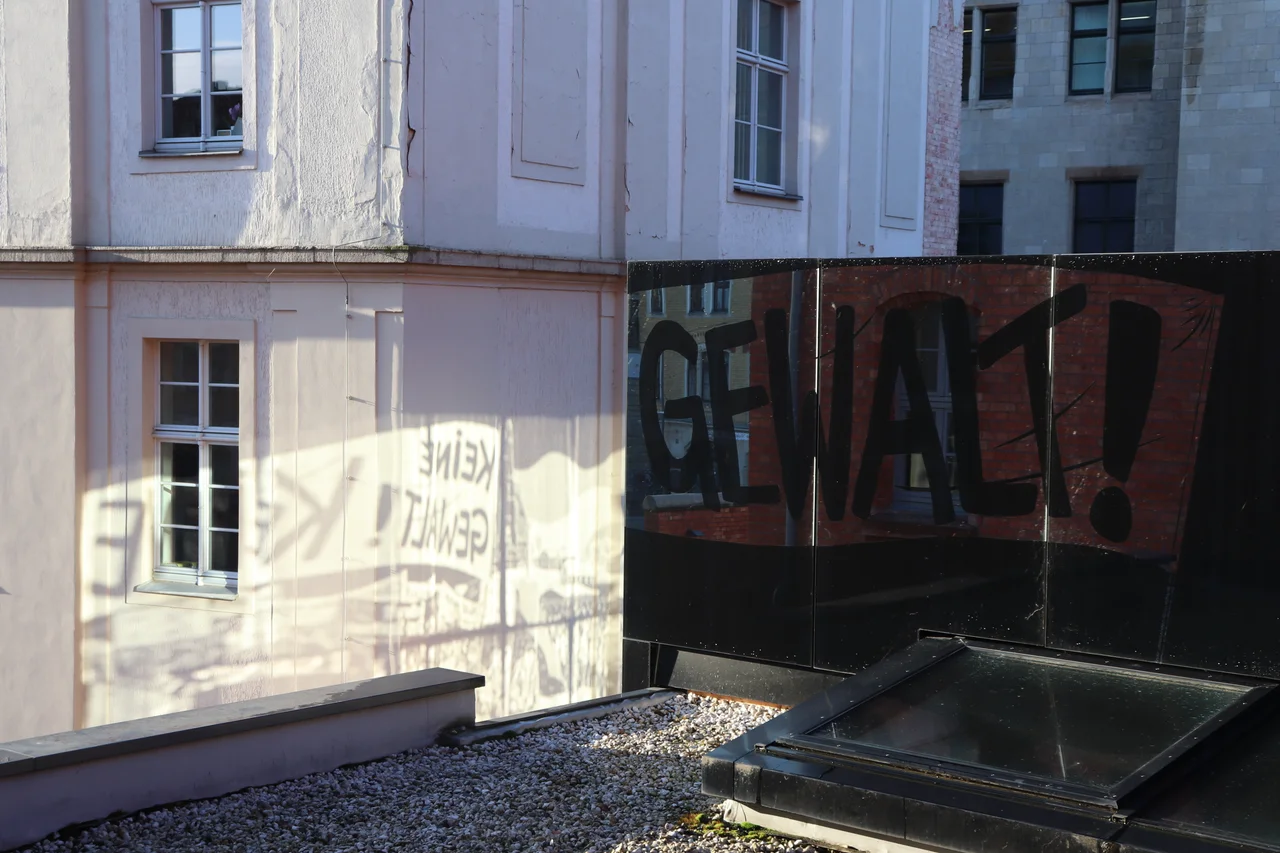
The prison outlived the state that used it. Federal authorities took it over at reunification and it kept working until 2002. On 4 December 2012, the twenty-third anniversary of the occupation, it reopened as a memorial and education centre, with the permanent exhibition - Imprisonment, Dictatorship, Revolution: Thuringia 1949 to 1989 - following on the same date a year later. The Stiftung Ettersberg runs it. A structure of concrete and glass called the Kubus sits on the building, and along some forty metres of facade the illustrator Simon Schwartz has drawn the Peaceful Revolution in comic-strip panels, so that the outside of a secret prison now tells the story of the week it stopped being one. Inside, the cells are as they were, and the exhibition is built around the people who were held in them.
From the Air
The memorial stands at 50.9786 degrees north, 11.0233 degrees east, on the western side of Erfurt's old town. The building itself is modest, but the reference points around it are not: the Petersberg Citadel, a full star-shaped bastion fortress on the hill immediately north-west, and the twin bulk of Erfurt Cathedral and St Severus on their shared terrace a short block south. The prison and its former Stasi headquarters occupy the ground between the citadel slope and the cathedral square. Best viewed at 1,500 to 2,500 ft AGL, which keeps the citadel's geometry legible while the street pattern is still readable. Erfurt-Weimar Airport (EDDE) lies about 5 km west with controlled airspace over the city; Leipzig/Halle (EDDP) is roughly 100 km north-east and Kassel-Calden (EDVK) about 130 km west. The Thuringian basin holds haze and low stratus through winter mornings, and the citadel is the last landmark to disappear in it.
Nearby Stories
- Battle of Frankenhausen 3.6 km away
- Opfermoor Vogtei 13 km away
- Naumburg Cathedral 17 km away
- Saalfeld Fairy Grottoes 26 km away
- Francke Foundations 31 km away
- Unicorn Cave 36 km away
- Observation Post Alpha 44 km away
- Horch 62 km away