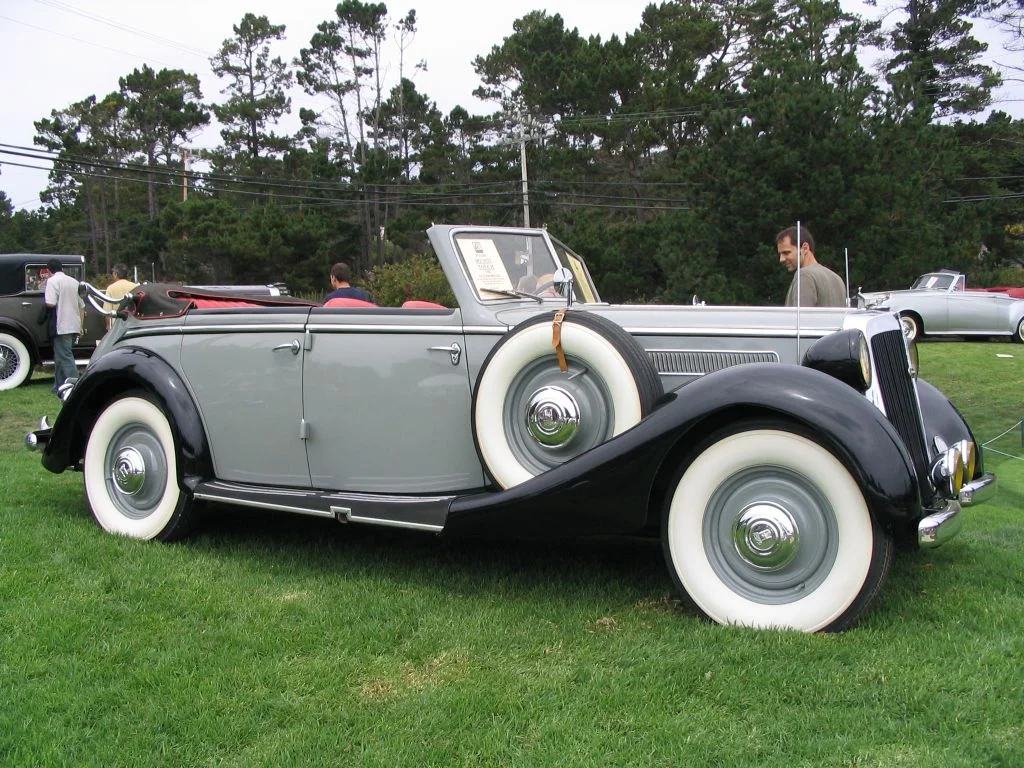

Horch
In 1909 a Saxon engineer lost the right to use his own name. August Horch had founded Horch & Cie. in Zwickau, quarrelled with his chief financial officer, and been pushed out by his own supervisory board. He walked a short distance across town and started a second car company - only to find that Horch was a registered trademark he no longer controlled. The German verb horchen means listen. The son of one of his Zwickau business partners supplied the answer: the Latin imperative for the same instruction is audi. On 25 April 1910 the name Audi Automobilwerke went into the Zwickau company register, and a man who had been legally erased from his own brand carried on building cars under a translation of himself.
Candle Lamps and an Alloy Crankcase
Horch had learned the trade under Karl Benz, running production for him before setting out on his own. On 14 November 1899, with a partner named Salli Herz, he opened a workshop in Ehrenfeld on the edge of Cologne. The first car he built there had a 4.5 hp engine and an aluminium-alloy crankcase, which in 1900 nobody else was attempting. Its lamps were lanterns with candles in them. Flat out, it managed barely 32 km/h. What mattered was underneath: a friction clutch and a driveshaft carrying power to the rear wheels at a moment when many builders were still using chains. Money ran short, as it always did, and Horch moved the shop to Reichenbach im Vogtland in 1902, where he produced a 20 hp four-cylinder. On 10 May 1904 he incorporated Horch & Cie. Motorwagenwerke AG in Zwickau, then a coal town and one of the industrial centres of the Kingdom of Saxony.
Eight Cylinders and the Four Rings
The brand outgrew its founder. Horch designed a six-cylinder engine in 1904 that reached the market in 1907, and after Paul Daimler arrived as chief engineer in 1923 the firm became the first in Germany to put straight-eights into series production. That set the pattern for everything after. The Horch 670 of 1931 carried a 6-litre V12 making 120 PS; the 850 and 853 of the mid-thirties used a 5-litre straight-eight and would run at 140 km/h, which is a genuinely alarming speed on 1930s roads. In 1936 the Zwickau works rolled out its 25,000th eight-cylinder luxury car. By then Horch no longer existed alone: on 29 June 1932, with the Depression crushing German carmakers, Horch merged with Audi, DKW and Wanderer to form Auto Union. Four companies, four interlocking rings - the badge Audi still wears.
The Racing Department and What It Cost
Auto Union's Grand Prix cars were designed and built inside the Horch works at Zwickau between 1933 and 1939. Ferdinand Porsche put the engine behind the driver, which almost nobody else was doing, and the Types A through D grew to nearly 550 hp - enough for Bernd Rosemeyer to take the 1936 European Championship and for the cars to win 25 races between 1935 and 1937. Rosemeyer was killed in 1938 attempting a speed record. The company's darker account came later. Auto Union became a major supplier to the Wehrmacht, building the Horch 108 and 901 staff cars and Sd.Kfz. 11 half-tracks; civilian production stopped in March 1940. To keep the plants running it used forced labour, including prisoners from the Leitmeritz concentration camp. A study the company itself commissioned, published in 2014, concluded that Auto Union bore moral responsibility for the 4,500 people who died at Leitmeritz.
Dismantled, Then Renamed
Zwickau ended the war in the Soviet zone. The factories were taken apart as reparations, the surviving Grand Prix cars shipped to Moscow to be reverse-engineered, and Auto Union AG was liquidated without compensation on 17 August 1948. Executives who had reached the west founded a new Auto Union GmbH at Ingolstadt in Bavaria on 3 September 1949, on Bavarian state loans and Marshall Plan money, and built small two-stroke DKWs because that was what a broke country could buy. Back in Saxony the old Horch halls made the Horch P240 from 1955, a solid six-cylinder saloon that the East German state was rather proud of - until Soviet authorities barred it from export and production was stopped. In 1958 the Horch and Audi works were combined under a new name, Sachsenring, and the P240 was rebadged accordingly. From 1957 the same site turned out the Trabant P50.
A Dormant Name Wakes Up
Volkswagen bought the Zwickau site in 1991, the year the last Trabant was built, and put up a new plant at Mosel just north of the town; since 2021 it has been assembling the Audi Q4 e-tron, which returned Audi-badged production to Zwickau after more than eighty years. The Horch name travelled a stranger route. Daimler-Benz held the trademark until the mid-1980s, then handed it to Audi, which in exchange waived any claim to Silberpfeil for its racing cars. Horch then sat unused for a generation. In 2021 Audi revived it in China as the flagship trim of the A8, aimed squarely at the Mercedes-Maybach. The August Horch Museum occupies the old Audi works in Zwickau - the plant a man built after being locked out of the company bearing his surname.
From the Air
The August Horch Museum and the historic Audi works site sit at 50.732 N, 12.480 E in northern Zwickau, western Saxony, at roughly 270 m elevation in the Mulde valley. From 2,500-4,000 ft AGL the town reads as a compact centre on the Zwickauer Mulde with the huge white Volkswagen plant at Mosel unmistakable 8 km to the north-north-west - long flat-roofed halls and a test track. The Erzgebirge foothills rise to the south. Leipzig-Altenburg (EDAC) lies about 28 km north; Dresden (EDDC) is roughly 105 km north-east and Leipzig/Halle (EDDP) about 75 km north-west. Winter brings persistent low cloud in the Mulde basin; the clearest views of the Ore Mountains beyond the town come on cold, dry days after a northerly airmass change.
Nearby Stories
- DKW 5 km away
- Naumburg Cathedral 22 km away
- Polabian Language 25 km away
- Walpersberg 29 km away
- Meissen porcelain 38 km away
- The Defenestration of Prague: The Thrown Men Who Started a Thirty Years' War 107 km away
- Zwingenberg Castle 238 km away
- The Anschluss: When Austria Vanished Overnight 272 km away