
Polabian Language
In 1756, in the village of Dolgow east of Lüneburg, a woman named Emerentz Schultze died at the age of eighty-eight. As far as anyone has been able to establish, she was the last person who had grown up speaking Polabian. Her language had been spoken along the Elbe for something like a thousand years, from the Baltic coast down to the edge of Sorbian Lusatia; its speakers called it vensťĕ rec, Wendish speech. By the time she died, about 2,800 of its words had been written down, together with a handful of prayers, one wedding song and a few folktales. That is the whole surviving corpus of a language that had once been spoken across a broad band of northern Europe. Somebody who still knew a little of it is said to have died in 1825, and after that, nobody did.
Along the Elbe
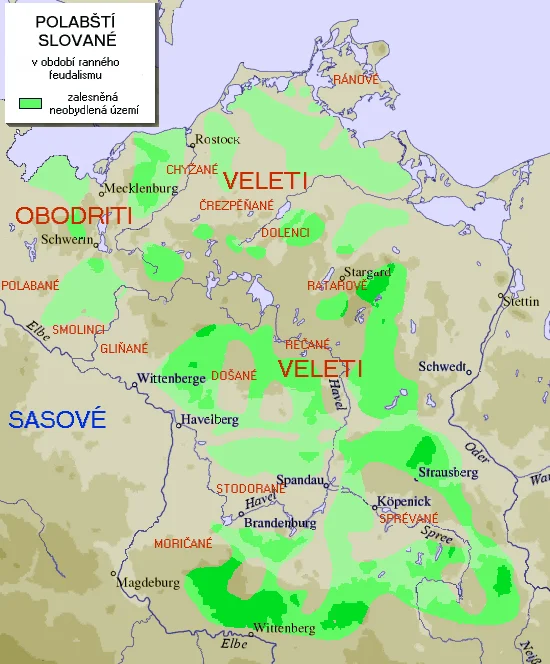
The name is a description: po Labe, along the Elbe. The Polabian Slavs occupied much of what is now northeastern Germany — Mecklenburg-Vorpommern, the central Mittelmark of Brandenburg, eastern Saxony-Anhalt, the eastern parts of Wendland in Lower Saxony, and into Schleswig-Holstein, Ostholstein and Lauenburg. Polabian was still being spoken in and around Lübeck and Oldenburg into the sixteenth century. The poorly attested Slavic dialects of Rügen appear to have had more in common with it than with the Pomeranian varieties further east. In the south it ran up against the Sorbian language area of Lusatia, which is still spoken today. Polabian belonged to the Lechitic branch, which makes it a close relative of Pomeranian and Kashubian and a cousin of Polish. Century by century the language area contracted under German settlement, until by the middle of the eighteenth century what remained was a pocket in the Wendland, and Low German had taken over there too.
What the Language Kept
Polabian held onto features that most of the Slavic family had let go. It kept the nasal vowels, so Proto-Slavic *pętь came through as pąt. It kept the aorist and the imperfect. It kept traces of the dual number, the grammatical form for exactly two of something. And it never underwent one of the sound changes that reshaped the rest of the family, so words that metathesised elsewhere stayed put here. At the same time it went its own way with enthusiasm. Closed vowels broke into diphthongs; o shifted toward ö and ü, a toward o; g and k softened in some positions into d' and t'. Proto-Slavic *dьnь became dan, day. *vъšь became vås, louse. *tьma became tåmă, darkness. The bones are recognisably Lechitic. The surface is not.
German in the Grammar
The pressure of the surrounding language shows up everywhere, and not only in vocabulary, though Polabian absorbed a great many Middle Low German words. It built a future tense with cą, I want, plus the infinitive — ci sneg ai̯t, it will snow. It developed a second perfect tense on the German pattern, with have or be plus a participle: vån mo nodenă, he found. It formed the passive with vardot, taken straight from German werden. The old Slavic word for a hundred was lost and replaced by disą(t)diśǫt, ten tens, or by a construction built on stíďə, borrowed from Middle German stige, a score. A language dying under another language does not simply fall silent. For generations it goes on working, borrowing the machinery of its replacement to keep saying what its speakers need to say.
Three Men With Notebooks
Almost everything known about Polabian was collected in the last decades, by people who could see what was coming. The most important record is the Vocabularium Venedicum, compiled between 1679 and 1719 by Christian Hennig von Jessen, a Lutheran pastor at Wustrow, who worked with a Polabian-speaking farmer named Johann Janieschge from the village of Klennow. Others assembled phrase lists and word lists and gathered folklore. Only one of the collectors was himself a native speaker: Johann Parum Schultze, a farmer, whose manuscript runs to 310 pages of which just thirteen are of use to linguists. The rest is the village chronicle he was actually setting out to write. It is worth pausing on that ratio. A man recording his own dying language gave it thirteen pages, because he had a farm and a village and a life, and the language was simply the thing he thought in.
Names That Outlived the Speakers
The language survives most durably on the map. Wustrow, where Hennig von Jessen kept his notebook, is Polabian Våstrüv and means simply island. Lüchow is Ljauchüw. Sagard, Gartow and Krakow carry Slavic roots too. And Berlin most likely does as well, from a Polabian stem berl- or birl- meaning swamp — the capital of Germany named, in all probability, in a language that has had no fluent speakers for two and a half centuries. That is not quite the end of it. Small, unorganised groups have started learning Polabian from the surviving materials, and as of 2023 there were a few limited speakers again, with more resources available to work from than at any point since Hennig von Jessen closed his book. Emerentz Schultze's language is not coming back as anyone's mother tongue. It is, at least, being read aloud again.
From the Air
This article is plotted at 51.000°N, 12.833°E, in the Saxon country between the Mulde and the Elbe — the southeastern margin of the old Slavic settlement zone rather than the Polabian heartland. The country the last speakers actually lived in lies about 250 km northwest: the Hannoversches Wendland of Lüchow-Dannenberg, around 52.97°N, 11.15°E, in the great bend of the Elbe where Lower Saxony, Brandenburg and Mecklenburg meet. That is the leg worth flying — follow the Elbe downstream from Wittenberg past Dessau and Magdeburg, and the river itself is the through-line of the whole story, a flat green corridor of meadow and floodplain running northwest. Near the plotted point, Leipzig/Halle (EDDP) is about 60 km northwest and Berlin Brandenburg (EDDB) about 130 km northeast. For the Wendland, Hannover (EDDV) lies roughly 110 km southwest and Hamburg (EDDH) about 105 km northwest, with Braunschweig (EDVE) and Magdeburg-Cochstedt (EDBC) as alternates. Terrain throughout is low and flat; summer haze over the Elbe lowlands is the main visibility constraint.
Nearby Stories
- Meissen porcelain 13 km away
- DKW 18 km away
- Ore Mountain Toy Museum, Seiffen 18 km away
- Battle of Lutzen 25 km away
- Francke Foundations 29 km away
- Torgau 29 km away
- 2001 American Memorial 45 km away
- Walpersberg 53 km away