_2006-11-30.jpg)
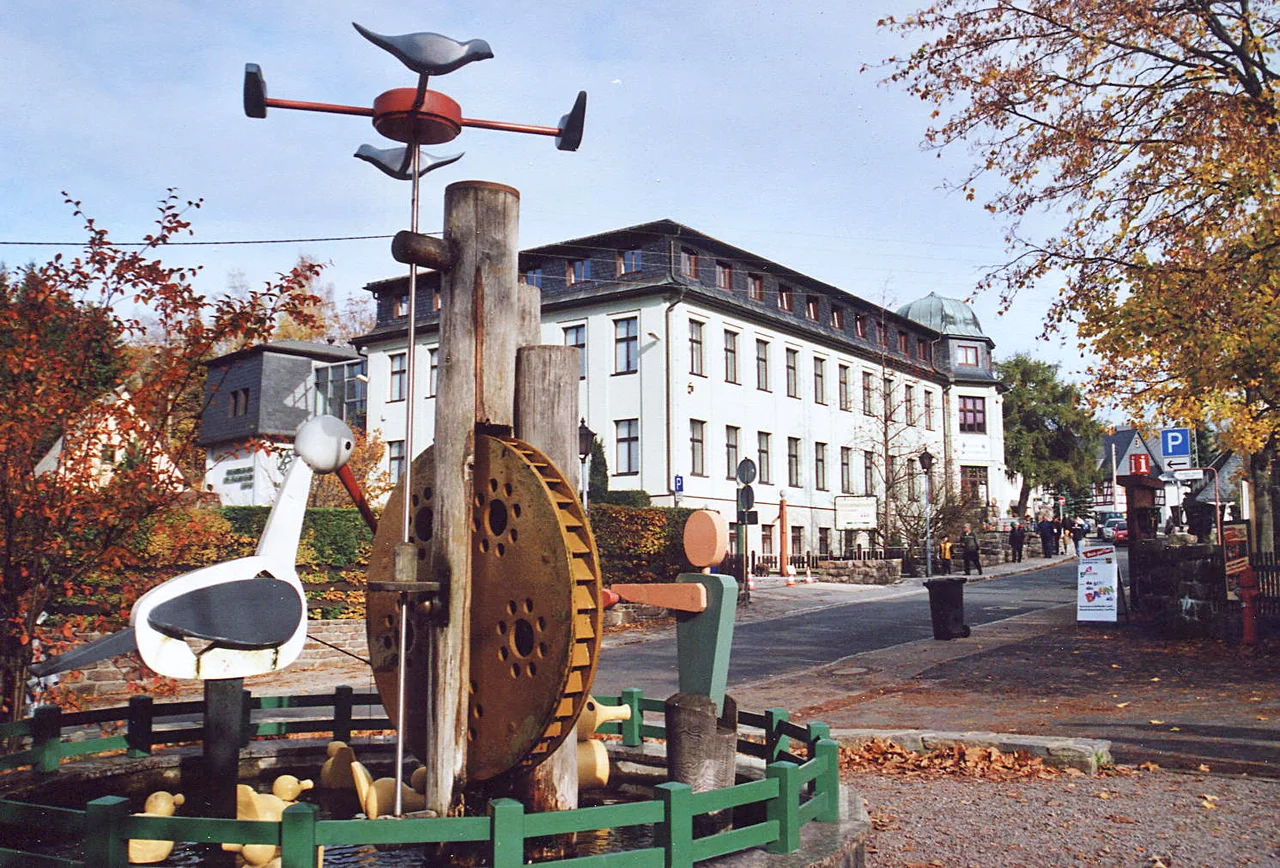
Ore Mountain Toy Museum, Seiffen
In 1890 the export duty changed from a tax on value to a tax on weight, and the toymakers of Seiffen responded by making their toys smaller. Much smaller. They began building complete Ore Mountain farmhouse parlours — stove, table, benches, sometimes the family as well — inside matchboxes, on the reasoning that a matchbox weighs almost nothing and a customs officer cannot argue with a scale. When the village staged its first great wooden toy exhibition in the summer of 1914, visitors could buy one at the counter on the way out. That is the local temperament in miniature, which is the only scale Seiffen has ever really needed: presented with a problem, carve your way around it.
When the Tin Ran Out
Seiffen sits at 650 metres in the heart of the Ore Mountains, close to the Czech border, and it was a mining village long before it was anything else — first documented in 1324 as Cynsifen, with roughly seven centuries of digging behind it. Then the silver and the tin gave out. A village at that altitude with no ore has very few options, and the one Seiffen took was the forest standing all around it. In 1699 Johann Friedrich Hiemann carried Seiffen toys down to the toy market at Nuremberg, which was the clearing house for the whole German trade, and they sold: cheap, and better made than cheap things usually are. Within a few generations an entire mining district had reinvented itself as a workshop. The miners' own imagery went with them into the new trade, which is why so much Ore Mountain folk art is populated by little carved men with lamps.
The Ring of Animals
The technique that made mass production possible is called Reifendrehen, ring turning, and it is genuinely ingenious. A turner mounts a sound, crack-free block on a specialised lathe and cuts a wooden ring 30 to 50 centimetres across, shaping it so that the ring's cross-section is the profile of an animal — the arch of a back, the set of a head, the taper of a leg. Segments are then split off the ring, and each one comes away as a rough animal identical to the last. Carving and painting finish them. The method emerged as tin mining declined around 1800, using the water power the mines had left behind, and it turned a craft into an industry: far faster and cheaper than carving each figure by hand. It also explains a particular Ore Mountain speciality. A Noah's Ark requires an enormous number of animals, and the ark shown at Seiffen in 1914 had three hundred.
Fifty Pfennigs, Summer 1914
The Seiffen Wooden Toy and Merchandise Exhibition ran from 9 July to 3 August 1914 in the Albert Salon. Admission was fifty pfennigs, twenty-five for children. It was organised by the parish priest Hermann Härtel, born at Lichtenstein in 1864, who had chaired the district trade association for years and who supplemented the show with pieces from his own parish collection: a painted four-poster bed of 1764, a chest of 1734, another whose lid was painted on the inside in 1785, a flower-covered wardrobe of 1798, a great farmer's table, a clay pitcher of 1739, a tin Gockel lamp, an open family bible, and a Spanleuchter — a candlestick dressed in curls of wood shaving. Its last day, 3 August 1914, was the day Germany declared war on France. Härtel died in Seiffen in 1919 without seeing what his exhibition became.
A Museum Through Several Germanys
On 5 December 1920 a proper toy museum opened in the State Trade Training School, built around the collection of older and newer playthings that Alwin Seifert (1873-1937) had been assembling since 1914, enlarged by Härtel's material. For a trade show in 1944 the staff put together a farmhouse parlour with a tiled cocklestove and a fireside bench, lit by a candelabra made by Louis Strauß, with Christmas angels, miners, nutcrackers and Räuchermännel all present and correct; at the time it was the only toy museum in Saxony. On 5 July 1953 the house reopened as the Local History and Toy Museum, later renamed the Erzgebirgisches Spielzeugmuseum. The first visitor through the door was Rudolf Mauersberger, whose Dresdner Kreuzchor sang that same evening in the Pinge — the hollow left in the ground by old mine workings, which the village had turned into an open-air theatre.
Fourteen Houses and Five Thousand Things
On 2 May 1973 the Ore Mountains Open-Air Museum opened on the edge of the toy village with fourteen groups of buildings showing how people here lived before 1900, among them a water-powered turning works dating from 1758-60. The toy museum itself was rebuilt and extended in 1999 and now holds around 5,000 objects across three storeys. None of it is elegy. Nutcrackers, Räuchermännchen, Christmas pyramids and Schwibbögen — the candle arches whose curve echoes the mouth of a mine — are still being made in workshops within walking distance of the display cases, in a village of about 1,800 people that has been selling small wooden things to the rest of the world for three hundred years. The octagonal Bergkirche stands above it all, and every December the whole valley lights up like one of its own exhibits.
From the Air
Seiffen lies at 50.648°N, 13.448°E in the eastern Ore Mountains, at 650 m elevation and only a few kilometres from the Czech border. Dresden (EDDC) is about 60 km north-northeast and the closest practical field; Chemnitz is roughly 40 km northwest and Prague (LKPR) about 90 km south across the range. From the air the village is a long ribbon of houses along a valley floor with dense conifer forest on both flanks, and the octagonal Bergkirche is the clearest single landmark; the Pinge, the mining hollow now used as an open-air theatre, shows as a distinct bowl at the edge of the built-up area. Recommended viewing altitude is 3,000-4,500 ft AGL, well clear of terrain — the Erzgebirge ridge continues west to 1,215 m at the Fichtelberg. This is genuine mountain weather: snow cover from late autumn into spring, frequent low stratus filling the valleys, and rapid icing conditions in winter frontal passages. December brings the region's Christmas lighting, which makes a night approach unusually rewarding.
Nearby Stories
- Polabian Language 13 km away
- Chemnitz 15 km away
- Kaditz Lime Tree 15 km away
- Bohemian Switzerland 19 km away
- Bautzen 34 km away
- The Defenestration of Prague: The Thrown Men Who Started a Thirty Years' War 47 km away
- The Anschluss: When Austria Vanished Overnight 260 km away
- Riesending Cave Rescue 306 km away