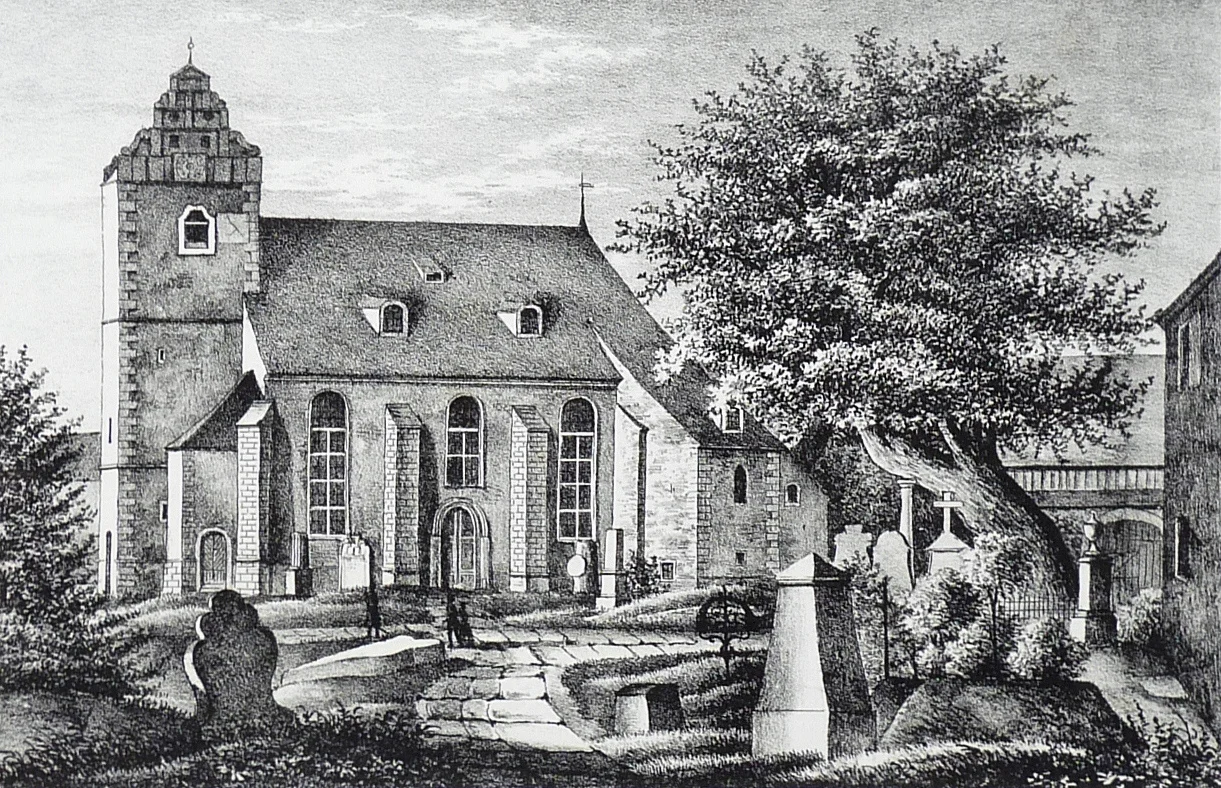

Kaditz Lime Tree
Look closely at the trunk and you can still find iron in it: rings and clips, nearly swallowed by bark now, that nobody put there for the tree's benefit. According to village tradition the great lime of Kaditz was the local pillory, and until the eighteenth century people convicted of something were chained to it where the congregation would have to walk past them. A description from 1836 records what the elders said their fathers had told them, and adds a detail that no human institution could have produced: the two half-circles of the iron collar had by then drifted about two ells apart. The tree had simply kept growing around the hardware, at its own speed, until the punishment no longer fitted anyone.
The Oldest Thing in Dresden
The large-leaved lime — *Tilia platyphyllos* — stands in the churchyard of the Emmaus Church in Kaditz, about six kilometres north-west of Dresden's historic centre, on a plateau ten metres above the normal level of the Elbe. It is roughly twenty metres tall and its trunk measures something like ten metres around, which was enough to put it among the largest limes in Germany even in the nineteenth century. Estimates of its age run from five hundred to a thousand years, and the higher end of that range would make it older than the city it now belongs to. The German Tree Archive lists it among trees of national significance, a register in which girth at one metre above the ground is the deciding measurement. A few paces away stands a second lime, a comparative infant: the parish register puts its planting in 1622.
Fire, Twice
In 1637, with the Thirty Years' War grinding through Saxony, the church burned. The lime came through almost untouched, and the church did not — it stood as a gutted shell until restoration began in 1650, and fragments of the older Lawrence chapel survive inside today's steeple. Swedish troops camped under the tree during those years. The second fire, in 1818, went differently. It tore through the western half of the village, destroying nineteen farmhouses, thirty barns and the parsonage a few metres from the churchyard, and this time the lime took the heat directly: one half of the trunk burned down to the core. It also stopped the fire there. Standing between the blazing parsonage and the church, the tree absorbed what would otherwise have crossed, and the church survived because the lime did not get out of the way.
The Room Inside
The trunk had been hollow before the fire, but sealed. The flames opened it, and when a heavy bough later rotted and tore away, the cavity widened into something people could walk into. For a while they did exactly that, setting up a table and chairs inside the tree; young people gathered in there to play music. In 1823 the cantor Johann Gottfried Ziller wrote down what he was watching happen: "It is remarkable that nature gradually re-covered the inner walls in the hollow of the trunk with new bark and brought new life to the trunk." Around 1830 a church superintendent had the lowest and heaviest branch propped on timber and pillars, plastered to look like stone masonry and shaped like a gateway. Over the following century the trunk split into two pieces that kept drifting apart. The smaller one, now standing alone several metres from the main body and measuring only about twenty by a hundred centimetres, still leafs out every spring.
Twenty-One Ells
Nineteenth-century Saxony was faintly obsessed with measuring this tree, and could not agree on a number. *Sachsens Kirchen-Galerie* gave the girth as 19¾ ells in 1836 and compared it favourably with the famous lime at Augustusburg. The journal *Saxonia* made it 21 ells in 1839, and settled the rivalry in Kaditz's favour. *Das Vaterland der Sachsen* reported 39½ feet in 1844. The Duke of Courland — a grandson of Augustus the Strong — had already had the thing surveyed geometrically around 1750. The measuring was not entirely disinterested: the churchyard was so short of space that graves had been dug well inside the tree's root zone, and *Saxonia* offered its readers the theory, in 1839, that the lime "probably nourished itself from the surrounding corpses." Kaditz also tells a story that Goethe came to see it on one of his seven visits to Dresden. The village has never been able to produce the book that supposedly records it.
Weddings and High Water
In 1945 a resident of Kaditz is said to have slept inside the hollow trunk to avoid the house-to-house searches of the first postwar weeks. Around 1960 the very old graves at the roots were cleared. A decade later the pastor Karl-Heinz Scharf, who had made the tree's history his subject, began inviting newly married couples to come to it after the church service — the split trunk standing in for the obstacles a shared life has to grow around. The lattice fence came down for those blessings. On 3 September 1985 the city declared it a natural monument; in 1996 the crown was braced at a cost of sixteen thousand marks; in 1997 residents saw off a gravel quarry application that would have dropped the water table enough to kill it. Then came the flood of 2002, which swallowed Kaditz whole, poured over the cemetery wall and submerged the graves. The water stopped at the church threshold, just short of the main trunk, and went no further.
From the Air
The lime stands at 51.0833°N, 13.6715°E, in the churchyard of the Emmaus Church in Kaditz, on the right bank of the Elbe about 9 km north-west of Dresden's old town and roughly 110 m above sea level. From 1,000–2,000 ft AGL the marker is the church rather than the tree: a small village core with a single steeple, set on a low plateau just north of the Elbe's big western bend, with the Kaditz flood channel — cut between 1918 and 1922 — running past to the south and the broad flood meadows beyond it. Dresden Airport (EDDC) is about 9 km north-east; Leipzig/Halle (EDDP) roughly 100 km west-north-west. Best light is late afternoon, and the tree is easiest to pick out between November and April when the crown is bare and the churchyard shows through it.
Nearby Stories
- Bastei 11 km away
- Polabian Language 14 km away
- Ore Mountain Toy Museum, Seiffen 18 km away
- Lusatian Lake District 21 km away
- Battle of Mühlberg 25 km away
- Torgau 26 km away
- Horch 38 km away
- Ještěd Tower 65 km away