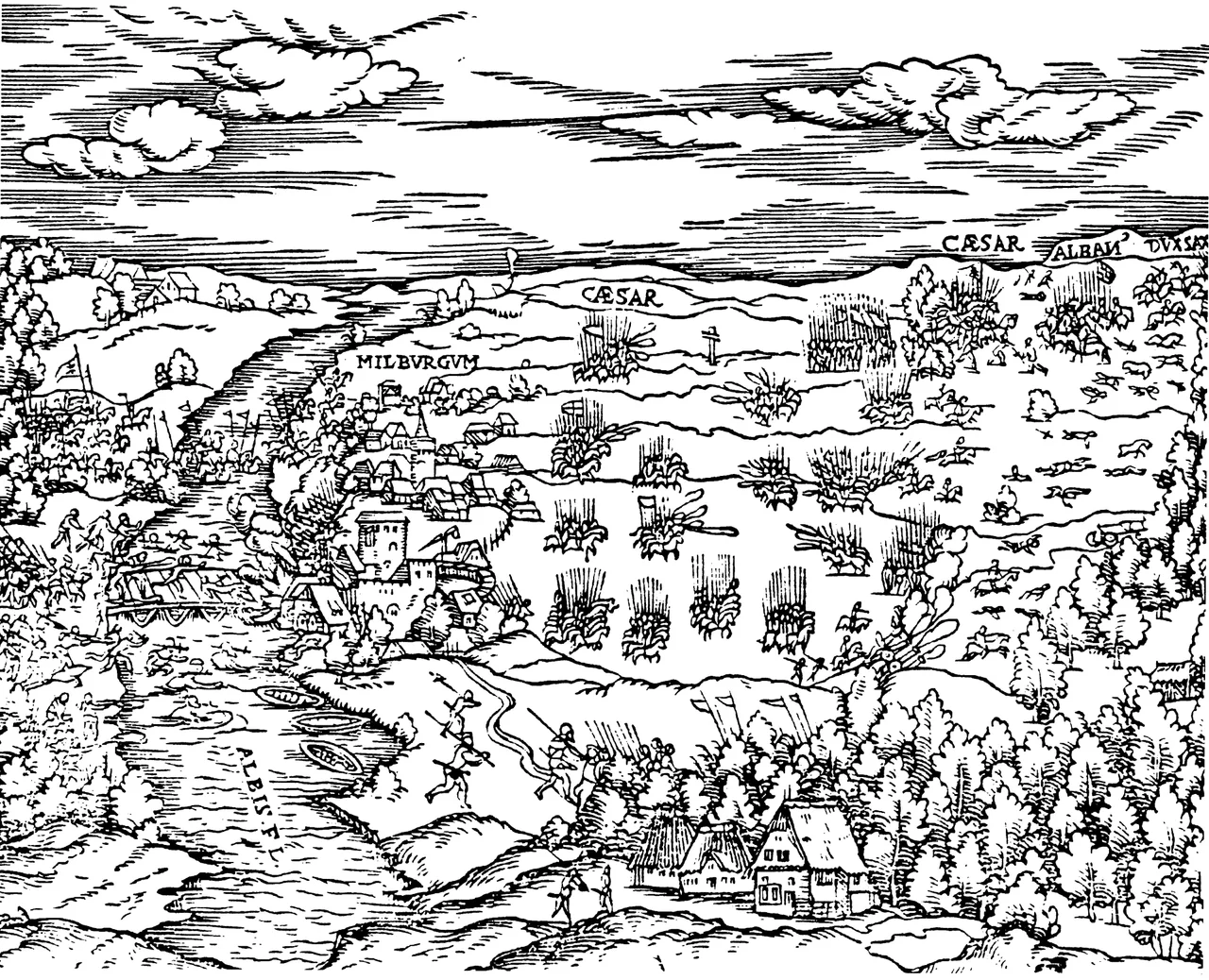

Battle of Mühlberg
Titian painted him in three-quarter armour on a dark warhorse, lance couched, riding out of a wood at dusk — the Equestrian Portrait of Charles V, finished in 1548 and still one of Europe's most reproduced images of power. Charles was not on a horse. He was forty-seven and so crippled by gout that his men carried him to the field in a litter and set him down at the rear to watch. What he watched lasted a single evening beside the Elbe on 24 April 1547. Two to three thousand men died on the Saxon side and around fifty on the imperial, and it was enough to end the military life of the Schmalkaldic League — the first alliance of Protestant princes in the Holy Roman Empire.
Why the Emperor Waited
The League took its name from Schmalkalden, the Thuringian town where the pact was drawn up: defensive in form, pointedly anti-Habsburg in temper. Free cities joined for reasons of their own — Bremen, Hamburg, Lübeck, Ulm and Strasbourg all wanted less of the central power, whatever they thought about the Mass — and France backed the Protestant princes because France opposed Charles everywhere. Charles, needing German troops against the Ottomans on his eastern frontier, judged that a Protestant coalition inside the Empire was cheaper to tolerate than to fight, and granted the League wide autonomy. Its leaders spent that autonomy advancing the Reformation and stripping Catholic bishops of authority. Then every reason for patience dissolved at once. The Treaty of Crépy in 1544 ended decades of war with Francis I and took French support off the table; Luther died in 1546; the Turkish pressure eased.
Cousins
The opening came from inside the House of Wettin. John Frederick I held the Saxon electorate; his cousin Maurice held the ducal Saxon lands, was equally Lutheran, and had declined to join the League in 1542. In 1546, helped by Ferdinand I, the emperor's younger brother, Maurice invaded his cousin's territory. John Frederick's army was away in Württemberg, but it got back and threw Maurice out. That was the fracture Charles had been waiting for. He entered the war in 1547, took Ulm and Württemberg, forced the Palatine Elector out of the League, and turned north into Saxony in the spring to finish the last Protestant prince still in the field.
Fog on the Elbe
John Frederick made three decisions that April, each defensible on its own. Hoping to spark an anti-imperial rising in Bohemia, he sent a large part of his army there. He detached small garrisons to hold the Saxon towns most exposed from the south. Then he abandoned Meissen and marched north for the safety of Wittenberg, camping near Mühlberg with only a handful of men watching the riverbank, because he judged the Elbe too wide to cross in a hurry. Charles reached the far side on the evening of 23 April and, against his generals' advice, decided to attack. At dawn a thick fog came up off the water. Spanish and Italian veterans swam the cold river under cover of it and killed the guards on the other bank, while troops of the tercios of Lombardy and Naples, working to a plan of Fernando Álvarez de Toledo, Duke of Alba, found a ford with the help of a local farmer. Others saved the Saxons' own pontoon bridge from demolition. John Frederick had thought an assault so improbable that he had sent several of his commanders to Mass.
An Evening on the Heath
Told the imperial army was across, the elector's first instinct was to run for Wittenberg. He then realised his men could not be ready to march in time, and convinced himself that only a vanguard had crossed. So he formed up along the edge of a forest, hoping the trees would stop the imperial cavalry working around his flanks and leave him a way out. He had perhaps seven thousand men against something over twenty thousand. The Saxon infantry — farmers and townsmen who had been trudging north two days earlier, not professionals — held off the first Hungarian cavalry charges before the imperial line came on in earnest. Then it was a rout. Two to three thousand of them were killed and many more taken prisoner, against about fifty imperial casualties. John Frederick was cut across the face by a sabre and captured in the pursuit near Falkenberg.
The Price of Winning
Charles is said to have summed the day up by rewriting Caesar: Vine, vi y venció Dios — I came, I saw, and God won. John Frederick was condemned as a heretic and sentenced to death, and Charles then traded that sentence for something he wanted more: the elector's life for the surrender of Wittenberg. The Capitulation of Wittenberg, signed on 19 May 1547, took his electoral title and much of his land and handed both to his cousin Maurice. He stayed a prisoner until 1552 and died two years after his release. Philip of Hesse surrendered soon afterwards and the war ended, but nothing was settled. Reformers including Martin Bucer left for England, where they shaped the English Reformation. Only the Peace of Augsburg in 1555 stopped the Empire fighting about religion, by letting each ruler choose between Catholicism and Lutheranism — which quietly buried the single-confession Germany that Mühlberg had been fought to secure. The town keeps a small museum about the battle, and a memorial with plaques stands near Falkenberg, on the ground where the pursuit ended.
From the Air
The battlefield lies around 51.4331°N, 13.2167°E, on flat Elbe floodplain and pine heath in the far south of Brandenburg, close to the Saxony border. There is no terrain to speak of here, so navigate by water: the Elbe runs northwest in broad lazy meanders, with Riesa roughly 15 km upstream to the southeast and Torgau about 20 km downstream to the northwest, and the small town of Mühlberg sitting tight against the river. From 1,500–3,000 ft AGL the contrast that matters is between the pale ploughed floodplain and the dark blocks of pine forest on the heath — the same kind of treeline the Saxon infantry formed along. Dresden (EDDC) is about 50 km southeast, Leipzig/Halle (EDDP) roughly 70 km west, and Berlin Brandenburg (EDDB) about 105 km north. Spring mornings here still produce exactly the river fog that hid the crossing, and it can sit on the valley floor well past sunrise.
Nearby Stories
- Hellerau 5.2 km away
- 2001 American Memorial 20 km away
- Monument to the Battle of the Nations 20 km away
- Lutherhaus 21 km away
- Colditz Castle 26 km away
- Wendish-German double church 28 km away
- Wittenberg 42 km away
- Horch 48 km away