.jpg)
Monument to the Battle of the Nations
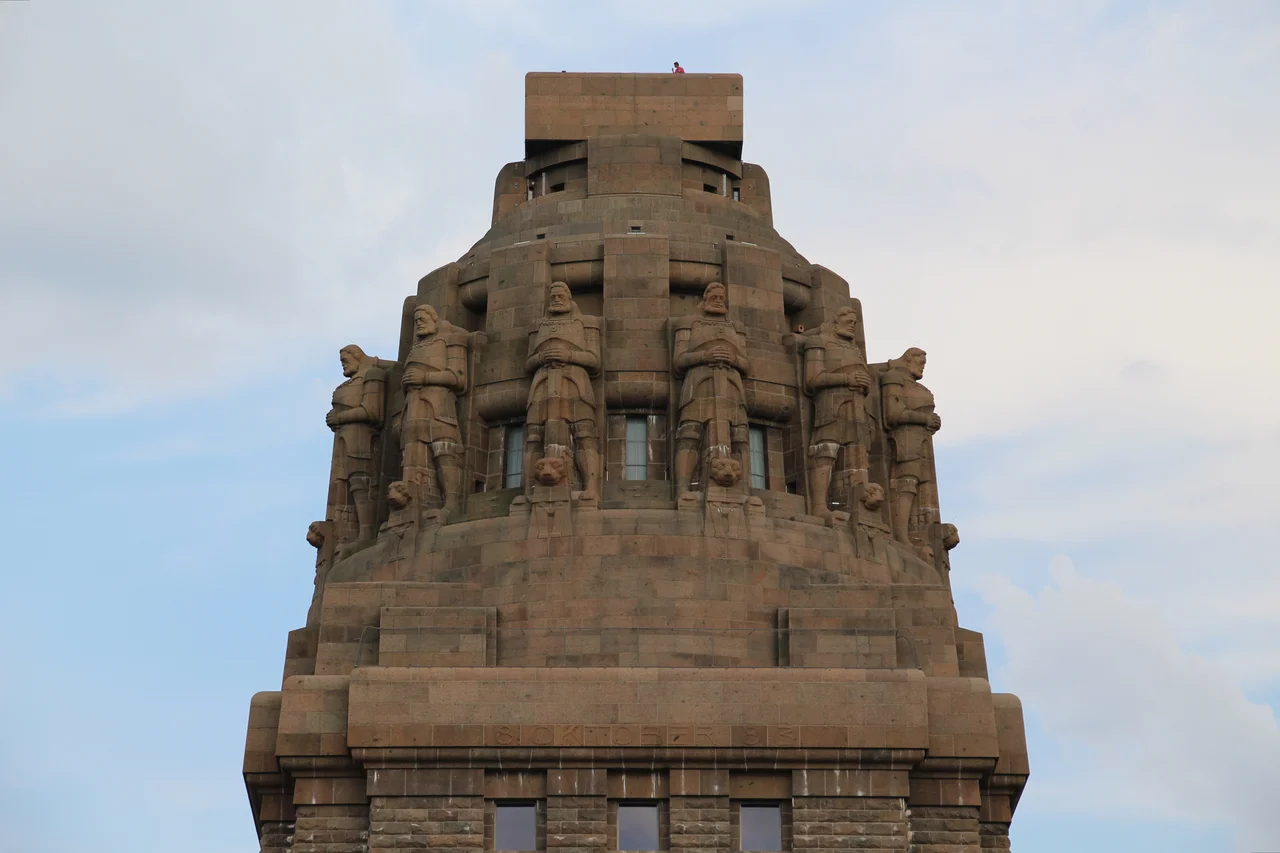
The architect Bruno Schmitz wanted scale that did not flatter human bodies. The base is a 124-meter square. The main structure rises 91 meters into the Saxon sky. Inside, twelve stone warriors thirteen meters tall stand on the dome, each assembled from forty-seven granite blocks. To climb to the observation deck you take 364 steps from the crypt, past statues of guarding warriors that face death masks six meters high, into a hall where the dome contains 324 nearly life-size equestrian sculptures of triumphant horsemen. The monument opened on 18 October 1913, in the presence of Kaiser Wilhelm II and a hundred thousand spectators. Eleven months later, Europe was at war again. The horses on the dome did not seem to know.
The Battle It Marks
Between 16 and 19 October 1813, just outside Leipzig, around half a million soldiers fought what is still the largest battle in European history before the First World War. Napoleon's army of about 200,000, including French and German troops conscripted from the Confederation of the Rhine, faced down a coalition of around 320,000 Russians, Prussians, Austrians, and Swedes, led by Tsar Alexander I and Karl Philipp, Prince of Schwarzenberg. About 110,000 men were killed or wounded across four days, and many more died in the field hospitals afterwards. The Volkerschlacht, the Battle of the Nations, broke Napoleonic power east of the Rhine. The emperor was exiled to Elba seven months later. He returned for the Hundred Days, and lost again at Waterloo. Leipzig was the turn of the tide.
Ninety Years of Trying
Calls for a monument began almost as the bodies cooled. The nationalist writer Ernst Moritz Arndt demanded one within weeks of the battle, asking for something visible from every road into Leipzig, large as a colossus or a pyramid or Cologne Cathedral. Designs were proposed by Caspar David Friedrich, August von Kotzebue, Friedrich Weinbrenner, and others, but no German state would pay. The Wars of Liberation cut both ways politically: liberals saw them as a foundation for a unified German nation, while princes saw the same memory as a threat to royal authority. The Carlsbad Decrees of 1819 outlawed the student fraternities and gymnastic clubs that had carried the memory forward. After German unification in 1871, Leipzig found itself eclipsed by the more recent victory at Sedan. The cornerstone laid by the city in 1863 sat alone in a field for thirty-five years, waiting for someone to build something on top of it.
Clemens Thieme's Patriotic Society
In 1894, a Leipzig businessman named Clemens Thieme heard about the abandoned project at a meeting of the local history association. Thieme was a Freemason and a National Liberal city councilor, and he saw an opportunity. He founded the Deutsche Patriotenbund, the German Patriots Association, the next year, raising six million gold marks through donations and a state lottery. The city of Leipzig donated a forty-thousand-square-meter site. After two design competitions, the commission went to Bruno Schmitz, already known for the Kyffhauser Monument in Thuringia and the Deutsches Eck in Koblenz. Construction began in September 1900. Workers moved 82,000 cubic meters of earth before they hit suitable foundation soil. The structure used 26,500 granite blocks and 120,000 cubic meters of concrete; about ninety percent of it is concrete, then a relatively new material at this scale. The keystone went in on 13 May 1912. Thieme was sixty-one when his great work opened the next year.
What the Sculptures Say
The front facade carries a 19-meter-high relief of the Archangel Michael, sword raised, with the inscription Gott mit uns above his head. To either side, furies hold firebrands while eagles symbolize newly won freedom. The staircase walls are decorated with massive heads of Frederick Barbarossa, the medieval emperor whom German nationalism mythologized as the once and future king. Inside the crypt, sixteen Totenwachter, Guardians of the Dead, stand watch over the symbolic tombs of fallen soldiers. The hall above contains four nine-meter sculptures of the supposed German virtues, bravery, strength of faith, the people's strength, and willingness to sacrifice. Schmitz drew architectural ideas from ancient Mesopotamia and Egypt rather than Greek classicism, deliberately reaching for something that felt older and heavier than what had come before. The Social Democratic press called the monument a 'heap of rocks.' That was not entirely unfair.
Each Regime Made It Theirs
The monument's symbolism has been overwritten by every German regime since it opened. The Patriotenbund used it for war bond rallies during the First World War. The Weimar Republic became the platform for grievances about the Treaty of Versailles. The Nazi Party held its first major Leipzig rally here on 16 July 1933, with Hitler speaking from the steps. In June 1934, Reichsbischof Ludwig Muller led 50,000 Christians here in a service pledging allegiance to the Nazi movement. In April 1945, the monument became the last German position in Leipzig: about 300 Volkssturm men and Hitler Youth boys, under Oberst Hans von Poncet, held out inside until US artillery blew through the wall and von Poncet surrendered. East Germany then refashioned the monument as a celebration of German-Russian alliance, drawing the line directly from Tsar Alexander to the Soviet Union. After 1989 the politics drained out, and what is left is a tourist attraction Leipzigers call, with a kind of weary affection, the Volki.
From the Air
Located at 51.31 N, 12.41 E on the southeastern outskirts of Leipzig, set on an artificial hill above a reflecting pool. The 91-meter granite-and-concrete tower is one of the most distinctive landmarks in central Germany and visible from cruise altitude in clear conditions. Leipzig/Halle (EDDP) is the closest major airport, about 25 km northwest. Best viewed from the south or west; the dark stone reads almost black against the surrounding parkland.
Nearby Stories
- Goseck Circle 7.7 km away
- Freiberg Cathedral 24 km away
- Battle of Mühlberg 26 km away
- Jena 26 km away
- Horch 27 km away
- Eisleben 28 km away
- Lichtenburg Concentration Camp 36 km away
- 2001 American Memorial 63 km away