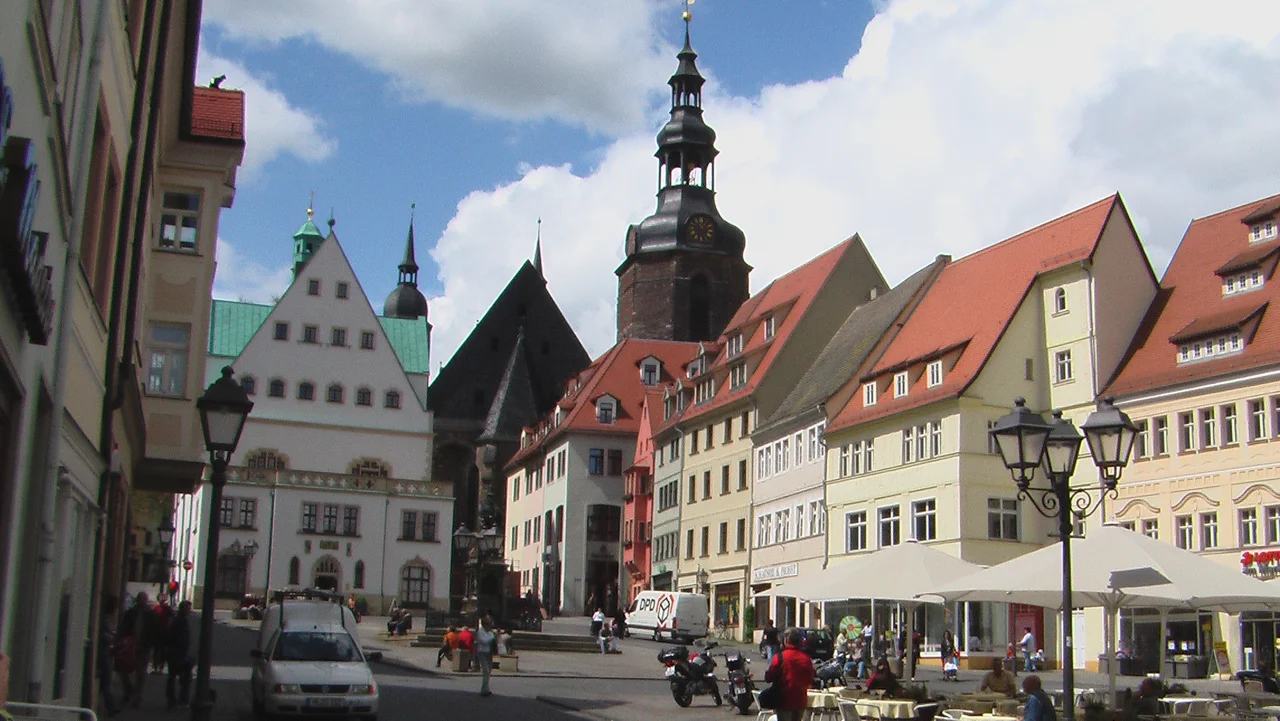

Eisleben
Martin Luther lived in Eisleben for about a year. He was born here on 10 November 1483, in a miner's household; the family moved to Mansfeld before his first birthday and he spent his working life in Wittenberg, a hundred kilometres east. Then, in the winter of 1546, an old and ailing man came back to arbitrate a family quarrel among the counts who owned the district, and died in lodgings a few minutes' walk from the room he was born in. Eisleben got both ends of the most consequential life in German religious history and almost nothing of the middle, which is a strange inheritance for a town of 22,000 - and it has been living on it, deliberately and profitably, for over three hundred years.
Copper in the Shale
The reason there was a town at all was a thin dark seam of Kupferschiefer, copper-bearing shale, running under the eastern Harz foreland. Ore was first opened at Hettstedt around 1200, and the Mansfeld field became one of the great metal districts of medieval Europe. Eisleben appears in the record in 997 as a market called Islebia and was a town by 1180, but its shape came from mining: the Altstadt around St Andreas grew organically, while the Neustadt was laid out around 1511 as a separate settlement for the miners and smelters pouring in. Luther's father Hans was one of them - not a labourer but a small operator leasing furnaces, ambitious for his clever son and furious when the boy dropped law for the monastery. The last copper shaft in Eisleben closed in 1963, and mining ended across the Mansfeld region in 1969, taking most of the local economy with it.
The Counts and Their Debts
The Counts of Mansfeld ruled here until the eighteenth century, and their internal fractures ran straight through the Reformation. Count Hoyer VI of Mansfeld-Vorderort stayed Catholic; the Mittelort and Hinterort branches went over to Luther. Count Albert VII signed the Augsburg Confession in 1530 and joined the Schmalkaldic League, the defensive alliance of Protestant princes that went on to lose the Schmalkaldic War to Emperor Charles V - and then, at the Peace of Augsburg in 1555, won the point anyway, since the settlement let each prince set the religion of his own lands. The counts were also chronically broke. In 1574 four of them concluded an agreement with the Elector of Saxony to work off the family's enormous debts, and forfeited property regardless. The Hinterort line died out in 1666, the Vorderort line in 1780, and Eisleben passed to Electoral Saxony, then to Prussia after the Congress of Vienna.
Coming Back to Die
It was a dispute among those same counts that brought Luther home. In January 1546 he travelled to Eisleben in bad weather and worse health to mediate between the quarrelling brothers over mining rights and revenues, a tedious errand for a man of sixty-two who had reshaped European Christianity. He preached at St Andreas, the church where he had preached before. On 16 February, with Justus Jonas, he signed the founding charter of the town's first Latin school. Two days later, on 18 February 1546, he was dead. The errand he had come to run was only just finished. He was carried back to Wittenberg for burial, lying overnight in the Market Church at Halle on the way, and the crowds that turned out along the road were the first sign of how the town's future would work.
The Invention of Heritage Tourism
Eisleben understood what it had remarkably early. The birth house burned in a town fire in 1689, and by 1693 the town had rebuilt it as a dedicated memorial and museum - centuries before anyone had a word for the practice - and pilgrims of a secular kind have been arriving ever since. Hans Christian Andersen came through in 1831 while touring Saxony and the Harz and looking into the Lutheran sites. The visitor today gets the Geburtshaus and the Sterbehaus, the birth house and the death house, both heavily restored and both, since 1996, on the UNESCO World Heritage list together with the Luther sites at Wittenberg. Two working churches complete the circuit: St Peter and Paul, where he was baptised the day after his birth and where the original font survives, and St Andreas, where he gave his last sermons. The font is the thing worth standing in front of. It is stone, it is plain, and it is the same one.
Helfta
A short way outside town is a place with a different claim, older and quieter. The Counts of Mansfeld endowed a nunnery in 1229 and moved it to Helfta in 1258, and under abbesses including Gertrude of Hackeborn it became a centre of visionary writing - Gertrude the Great and Mechthild of Magdeburg both wrote here, and later admirers called it the crown of German convents. Duke Albrecht of Brunswick destroyed it in 1342; it was rebuilt the following year. The Reformation closed it in 1524, it limped on until 1542, and after that it was farmland - a Prussian state farm from 1712, a GDR fruit farm from 1950. In 1994 the Catholic Diocese of Magdeburg bought the site with donations from around the world, and from about 1999 Cistercian nuns from Bavaria moved back in. After more than four and a half centuries, the choir is being sung again.
From the Air
Eisleben lies at 51.517 N, 11.550 E in the Mansfeld-Suedharz district of Saxony-Anhalt, at roughly 130 m elevation on the eastern edge of the Harz foreland. From 2,500-4,000 ft AGL the town shows as a compact old core with two prominent church towers, ringed by the distinctive spoil heaps of the abandoned Mansfeld copper field - conical grey mounds scattered across otherwise open farmland, the clearest navigation feature in the area. The Harz rises to the west, the Brocken about 70 km distant; the Suesser See sits 8 km east, a useful mark on the run in from Halle. Leipzig/Halle (EDDP) is about 55 km east. Winter fog forms readily in the shallow basins around the lakes; the best light on the spoil heaps is early and late in the day, when they throw long shadows.
Nearby Stories
- Nebra sky disc 8.2 km away
- Bad Dürrenberg burial 8.6 km away
- German National Academy of Sciences Leopoldina 12 km away
- Mittelbau-Dora Concentration Camp 12 km away
- Dessau-Wörlitz Garden Realm 23 km away
- Royal Palace of Werla 31 km away
- Domfelsen 33 km away
- Opfermoor Vogtei 36 km away