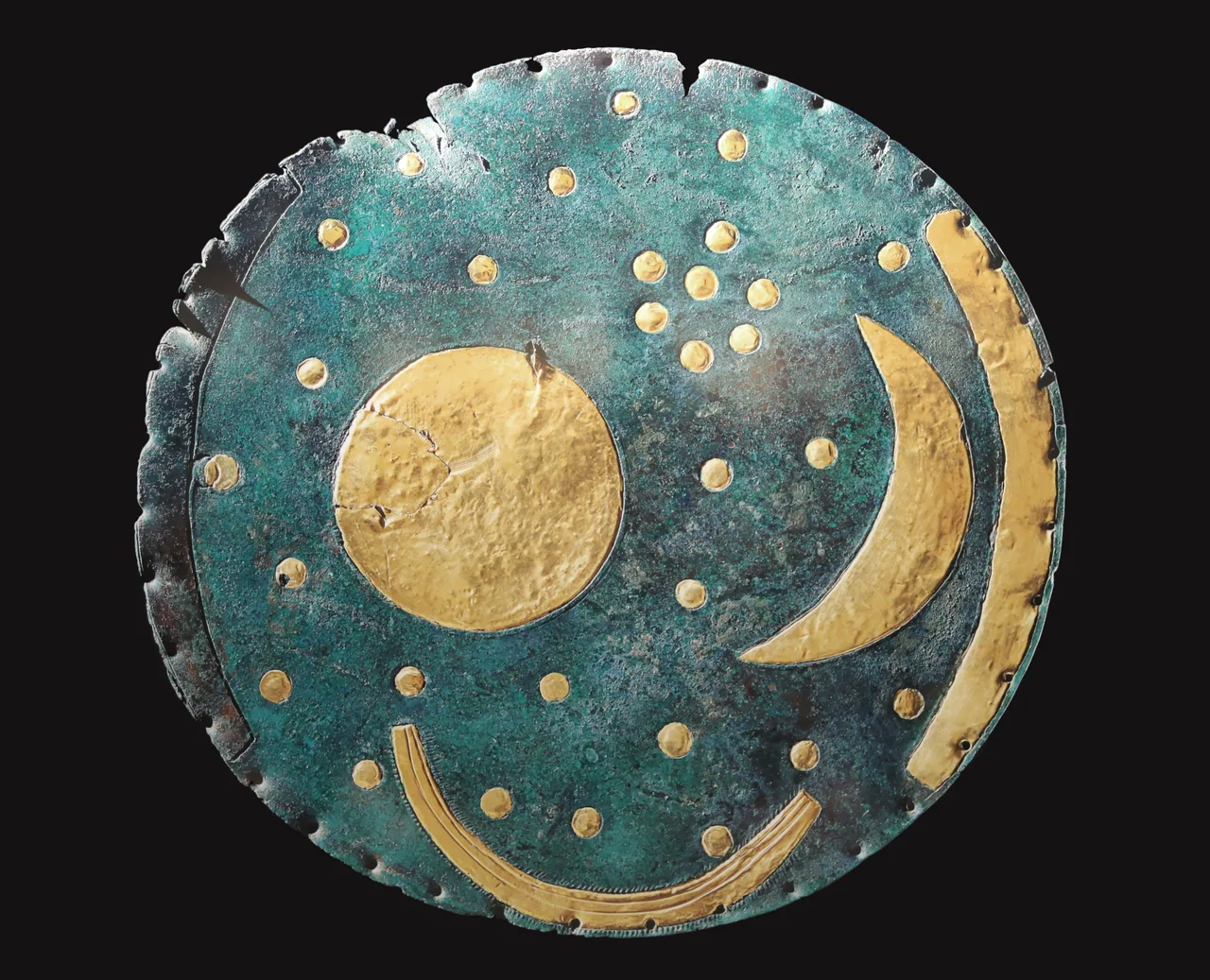

Nebra sky disc
The spade hit it first. Two men were working the Mittelberg with a metal detector in the summer of 1999, unlicensed and well aware that in Saxony-Anhalt everything archaeological in the ground belongs to the state. They struck bronze, gouged the object they had come for, tore up the ground around it, and by the following day had sold the entire hoard to a dealer in Cologne for 31,000 marks. What they pulled out of that hill is now the most famous object in German archaeology: a bronze disc the width of a dinner plate, patinated deep blue-green, inlaid with a gold sun, a gold crescent, and a scatter of gold stars.
The Sting in Basel
The hoard - the disc, two bronze swords, the remains of two sets of axes, a chisel, fragments of spiral armbands - changed hands inside Germany over the next two years, its price climbing toward a million marks. By 2001 word of it had reached the archaeologists. In February 2002 Harald Meller, the state archaeologist of Saxony-Anhalt, met a couple in Basel who were offering the disc on the black market for 700,000 marks; police closed the trap around the sale.
The original finders were traced. In a plea bargain they led investigators back to the Mittelberg, and a proper excavation found exactly what they had described: traces of bronze in the soil, and ground whose chemistry matched the dirt still clinging to the artefacts. A court in Naumburg sentenced the two men to four and ten months in September 2003. They appealed. The appeals court raised the sentences to six and twelve.
Thirty-Two Stars and a Boat
The disc is about 30 centimetres across and weighs 2.2 kilograms. It was not made in one go. The first version carried a large gold circle, a gold crescent, and thirty-two small gold dots, seven of them clustered tightly together - a group almost everyone reads as the Pleiades. Later someone added two gold arcs to opposite rims, shifting one star inward and covering two others to make room. Those arcs span 82 degrees, precisely the angle between midsummer and midwinter sunset at this latitude, 51 degrees north. Later still came a third arc across the bottom, hatched with short parallel strokes and usually read as a boat rowing the sun across the sky, though rainbow, comet, sickle and aurora have all been proposed. By the time it went into the ground it also carried thirty-eight to forty small punched holes around its edge. The gold of that first phase came from the River Carnon in Cornwall, and so did the tin in the bronze - a picture of the central European sky made partly of English metal.
How Old, and How Sure
The swords and axes buried with the disc type to the centuries before 1500 BCE, and birch bark preserved inside the sword hilts radiocarbon-dates to between 1600 and 1560 BCE. That fixes the burial; the disc itself had probably been above ground for generations by then. Archaeologists attribute it to the Early Bronze Age Únětice culture.
The date has been fought over in public. In 2020 the prehistorians Rupert Gebhard and Rüdiger Krause argued that the hoard was not a closed find, that the looters' accounts did not line up, and that the disc might belong to the Iron Age - a thousand years younger. Ernst Pernicka and colleagues published a detailed rebuttal, the state museum noted that the find circumstances had already been tested in open court, and a full interdisciplinary review of metal composition, corrosion chemistry, soil matching and radiocarbon results followed. The Early Bronze Age dating stands. An earlier attack fared worse: a 2005 claim that the patina could be faked with urine, hydrochloric acid and a blowtorch collapsed when its author conceded in court that he had never handled the disc, unlike the eighteen scientists who had.
The Hill Below the Brocken
Mittelberg - "central hill" - is a 252-metre rise in the Ziegelroda Forest, some 60 kilometres west of Leipzig, ringed by an ancient bank-and-ditch enclosure and surrounded by roughly a thousand burial mounds. Stand there on the longest day and the sun goes down behind the Brocken, the highest summit of the Harz, 80 kilometres to the northwest. Hold the disc up aligned to north and the upper end of the western gold arc points at that same mountain. The find spot matters as much as the object.
A Rule for Fixing the Year
What the disc was for is still argued, and the most persuasive reading is a calendar rule. When the Pleiades stand beside a young crescent moon in spring, insert a leap month and pull the lunar year back into step with the sun. That rule is written down in MUL.APIN, a Babylonian compendium from around 700 BC - nine centuries after the disc was buried. Harald Meller suggests the knowledge travelled the trade routes. Some Assyriologists and astronomers reject the comparison outright. Others point to the arithmetic instead: thirty-two stars plus the sun makes thirty-three, and thirty-two solar years run almost exactly as long as thirty-three lunar ones, out by only two days.
Instrument, creed, or both, the disc is the oldest concrete depiction of astronomical phenomena known anywhere in the world. It lives in the State Museum of Prehistory in Halle. In November 2021 a replica rode to the International Space Station with the German astronaut Matthias Maurer - twenty-two years after two men with a metal detector prised the original out of a hillside.
From the Air
The Mittelberg find site sits at 51.284 N, 11.520 E, a wooded 252-metre hill in the Ziegelroda Forest between the Unstrut valley and Querfurt, about 60 km west of Leipzig. From 3,000 to 5,000 feet the terrain reads as rolling farmland with dark blocks of forest and the Unstrut and Saale rivers converging to the southeast; the Harz massif fills the northwestern horizon, and on a clear day the Brocken - the alignment target from the hilltop, 80 km out - is the obvious landmark. Nearest major fields are Leipzig/Halle (EDDP), roughly 52 km east-northeast, and Erfurt-Weimar (EDDE), about 52 km southwest. The site is a stop on the Himmelswege or "sky paths" tourist route linking the region's prehistoric monuments. Summer haze over the Leipzig basin routinely softens the long sightlines that made this hilltop worth choosing.
Nearby Stories
- Haus am Horn 6.1 km away
- Eisleben 8.7 km away
- Bad Dürrenberg burial 9.7 km away
- Mittelbau-Dora Concentration Camp 11 km away
- Opfermoor Vogtei 33 km away
- Dejudaization Institute Memorial 40 km away
- Bauhaus Dessau 42 km away
- Horch 46 km away