
Bad Dürrenberg burial
She was buried sitting up, facing south, her legs drawn beneath her and her arms resting on her thighs, with a baby laid across her lap. Someone packed powdered red ochre around both bodies until the soil ran red. The walls of the shaft were lined with wattle; when it was done the shaft was capped with wood, sealed with loam, and filled in. Nine thousand years later, on 4 May 1934, workmen laying a water pipe through a spa garden at Bad Dürrenberg on the Saale drove their trench straight through her.
One Day to Dig
The gardens were due to reopen the following morning, so the grave got a single day. Wilhelm Henning, a conservator from the state museum in Halle, directed the work, though objects had already been lifted before he arrived. Nobody took a photograph. What survives of that day is a two-page report and a sketch of the plan and profile, and neither records where anything actually lay.
In 2019 archaeologists went back. The garden was due for redevelopment ahead of the 2022 State Garden Show, so they relocated the grave, lifted it in two blocks and excavated it in a laboratory - the slow, controlled dig it never received. The old water-pipe trench was still there, slicing through the burial. They recovered the small bones of hands, feet and spine that 1934 had missed.
What Went into the Ground with Her
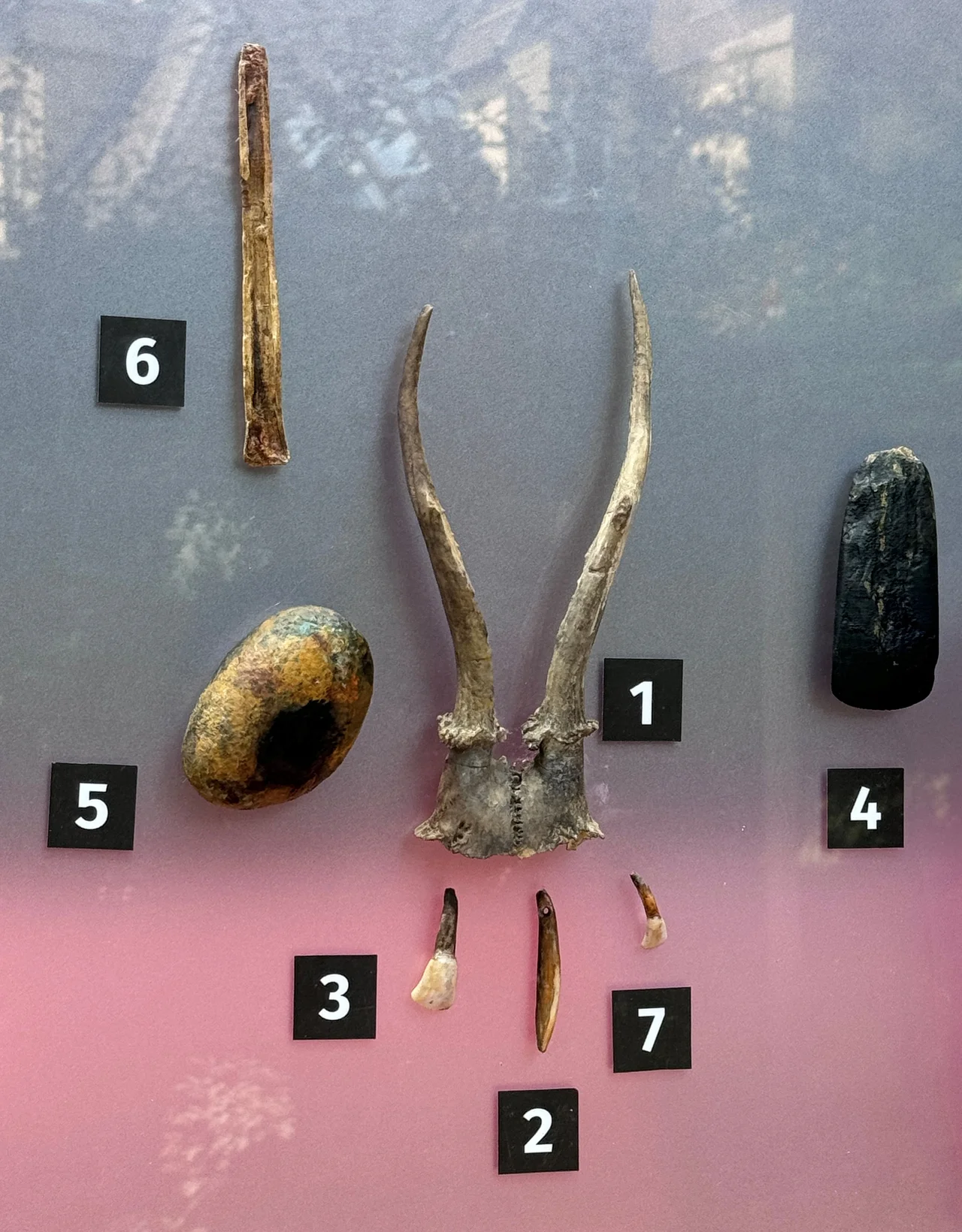
For a Mesolithic grave anywhere in Germany, the assemblage is extraordinary. A polished amphibolite axe blade lay by her right arm. Thirty-one microlith blades had been stored in a container made from a crane's wing bone. There were shaped pebbles and an ochre-stained hammerstone, and more than 140 animal teeth and bones - fifty incisors from aurochs, steppe bison, wild boar, red deer and roe deer, many pierced to be worn, plus six split boar tusks. Some pieces were tools: bone awls, a spatula with ochre still on it. Others were placed purely as offerings - roe deer jaws and shoulder blades, three cleaned pond turtle shells, 120 fragments of mussel shell, parts of a beaver and a hedgehog. And there were the antlers of a two-year-old roe deer buck, skinned and worked, almost certainly the frame of a headdress.
The Weight of a Word
The headdress, the rich grave, and one detail of her anatomy are why she is known as the Bad Dürrenberg shaman. Her uppermost two neck vertebrae never formed completely - large parts of their rear arches are missing, and the opening at the base of her skull is malformed with them. She may have been able to pinch off blood flow to her brain by holding her head at certain angles, which could have produced crawling sensations, loss of coordination, flickering eye movement, or double vision.
It is a plausible chain. An unusual body, unusual experiences, and a community that understood those experiences as contact with something beyond itself. It is also a chain of maybes. "Shaman" is a modern interpretation drawn from antlers and grave goods, not a title anyone wrote down, and in the whole reconstruction the woman is the only certainty.
The Woman Herself
For decades she was a man. The polished axe and blades suggested a Neolithic burial, and the anthropologist G. Heberer read the skull as belonging to a mature male. The regime then in power found that reading useful and worked the grave into propaganda as an Aryan ancestor. Re-examinations in the 1950s and again in the 1990s established that the skeleton was female; radiocarbon dating, first run in the 1970s, moved her out of the Neolithic altogether, to 7000-6800 BC.
She died between thirty and forty. Her muscle attachments are light for a hunter-gatherer, and wear in her lower spine with facets on her leg bones marks someone who spent a great deal of time kneeling. Her growth had never been interrupted by hunger. Ancient DNA points to dark hair, a relatively dark complexion and blue eyes - the ordinary combination among western hunter-gatherers then, shared with Cheddar Man. Her two upper front teeth were worn through to the pulp, and worn fast; the state museum's director has suggested they were filed deliberately, as ritual. Infection got into the open cavities, an abscess spread into her sinus, and Martin Porr and Kurt Alt think that is what killed her.
The Child, and the Long Memory
For a century the infant in her lap was assumed to be her baby. Genetics says otherwise. He was a boy, six to eight months old, a fourth- or fifth-degree relative who shared her mitochondrial lineage - family through the female line, but distant. She may have been his great-great-grandmother, in which case the two were buried at different times, or an aunt or cousin several generations removed, in which case they were alive together. His small skeleton shows signs of vitamin deficiency.
Around 6400 BC, roughly six hundred years after she was buried, someone dug a pit in front of her grave and set two more antler headdresses in it. They knew where she lay. Six centuries is a long time for a place to stay marked in a world without writing. Recent analysis of the antler pieces has turned up songbird and grouse feathers and plant bast fibre: not bare racks of horn but assembled headpieces, worth remaking long after the woman who first wore one was gone. She and the child are on display today in the State Museum of Prehistory in Halle.
From the Air
The burial site lies at 51.294 N, 12.063 E, on a terrace above the east bank of the Saale in the spa gardens of Bad Dürrenberg, 20 km south of Halle. From 2,000 to 3,500 feet the town is easy to pick out by the long straight timber run of its salt graduation tower beside the river - an unmistakable linear structure in an otherwise ordinary industrial-edge landscape, with the Saale winding north toward Halle and the open-cast country of the central German lignite belt spreading east. Leipzig/Halle (EDDP) is close, roughly 19 km northeast, so expect controlled airspace and arrival traffic overhead; Erfurt-Weimar (EDDE) lies about 85 km west-southwest. Winter inversions frequently fill the Saale valley with haze and low stratus.
Nearby Stories
- Battle of Jena-Auerstedt 3.5 km away
- Eisleben 3.8 km away
- Nebra sky disc 7.5 km away
- Colditz Cock 16 km away
- Chemnitz 24 km away
- Torgau 25 km away
- Horch 37 km away
- Bauhaus Dessau 38 km away