
Colditz Cock
The plan required a bathtub. Fill it with concrete, run a cable from it over a pulley to the nose of a glider parked on a runway of dining tables, push the tub off the castle roof, and the falling weight would drag two men to thirty miles an hour in sixty feet of table-top — fast enough, in theory, to carry them off the chapel roof, across the River Mulde sixty metres below, and into a meadow on the far bank. Everything about that sentence sounds like a joke. None of it was. The glider was real, built from bed slats and floorboards behind a false wall in the attic above the chapel at Oflag IV-C, and by April 1945 it was very nearly finished.
The Man Who Was Not a Pilot
The idea came from an officer with no aviation background at all. Lieutenant Tony Rolt, studying the castle the way prisoners study anything they are forced to look at every day, noticed that the ridge line of the chapel roof was completely hidden from the German guards' sightlines. No sentry could see it. Rolt worked out what that meant before anyone else did: a roof nobody watches is a runway. The timing mattered too. After fifty men were murdered following the Great Escape from Stalag Luft III, Allied high command had begun discouraging escape attempts outright. The glider was encouraged anyway — partly as engineering, partly as therapy, a way of aiming the energy of caged men at something other than the walls.
Two Volumes in the Prison Library
Bill Goldfinch and Jack Best led the build, and their most valuable find was not a tool but a book. The camp library held C.H. Latimer-Needham's two-volume *Aircraft Design*, which laid out the physics they needed and, crucially, included a detailed diagram of a wing section. Goldfinch worked up the stress calculations. Lorne Welch, a glider expert who happened to be in the same castle, was asked to check them. Twelve assistants, known to everyone as the "apostles," did the labour; the future RAF air commodore Geoffrey Stephenson helped as well. A false wall went up to hide the workshop, lookouts were posted, and the builders rigged an electric alarm to warn them when guards approached. Their real protection was a habit of mind. The Germans had learned to look down for tunnels. Nobody thought to look up.
Bed Slats and Boiled Millet
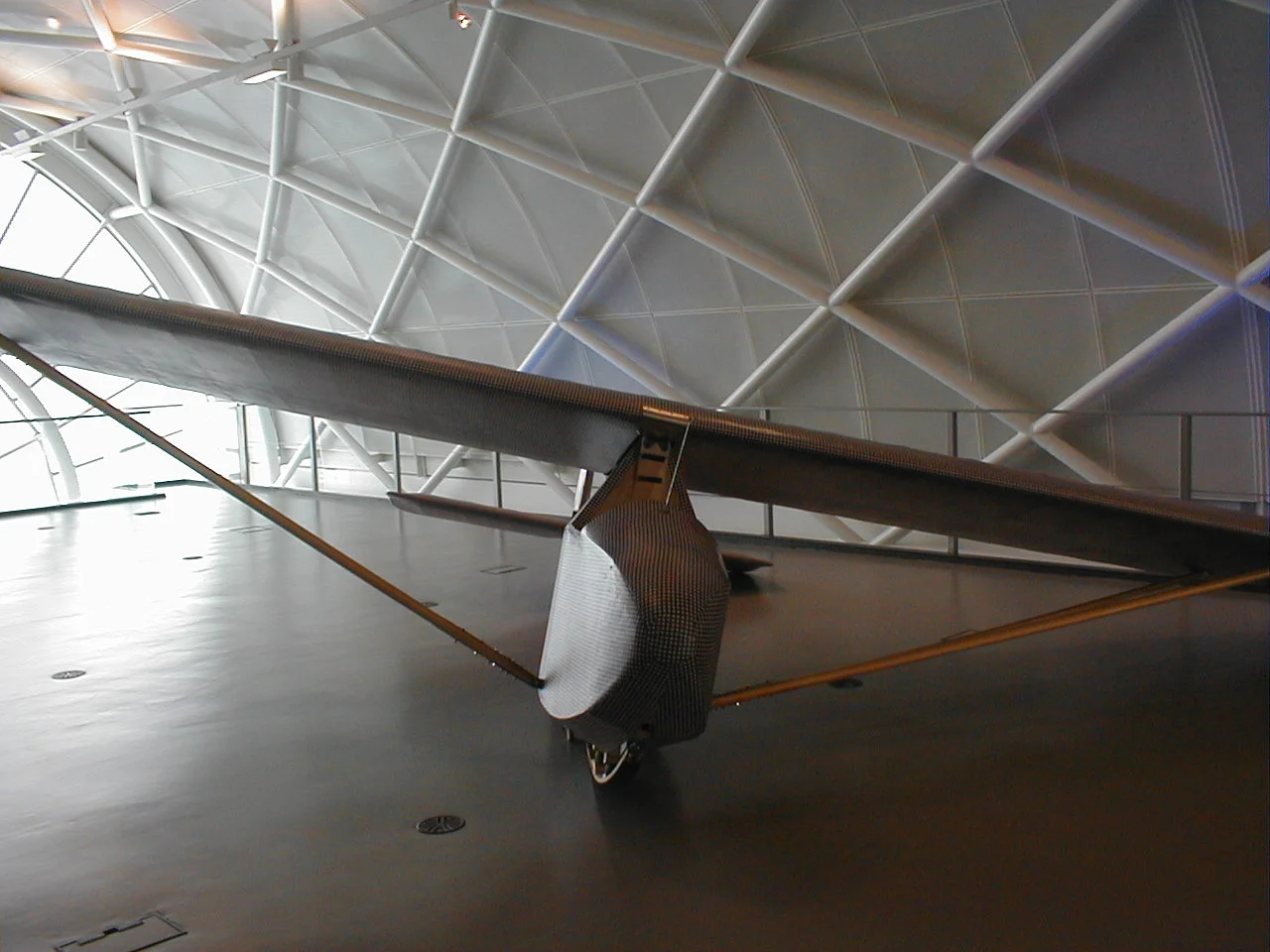
More than thirty ribs had to be shaped, roughly a third of them structural compression ribs, and most came from bed slats. The wing spars were floorboards. Control wires were pulled from the electrical wiring of unused parts of the castle. The skin was blue-and-white checked cotton stripped from prison sleeping bags, and to seal the pores of the fabric — the job aircraft dope does on a real machine — the prisoners boiled their German ration millet into a paste and painted it on. The finished aircraft was a high-wing two-seat monoplane with square elevators and a Luton Major-style rudder, thirty-two feet from tip to tip, nineteen from nose to tail. It weighed 240 pounds. The prisoners called it the Colditz Cock.
The Flight That Never Happened
Take-off was pencilled in for spring 1945, during an air-raid blackout. By then the Allied guns were audible from the courtyard and the outcome of the war was no longer in doubt, which changed the glider's purpose entirely. The British escape officer decided it should be held in reserve for one contingency only: if the SS ordered the prisoners massacred, two men would go off the roof to carry word to the approaching Americans. The order never came. The American Army reached the castle on 16 April 1945. War correspondent Lee Carson, attached to the task force, had walked in a day earlier and climbed to the attic, where she took the only photograph of the completed glider that exists. After that the trail goes cold. Colditz fell inside the Soviet zone, no cooperation was forthcoming, and what became of the aircraft is simply unknown.
Fifty-Five Years Late
Goldfinch had kept his drawings, and they turned out to be the thing that survived. A one-third scale model built from them was launched off the castle roof in 1993. Six years later Channel 4 commissioned a full-size replica, built by Southdown Aviation at Lasham Airfield, and in 2000 John Lee flew it successfully at RAF Odiham on the first attempt while Best, Goldfinch and about a dozen of the men who had shaped those ribs stood and watched. Jack Best died later that year. Then, in March 2012, Tony Hoskins' South East Aircraft Services built another full-size replica in the chapel attic itself, radio-controlled and unmanned, and launched it from the roof Rolt had picked out seventy years earlier. It crossed the river and landed in a meadow 180 metres below — the flight exactly as designed, seven decades late. That glider is now on display in the attic where it was built, opened to the public in April 2015 on the seventieth anniversary of the castle's liberation. Goldfinch's original plans are held by the Imperial War Museum.
From the Air
The chapel attic sits inside Colditz Castle at 51.131°N, 12.807°E, about 192 m above sea level on a spur above the Zwickauer Mulde in Saxony. The intended flight path ran from the chapel roof, on the river side of the castle, across the Mulde some 60 m below to the meadows on the far bank — a line of about 200 m that is easy to trace from 2,000–4,000 ft AGL, with the castle's pale walls above the wooded bend and the town's red roofs downstream. Leipzig/Halle (EDDP) lies roughly 50 km north-west, Leipzig–Altenburg (EDAC) to the south-west, Dresden (EDDC) about 65 km east. Morning valley fog along the Mulde is common in autumn; afternoon light favours the river-facing roofline.
Nearby Stories
- Meissen porcelain 13 km away
- DKW 18 km away
- Ore Mountain Toy Museum, Seiffen 18 km away
- Battle of Lutzen 25 km away
- Francke Foundations 29 km away
- Torgau 29 km away
- 2001 American Memorial 45 km away
- Walpersberg 53 km away