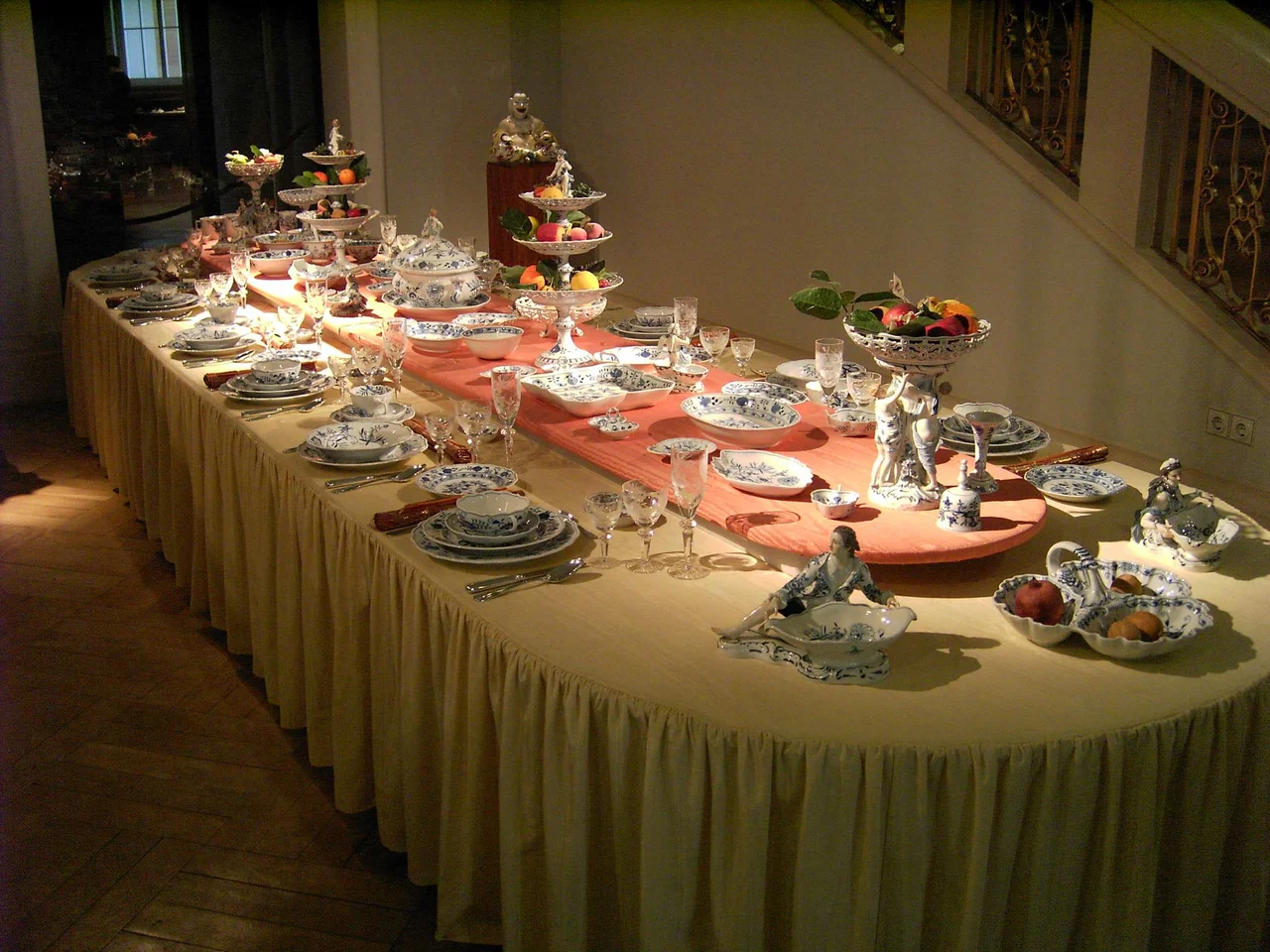

Meissen porcelain
Augustus the Strong wanted gold. Around the turn of the eighteenth century he had a young apothecary's apprentice named Johann Friedrich Böttger detained and brought to Dresden, because Böttger had been claiming he could make it out of worthless material, and a ruler with expensive tastes was not inclined to let such a claim wander off. Böttger could not make gold. Nobody could. What he could do, after years in the Elector's custody and under the supervision of a genuine scientist, was work out how to fire a white, translucent, ringing-hard ceramic that Europe had been trying and failing to reproduce for two centuries. The kilns went up inside a fortress on a rock above the Elbe, and Saxony has been selling the result ever since.
The Prisoner and the Mathematician
The man who supplied the science was Ehrenfried Walther von Tschirnhaus, a mathematician who had spent years experimenting with glass and high-temperature furnaces, and whose ingredient list already included kaolin — the china clay that makes true porcelain possible — though he had never made it work. Tschirnhaus was set to supervise the reluctant Böttger, and by 1707 the two were working together in earnest. In November of that year Böttger fired a hard red stoneware. Then Tschirnhaus died, in October 1708, and within days the recipe was in Böttger's hands alone. In March 1709 he sent word to the king that he could make porcelain. Augustus founded the Royal-Polish and Electoral-Saxon Porcelain Manufactory that same year, installed the laboratory in the Albrechtsburg at Meissen, and production began in 1710. Böttger ran Europe's first porcelain works and died in Dresden in March 1719, aged thirty-seven, having spent most of his adult life as the king's property.
White Gold
It is hard now to feel how badly Europe wanted this. Chinese and Japanese export porcelain arrived by the shipload with the Dutch East India Company and its rivals, and by the time a cup reached a European table it cost a fortune and announced its owner's wealth in a single object. Attempts to copy it had failed repeatedly; the Medici experiment in Florence produced something, but not this. Meissen's formula was therefore a state secret. The Albrechtsburg was a castle, and it was used as one: the arcanum was broken into parts so that only a handful of workers understood any of it, and almost nobody understood all of it. The monopoly lasted seven years. In 1717 Samuel Stöltzel, the head arcanist himself, sold the recipe to a rival works in Vienna. By 1760 roughly thirty porcelain factories were operating in Europe, though most were still making the softer, frit-based imitation.
Two Blue Swords
Meissen's defence against the copyists was a mark. Early pieces carried painted initials — AR for Augustus Rex, K.P.M. for the royal manufactory — before the factory settled in 1720 on two crossed swords lifted from the arms of the Elector of Saxony in his ceremonial role as Arch-Marshal of the Holy Roman Empire. From 1731 the swords were required by decree, and they have been painted in underglaze blue on the base of Meissen ware ever since, which makes them one of the oldest trademarks still in use anywhere. The small variations matter: the angle of the hilts and the shape of the blades let a collector date a piece within a decade or two. Eighteenth-century painters, who did not think the mark important, often slapped it on carelessly. The factory only grew strict about it after a customer asked to have his swords adjusted to look older than they were.
Kändler's Menagerie
The porcelain was the invention; the figures were the fame. Johann Gregor Höroldt arrived as director in 1720 and introduced brilliant overglaze colours in 1723 — his enamel formulations still underlie modern ceramic paints. Johann Joachim Kändler became chief modeller in 1733 and stayed for forty-two years, and it was Kändler who understood what the material could do. His small figures were made first as table decoration, replacing the sugar sculptures that had ornamented grand dinners, then escaped the banqueting hall entirely to sit on mantelpieces in houses that could never have afforded a full dinner service. For the Japanese Palace Augustus was building, Kändler modelled a menagerie of animals at close to life size, pieces so large they strained what a kiln could physically survive. He also gave the world the Monkey Band of the 1750s, a comic orchestra of monkeys in court dress, copied by half the porcelain works in Europe.
Occupations and Owners
For a factory selling luxury, Meissen has had a violent three hundred years. Prussian troops occupied the town in 1756, and Frederick II used the opportunity to move artisans north and found his own royal manufactory in Berlin. Count Marcolini ran the works from 1774 until 1813, when he followed the Saxon king into exile after the Battle of Leipzig. The manufactory left the Albrechtsburg in the nineteenth century for purpose-built works down in the valley. After 1945 most of its equipment was shipped to the Soviet Union as reparations — but the kilns that could not be dismantled stayed, workers using traditional methods restarted production in 1946, and for years almost everything made went east, which is precisely what kept the craft alive. VEB Meissen Porzellan became one of the few dependably profitable enterprises in East Germany. Since 1991 the Free State of Saxony has been sole owner, and the Swan Service ordered by Count Brühl in 1737 is still made from the surviving moulds.
From the Air
Meissen lies at 51.156°N, 13.466°E on the Elbe, about 25 km north-west of Dresden. The landmark from the air is the rock above the old town, where the late-Gothic Albrechtsburg and the twin spires of Meissen Cathedral sit together on the same outcrop — Böttger's original laboratory was inside the castle. The modern manufactory stands in the valley south-west of the centre, near the Triebisch. Dresden (EDDC) is roughly 20 km south-east; Leipzig/Halle (EDDP) about 90 km north-west. The Elbe valley runs north-west to south-east here and channels morning fog; 2,000–4,000 ft AGL gives the best view of the castle rock, with afternoon light on the river-facing façades.
Nearby Stories
- Bastei 1.1 km away
- Torgau 6.3 km away
- Freiberg Cathedral 15 km away
- Karl Marx Monument, Chemnitz 17 km away
- Colditz Cock 19 km away
- Bautzen 26 km away
- 2001 American Memorial 27 km away
- Wendish-German double church 31 km away