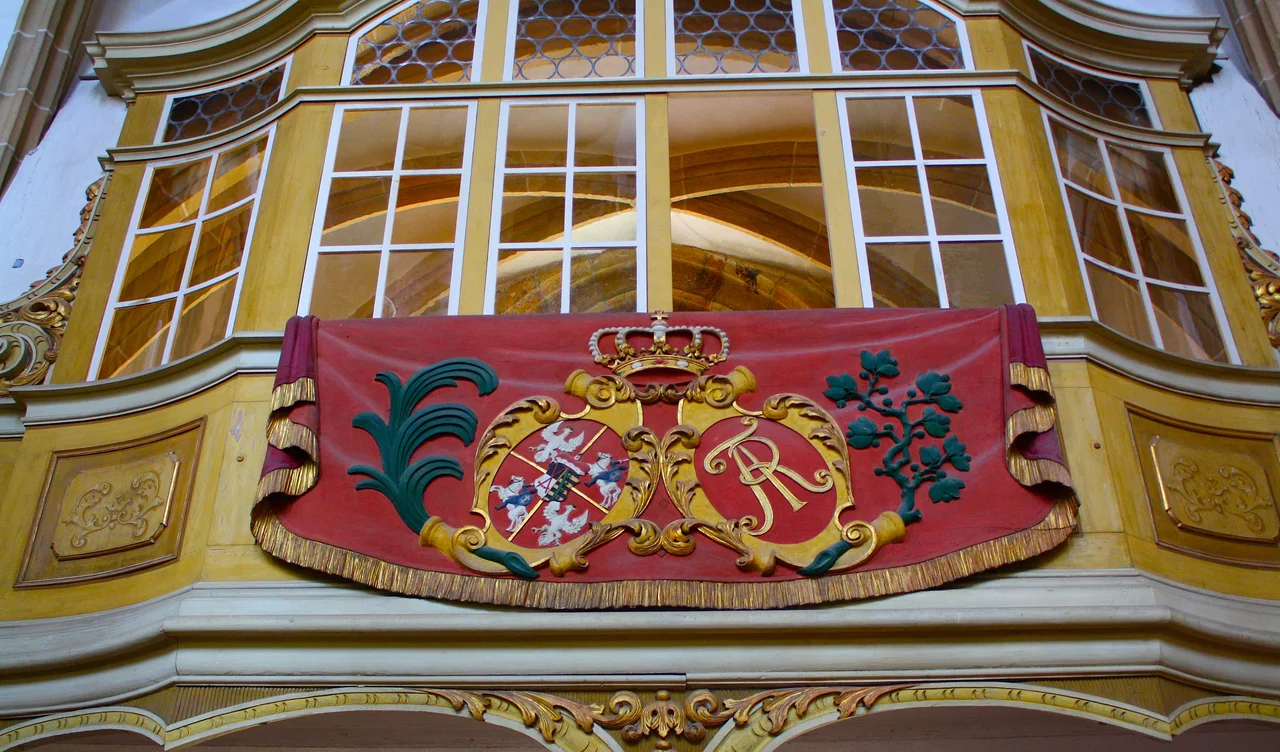

Freiberg Cathedral
A stone tulip grows out of the floor of Freiberg Cathedral. Its stem twists up from the nave, its leaves curl outward, and where the bloom opens there is a platform with room for a preacher. Master H.W. cut it in 1505 from a pale tuff quarried at Chemnitz-Hilbersdorf, and it is the most extravagant object in a church that has no shortage of them. A hundred and thirty-three years later a second pulpit went up in the same nave — the Bergmannskanzel, the Miner's Pulpit, carved by Hans Fritzsche in Saxon sandstone in 1638. A flower and a mineshaft, facing each other across the aisle. That is Freiberg's entire biography in two pieces of stone: silver came out of the ground here, and everything else in this building was paid for with it.
Silver Under the Mountains
Freiberg exists because someone found silver in the Ore Mountains, and the town grew fast enough on the proceeds that by about 1180 it was building a basilica of Our Lady. Two works from those first decades survive and are still the finest things here. The Goldene Pforte, the Golden Gate, is a late Romanesque sandstone portal on the south side, dense with sculpture and ornamented columns that were once painted in strong colour; since 1902-03 it has sheltered under an extension built specifically to keep the weather off it. The Triumphkreuzgruppe, the crucifixion group, dates from around 1225. In 1480 the church was raised to collegiate status, which is why German-speakers call it a Dom — a word used for collegiate churches as well as cathedrals — even though no bishop ever had his seat here. The college lasted 57 years. The Reformation in the Electorate of Saxony dissolved it.
The Fire of 1484
The great fire of 1484 came close to erasing the building entirely. What came through it was the oldest part: the Golden Gate, the crucifixion group and sections of the quire. Everything else had to be rebuilt, and the replacement went up on the same ground in a different idiom altogether — a triple-naved Gothic hall church, three aisles of equal height, the open and airy plan that late medieval Saxony favoured. The Tulip Pulpit followed in 1505, barely twenty years after the fire. The building visitors walk through is therefore two churches spliced together: a Romanesque doorway and a Romanesque crucifix embedded in a late Gothic hall, with a century and a half of Renaissance and Baroque furnishing layered on afterwards.
Silbermann's Room
Gottfried Silbermann was born in 1683 at Kleinbobritzsch, in the hills south of Freiberg, learned the trade from his brother Andreas in Strasbourg, and opened his own workshop in Freiberg in 1711. He built around fifty organs in his lifetime, of which some thirty-five survive, and the one he completed at Freiberg in 1714 is generally counted among his greatest. It has three manuals and more than forty stops, and it is a deliberate hybrid: the reeds voiced in the French manner he learned in Alsace, the foundation stops reinforced in the German way, with Quintadena stops and conical reeds that could only have come from a German shop. It was originally tuned in meantone temperament with the A at about 473 Hz, and today it sounds a slight variation of that same system with the A at roughly 476 Hz — close enough to its 1714 self that the instrument still argues with modern ears. A second, smaller Silbermann organ faces it across the church.
The Angels' Instruments
Look up in the quire and the ceiling is neither wholly painted nor wholly carved but both at once, in an Italian mannerist manner, with the join between wall and ceiling masked by a crowd of music-making angels along the uppermost ledge of the epitaph architecture. The instruments in their hands turned out to be more than decoration. Analysis established that they are real Renaissance instruments, or imitations good enough to pass for them, and the carvings were detailed enough to serve as working blueprints. Researchers in Leipzig examined the figures and built playable replicas from what they saw, recovering the sound of an ensemble of the period from a church ceiling. It is a strange kind of survival — a Saxon woodcarver, working to fill an awkward architectural corner, preserved the shape of an orchestra by accident.
Nine Electors and the Great Susanne
Between 1541 and the conversion of Augustus II the Strong to Catholicism, nine rulers of Saxony were buried in the quire, and the walls around them are thick with epitaphs and ducal sculpture; monumental brasses form the floor. Maurice, Elector of Saxony, lies here beneath a monument of his own. Augustus's mother and her sister rest in the sisters' crypt in the All Saints chapel, under a tomb by the Saxon Baroque sculptor Balthasar Permoser that was originally made for the monastery at Prettin and moved to Freiberg in 1811. Overhead hang six bells, four of them from the Hilliger foundry, the heaviest being the Große Susanne at five tonnes. The Dom is not a monument to be visited and left. It is still the parish church, still holding services, and open daily for guided tours in between.
From the Air
Freiberg Cathedral stands at 50.920°N, 13.343°E on the Untermarkt in Freiberg, a mining town on the northern slope of the Erzgebirge at roughly 400 m elevation. Dresden (EDDC) is about 38 km northeast — the closest useful field — with Leipzig/Halle (EDDP) around 100 km northwest. From the air, Freiberg is easy to pick out by its surroundings rather than its skyline: centuries of mining have left spoil heaps and shaft-head structures scattered across the fields around the town, and the pattern is unmistakable once you know to look for it. The cathedral's steep roof and tower sit at the southeast corner of the old town, with the Obermarkt and its town hall a short distance northwest. Recommended viewing altitude is 2,000-3,500 ft AGL. Terrain climbs south into the Erzgebirge toward the Czech border; the range reaches 1,215 m at the Fichtelberg about 45 km southwest, and cloud tends to build against the northern slope in southerly flow.
Nearby Stories
- A. Lange & Söhne 6.4 km away
- Meissen porcelain 20 km away
- Horch 21 km away
- Battle of Leipzig 25 km away
- 2001 American Memorial 45 km away
- The Defenestration of Prague: The Thrown Men Who Started a Thirty Years' War 77 km away
- The Anschluss: When Austria Vanished Overnight 281 km away
- Zwingenberg Castle 291 km away