.JPG)
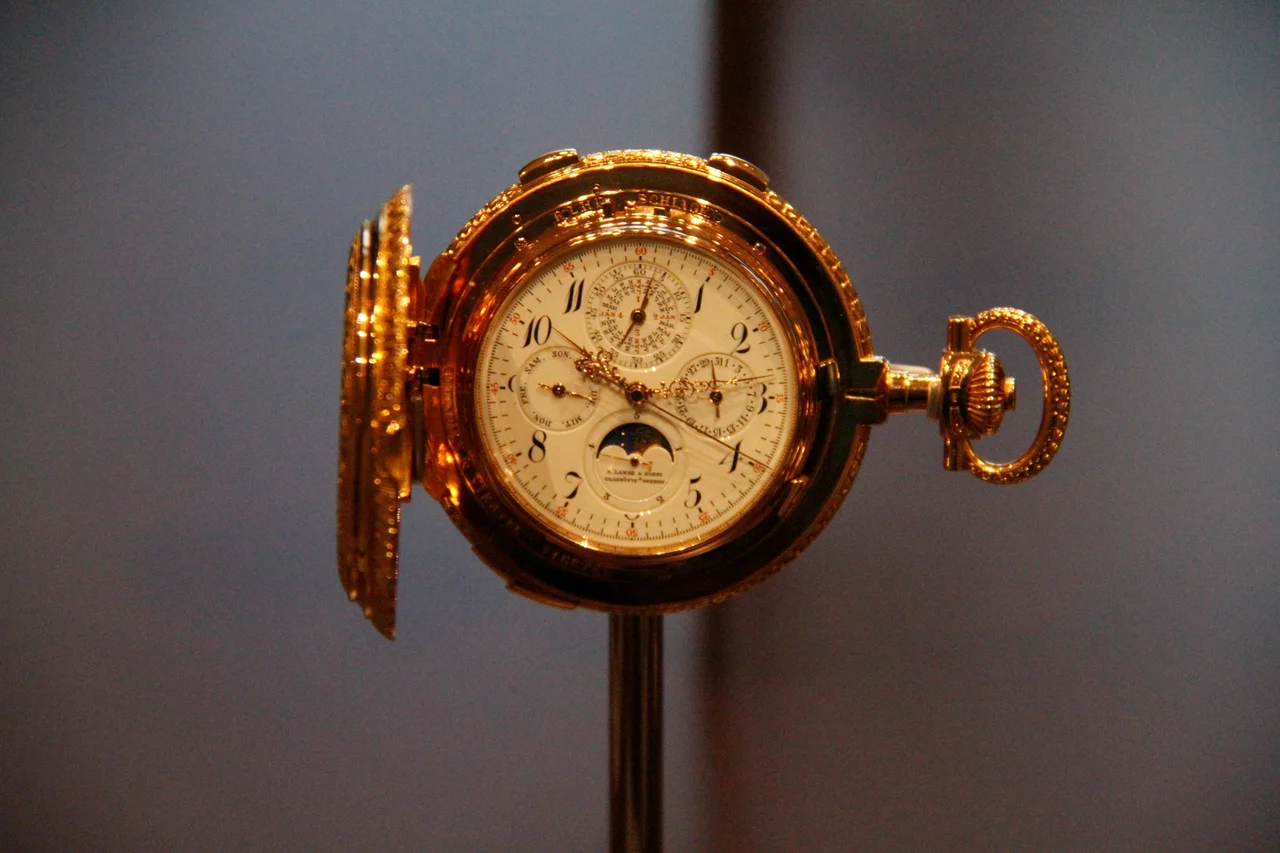
A. Lange & Söhne
Ferdinand Adolph Lange came back to Dresden in 1841 with a notebook full of French gear calculations and a proposal nobody in government had asked for. He wanted a licence to start a watchmaking industry in the Ore Mountains, in a valley where the silver had run out and the work had gone with it. His letter to the ministry pitched the idea as welfare rather than luxury: grant the means to establish an institution for ten or fifteen young people, put him in charge, and "livelihood and prosperity will spread among a large number of these unfortunate people." He got the licence. On 7 December 1845 he founded A. Lange & Cie in Glashütte, and for the next hundred years the fortunes of the town and the family were the same thing.
The Apprentice and the Five-Minute Clock
Lange was born in Dresden on 25 February 1815, and after his parents separated he was raised by a foster family who put him through school. At fourteen he entered the city's technical institute, which split its students' week between theory and bench work. His master was Johann Christian Friedrich Gutkaes, the maker of the five-minute digital clock that still counts the hours above the stage of the Semperoper. Lange finished his apprenticeship with honours in 1835, then spent his journeyman years abroad — four of them in Paris running the workshop of Joseph Thaddäus Winnerl, inventor of the split-seconds chronograph, and attending lectures by François Arago at the observatory. What he brought home was not just skill but a system. French watchmakers still measured in ligne; Lange converted to the metric system, and built himself a micrometer that read to a thousandth of a millimetre.
The Three-Quarter Plate
In 1864 he replaced the tangle of separate bridges holding a movement's gear train with a single plate covering three quarters of the calibre. Assembly got harder. Stability got better, and the three-quarter plate became the signature of Glashütte watchmaking, as recognisable as a maker's mark. His sons split the work between them: Emil ran the business and was made a Knight of the French Legion of Honour for his service as a juror at the Paris world fair, while Richard chased his father's technical problems. Richard's most consequential idea was metallurgical — he was the first to realise that adding beryllium to a nickel-steel alloy made hairsprings less sensitive to temperature swings and magnetic fields while improving their elasticity. His patent was granted in 1931, and it underlies the balance springs still used today. Wilhelm II, Alexander II of Russia, and Sultan Abdul Hamid II all carried Lange watches.
Who Made the Chronometers
The First World War collapsed the market for gold pocket watches, and the 1920s and 1930s emptied the workshops. Walter Lange, the founder's great-grandson, remembered the period as a childhood injury: looking out of the living-room window at the unemployed men lined up across the street, waiting. "I will never forget that view." The Second World War brought orders back — about 13,500 precision observation watches, the *Beobachtungsuhren* navigators wore, along with timers and fuses. Those chronometers were built with forced labour. Glashütte held more prisoners than residents in those years, and most of them were women who had been brought to Saxony from elsewhere in occupied Europe. The precision the valley traded on was, for a period, taken from people who had not chosen to come and were not free to leave. On 8 May 1945, the last day of the war, a Soviet air raid destroyed the main production building.
Forty-Two Years Off the Dial
What the bombing left, the peace took. Saxony's watch companies were nationalised in 1948, and the last movement the firm developed — Calibre 28, a wristwatch version of the big observation calibre — went into production in 1949 under a different signature entirely: "Lange VEB," for *Volkseigener Betrieb*, publicly owned enterprise. In 1951 the seized companies were merged into VEB Glashütter Uhrenbetriebe and the family name came off the dials altogether. It stayed off for four decades. The town kept making watches; the skills did not vanish, and neither did the three-quarter plate. But the name that had been the point of the whole exercise in 1845 existed only in auction catalogues and in the memories of people who had worked there.
Seven December, Again
Walter Lange refounded the company on 7 December 1990 — one hundred and forty-five years to the day after his great-grandfather signed the original papers, and less than two months after German reunification. He did it with Günter Blümlein, a watch executive, and with help from Swiss manufacturers including IWC and Jaeger-LeCoultre, which is a sentence that would have startled anyone in 1845. The new Lange Uhren GmbH re-registered the old trademark and set up again in Glashütte. Richemont took ownership in 2000. Production runs to roughly five thousand watches a year, every movement designed in-house, cases in gold or platinum, balance cocks engraved by hand so that no two are identical. The outsize date on the dial is borrowed from the stage clock Gutkaes built for the Semperoper. Walter Lange died in 2017, aged ninety-two. His personal motto was "Never Stand Still."
From the Air
Glashütte sits at 50.851°N, 13.781°E, in the narrow Müglitz valley in the eastern Ore Mountains, about 30 km south of Dresden and roughly 15 km north of the Czech border. From 2,000–4,000 ft AGL the town reads as a thin ribbon of red roofs threaded along a steep wooded cleft, with the Müglitz railway line following it — there is almost no flat ground, which is exactly why the valley was poor enough to need Lange's proposal. Dresden Airport (EDDC) lies about 30 km north; Leipzig/Halle (EDDP) is roughly 115 km north-west, and Prague (LKPR) about 90 km south. The valley fills with fog in autumn mornings and the ridges above it hold snow into March, so plan for low ceilings between the hills.
Nearby Stories
- Bautzen II 3.3 km away
- Freiberg Cathedral 3.7 km away
- Moritzburg Castle 15 km away
- Oybin 24 km away
- Battle of Mühlberg 33 km away
- The Defenestration of Prague: The Thrown Men Who Started a Thirty Years' War 70 km away
- The Battle of Vienna: The Cavalry Charge That Saved a Continent 300 km away
- Salzburg 314 km away