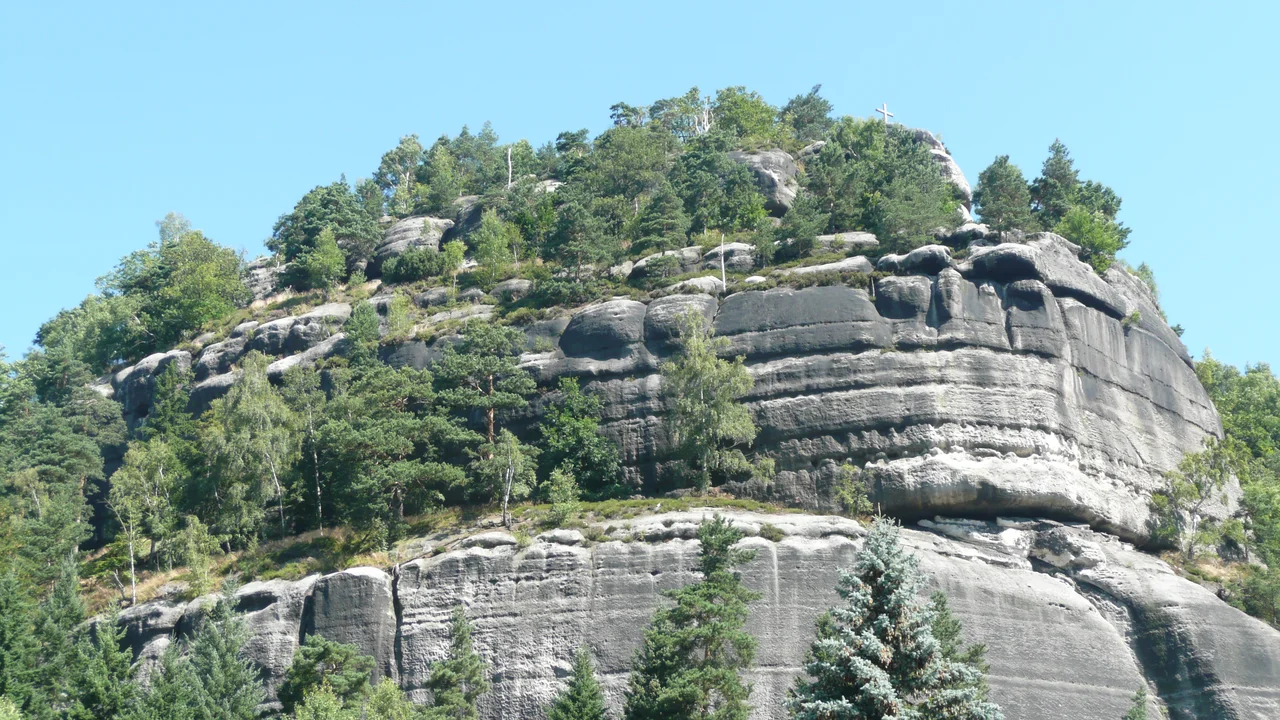

Oybin
On certain nights the villagers put on white habits, light torches, and walk up the mountain in a line - a procession of monks for a monastery that has been a ruin since the Reformation. The rock above Oybin is a bare sandstone dome, rounded like a hive, and on its summit sit the broken walls of a Celestine house founded by an emperor. Nobody has said mass up there in roughly five hundred years. The village keeps the walk anyway, which tells you something about how thoroughly this place has decided that its ruin is the point.
Moybin, 1290
The rock was fortified long before it was consecrated. A castle here appears in the record in 1290 under the name Moybin, and shortly after 1291 Heinrich von Leipa rebuilt it - the Bohemian nobility of the Ronovci family, whose sons Chval of Lipá and Čeněk of Oybin took their names from these hills. In 1319 the place passed to the Duchy of Jawor, the southwesternmost of the fragmented duchies of Piast-ruled Poland, and after that the crown above it kept changing: Bohemian, Hungarian, Saxon, Polish. This is border country in the oldest sense. The village today sits in Saxony at 389 metres, a few kilometres from the Czech frontier, with about 1,270 residents spread across three districts - Oybin, Hain and Lückendorf - and a history of belonging to whoever last won.
An Emperor's Monastery on a Rock
Charles IV, Holy Roman Emperor and King of Bohemia, took an interest. He had the castle extended, and in 1369 he founded a Celestine monastery on the summit - an austere Benedictine reform order, installed on a dome of rock reachable only by a cleft in the stone. It was an odd and expensive gesture: imperial patronage delivered to one of the least convenient addresses in central Europe. The monastery lasted nearly two centuries. The Reformation dissolved it, the last monk left in 1559, and the buildings and the castle were allowed to fall in together. What remains is a shell of extraordinary quality - the tall traceried windows of the church still standing open to the weather, the walls following the curve of the rock they were built on.
A Border People Crossed to Survive
The Reformation that emptied the monastery eventually pushed people the other way over the same ridge. After the Habsburg victory over the Protestant armies at the Battle of the White Mountain in 1620, Protestant Czechs left Bohemia rather than convert, and many found refuge across the border in the hills of Upper Lusatia. It is worth pausing on what that meant: families walking out of the country they were from, over these wooded passes, because staying had become impossible. The traffic left its mark on the whole region. A century later, another wave of Moravian refugees would be given land some twenty kilometres north of here and would found Herrnhut, which sent missionaries around the world. Oybin's mountain and its ruin sit at the top of a corridor that people used when they had run out of other options.
The Painters' Ruin
The Romantics could hardly have invented a better subject if they had tried, and they came in numbers. Caspar David Friedrich worked here, and the Oybin gave him everything his painting wanted: Gothic tracery with sky behind it, stone dissolving into forest, the whole vocabulary of time and loss arranged on a single hilltop. The village leaned into its own image and never stopped. A camera obscura still operates in the village, projecting the mountain onto a table indoors - a nineteenth-century optical amusement kept working into the twenty-first. Below the summit stands the Bergkirche, a baroque mountain church built in 1734 at the foot of the ascent, and Oybin holds the state certification of Kurort, a recognised spa resort, which is the formal way of saying that people have been coming here to feel better for a very long time.
Chalice Rock, Broody Hen, Devil's Mill
The Zittau Mountains are the smallest range in Germany and, in local opinion, the best-looking, and the rock around Oybin has been named with real affection. There is the Kelchstein, a red mushroom-shaped tower among the Rosensteine known as the Chalice Rock; the Handschuh-Felsen, the Mitten; the Brütende Henne, the Broody Hen, on the Töpfer; and the Teufelsmühle, the Devil's Mill. The Große Felsengasse is a narrow canyon alley containing a chamber called the Muschelsaal, the Shell Hall, and a via ferrata named the Alpiner Grat. Hochwald carries a lookout tower and two mountain huts; Scharfenstein and Ameisenberg fill in the ridgeline. The proper way to arrive is the narrow-gauge steam railway, opened in 1890, which runs from Zittau via Bertsdorf to Oybin and Jonsdorf at a deliberate sixteen kilometres an hour. There is a small museum at the station. Nothing here is in a hurry, including the trains.
From the Air
Oybin lies at 50.84 N, 14.74 E in the Zittau Mountains of southeastern Saxony, hard against the Czech border and about 12 nm west-northwest of Liberec. Best viewed between 1,500 and 3,000 feet AGL. The village sits at 389 metres, and the navigation mark is the Oybin rock itself - an isolated, rounded, pale sandstone dome standing clear of dark conifer forest with ruined walls and a roofless church visible on its crown. The wooded ridge of the Hochwald rises to the south on the border, its lookout tower a useful secondary mark, and the town of Zittau lies about 8 km northeast on the flat. Nearest airports are Liberec (LKLB) about 12 nm east-southeast in the Czech Republic, Bautzen (EDAB) about 23 nm northwest, and Dresden (EDDC) about 41 nm west-northwest. This is genuine mountain terrain in miniature: expect valley cloud filling the basins on autumn mornings, and rapid deterioration in visibility when weather moves up from Bohemia over the border ridge.
Nearby Stories
- Königstein Fortress 3.4 km away
- Bautzen II 11 km away
- Jizera Dark-Sky Park 18 km away
- Moritzburg Castle 27 km away
- Stalag Luft III 51 km away
- The Defenestration of Prague: The Thrown Men Who Started a Thirty Years' War 61 km away
- The Battle of Vienna: The Cavalry Charge That Saved a Continent 280 km away
- The Anschluss: When Austria Vanished Overnight 281 km away