
Bautzen II
On 1 April 1955, a West Berlin journalist named Karl Wilhelm Fricke accepted a drink from a man he knew as Kurt Maurer. The brandy was drugged. Fricke came round on the far side of the sector boundary, and a secret trial the following year sentenced him to fifteen years for "agitating for wars and boycotts" - the East German state's phrase for a man who wrote about East German repression. The sentence was cut to four. He served them mostly alone, and largely without daylight, first at Brandenburg-Görden and then in a plain building on a side street in the Saxon town of Bautzen. Nothing outside identified it. Everyone in town knew what it was. Bautzen II was the only prison in the German Democratic Republic under the direct control of the Ministry for State Security, and what it mainly held was people who had said the wrong thing.
One Hundred and Fifty-Seven Cells
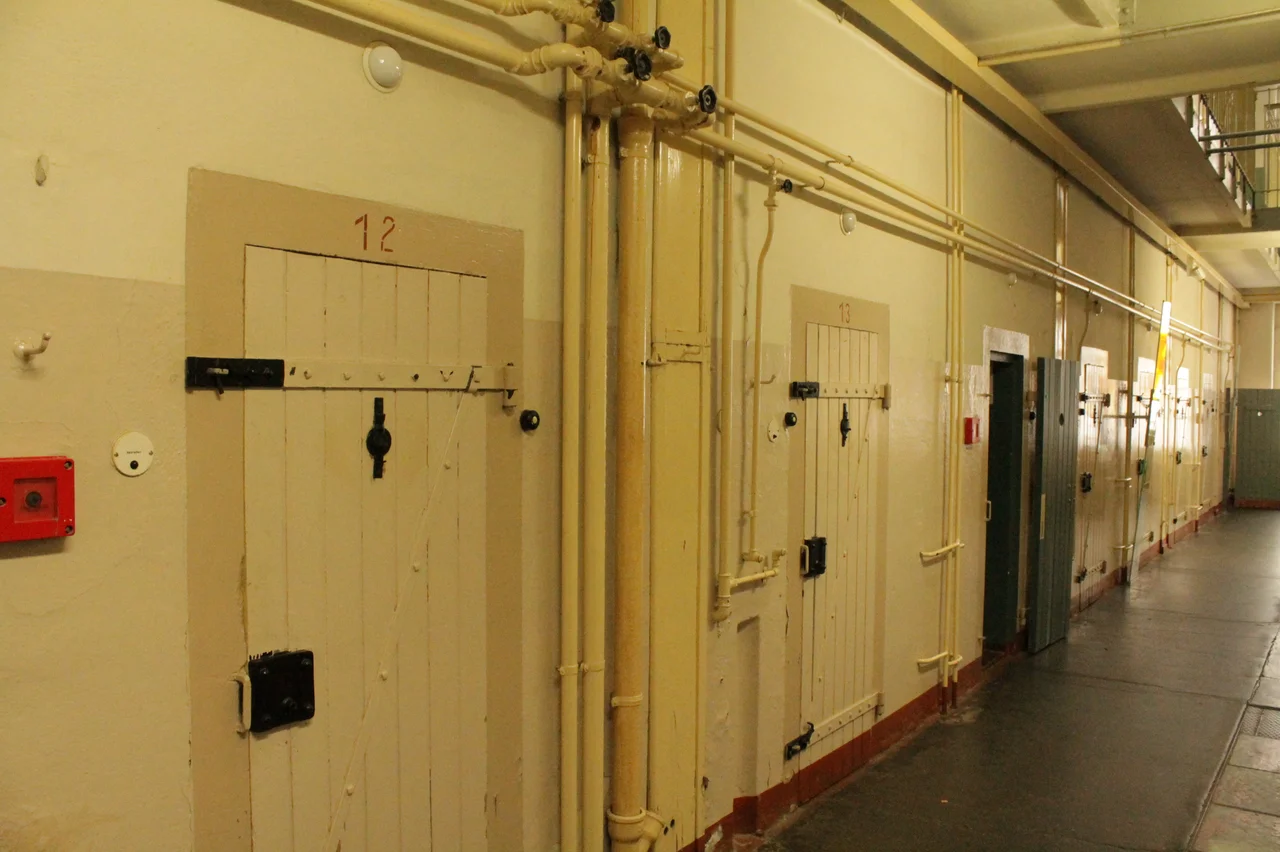
The building went up between 1904 and 1906 and was, for its moment, advanced - electric light throughout, steam heating, 157 cells with room for 203 prisoners. It was built as a court prison, for people awaiting trial or serving short sentences, and it sits inside a working legal complex to this day - police headquarters and law courts still occupy the ground to the south, east and west, which is why visitors enter from the north, off Weigangstrasse. When the Stasi took it over in 1956, the architecture barely changed. The method did. Isolation was the point: prisoners kept apart from one another, watched through cameras, listened to through microphones, reported on by informers placed among them. Around 150 people were held at a time; the peak came in July 1962, at 260. Renovations in the 1970s brought better heating, washbasins and toilets into the cells - improvements measured in plumbing, while the silence stayed exactly where it was.
Four Regimes, One Address
The same corridors served four different states, and each one used them for its enemies. Under the Kaiser and then the Weimar Republic it was an ordinary court prison, at its most lenient between 1923 and 1933. After 1933 the cells filled with political prisoners, communists above all, and from 1939 with resistance fighters captured in the countries Germany had occupied. The Soviet occupation authorities kept it as a political prison from 1945 to 1949, its most crowded era by far - as many as 400 people in a building designed for half that. The Saxon judiciary ran it briefly in the early 1950s. Then, in 1956, the recently formed Ministry for State Security took the keys and did not give them back for thirty-three years.
The People in the Cells
Georg Dertinger had been the GDR's first foreign minister; he was held here from 1956 to 1964. The philosopher Wolfgang Harich, who had argued that East German socialism needed reforming, arrived in 1959 and left in 1963. The novelist Erich Loest, convicted in 1957 of "counter-revolutionary group formation," served seven years in Bautzen and was forbidden to write throughout; in 1991 he published a memoir about being permanently overheard, titled after Goethe's secretary - Die Stasi war mein Eckermann, my life with the bug. Rudolf Bahro was here in 1978 and 1979. From 1963, a wing on the first floor held women, never more than nineteen at once. The Raufeisens came as a family: Armin, sentenced to life for espionage, his wife Charlotte to seven years, their son Thomas to three, all three inside the same building and unable to see one another. Thomas was released in September 1984. Armin died on 12 October 1987 in a prison hospital at Meusdorf near Leipzig, after gall bladder surgery. The official cause was recorded as pulmonary embolism. The circumstances have never been explained.
Nine Days
In thirty-three years of Stasi control, one person got out without permission. Dieter Hötger escaped in 1967 and was free for nine days before he was recaptured. The number sounds like a footnote until you consider what produced it: constant observation, cells that isolated, sentences calibrated to frighten. People convicted of helping others flee to the West were given fifteen years as a matter of deterrence - a punishment aimed less at the person in the dock than at everyone who heard about it. Deterrence was always what Bautzen II manufactured. It worked best when nobody had to be sent there at all.
The Doors Left Open
The last political prisoners walked out by 22 December 1989, six weeks after the Berlin Wall opened and ten months before the two Germanys became one. A handful of ordinary convicts, never more than twenty-three, stayed until the prison shut completely in January 1992. Then came the argument about what to do with the building, and the decision that makes it worth the trip: keep all of it. Since 1993 it has been a memorial and museum, most of it untouched - the central stair, the corridors, the cells, the punishment cells, the exercise yards with their concrete table-tennis tables. Admission is free. Outside stand the vans that brought people here without letting them know where they were going. In the north of town, on Talstrasse near the still-operating Bautzen I - the penitentiary the GDR nicknamed the Yellow Misery - lies the Karnickelberg, a burial ground for prisoners who died of illness or of beatings, mostly during the Soviet years. It opened to the public in 1990, and a chapel followed in 2000 to tell visitors who the dead had been.
From the Air
Bautzen II stands at 51.178 N, 14.436 E, a few hundred metres southwest of Bautzen's walled old town in Upper Lusatia, eastern Saxony. Best viewed between 1,000 and 2,500 feet AGL. From the air the building is hard to single out - it is a plain rectangular block inside a courthouse complex, which was always the point - so navigate instead to the unmistakable medieval skyline on the bluff above the Spree, then look immediately southwest of the towers. The Spree bends sharply below the old town, the Bautzen reservoir is a large open water body just north, and the Upper Lusatian pond landscape beyond it shows as hundreds of small rectangular ponds. Dresden (EDDC) lies about 25 nm west and Prague (LKPR) roughly 66 nm south; the recreational airfield at Klix is a few miles north of town. Autumn and winter fog forms readily over the ponds and can persist well past mid-morning.
Nearby Stories
- Kromlau Azalea and Rhododendron Park 4.8 km away
- Königstein Fortress 6.4 km away
- 2001 American Memorial 10 km away
- Stalag Luft III 17 km away
- Zittau 18 km away
- Jizera Dark-Sky Park 22 km away
- Hellerau 26 km away
- Czocha Castle 27 km away