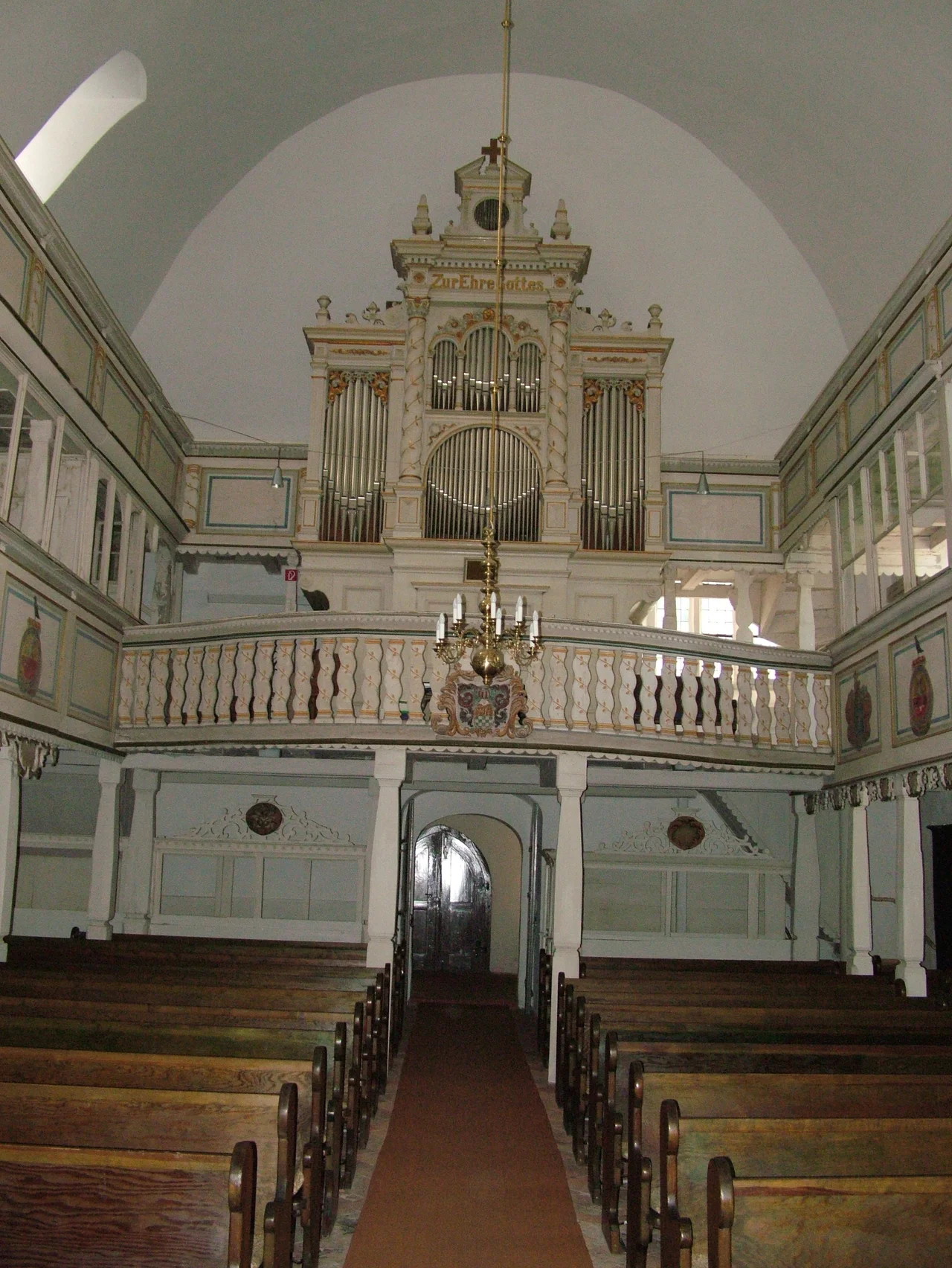

Wendish-German double church
The writer Ehm Welk recorded a story his father told him, set in this building in 1866. The village boys used to sit on the white benches outside the Wendish pastor's door, sometimes with girls, decent ones mind you, and the pastor kept chasing them off. You would do better on a bench in church, he said, though I never see you there. So the boy asked him which of the two churches he ought to sit in - because there were two of them, right there, sharing a wall. The pastor was taken aback, then answered that the Lord God did not care. Well then, said the boy, if the Lord God doesn't care, why do we have two? At which point the pastor swore about cheeky rascals and gave chase. Nobody in Vetschau has ever had a better answer than that one.
One Roof, One Tower, Two Naves
What stands in the middle of Vetschau - Wětošow in Lower Sorbian - is a single Protestant church with two complete naves lying against each other, sharing a bell tower at the west end and a vestry at the east. The first church here probably went up late in the thirteenth century, during the Christianisation of the Wends, as the German-speakers of the time called their Slavic neighbours. It was built from stones cleared out of the fields and from bog iron dug out of the marshes, which is about as local as building material gets. The lords von Schlieben took the parish Protestant in 1540. Fire gutted it in 1619 and damaged it again in 1642, leaving only the base of the tower standing. That base is still there, carrying everything above it.
The Principal Church
After the Thirty Years' War a new brick church was raised on the old foundations - flat ceiling, exposed crossbeams, tall lancet windows, no tower for the moment. On the north side a chapel was added for the local German lords, and services in German were held in it as required. A register entry from 1673 and 1674 is unambiguous about the arrangement: the main building is the principal church, and it is used above all for services in Wendish, serving the ten Sorbian-speaking hamlets in the surrounding countryside. The Germans in the chapel were the congregation on the side. They did not care for the arrangement, and there were efforts on their part to have their chapel recognised as the principal church instead. It did not work.
A Church for the Other Half
So they built their own. The German share of the town's population was rising while the countryside stayed Sorbian, and the townspeople wanted the distinction made visible, in religion as elsewhere. The chapel was pulled down in 1689; foundations for a proper German church were laid on 31 May 1690, the building was finished in 1693, and the General Superintendent Römer came from Lübben to consecrate it on 30 January 1694. The local clergy, by all accounts, were against the whole scheme. What resulted was a late Baroque brick nave with a barrel vault and galleries carrying the lords' private lodges - grander than its neighbour, and formally subordinate to it, since the Wendish church kept its status as the parish church. The tower was rebuilt between 1704 and 1709, an octagonal brick stage on the old square stump, and topped with a Star of Bethlehem above a lying crescent moon to mark the halting of the Ottoman advance.
The Last Service in Wendish
In 1910 the two congregations were merged into one parish, at a time when the German authorities were working steadily to push Sorbian out of public life. Schooling in the language had already been discontinued. Attendance at the Wendish services fell away, and the last one was held in 1932; the timing suggests eagerness to anticipate what the new regime would want. Both naves were still used for worship until 1977, after which the Wendish church stopped being a church and became a store. What it stored is the bitterest detail in the building. Parts of the church of Pritzen were kept in it, because Pritzen had to be demolished for an open-cast lignite mine. The thirteenth-century font that now stands to the left of the German altar came from Schönfeld, another village the coal removed. Its lid ended up in Kittlitz.
The Room That Was Not Torn Down
On 10 October 1995 a society called Wendische Kirche was founded to give the empty nave a purpose, and both churches were restored across 2000 and 2001. The German side still holds regular services. The Sorbian side belongs to the town now, and is used for concerts and exhibitions - one of them devoted to the churches that were destroyed in this region to reach the coal. Every year since 1995 a service in Lower Sorbian has been held here on European Heritage Day, which is not a living congregation but is not nothing either. On the tower a plaque remembers Hans Bock, the Lower Sorbian poet born in Vetschau in 1569. The brown-coal power station that dominated the town from 1964 was shut down in 1996 and its chimneys felled the year after. The church outlasted it, both halves of it.
From the Air
The double church stands at 51.784 N, 14.073 E in the centre of Vetschau/Spreewald, at about 60 metres above sea level on the flat Lower Lusatian plain, 18 km north-west of Cottbus and 12 km south-east of Lübbenau. Best read between 1,000 and 2,500 feet AGL. From directly overhead the building gives itself away instantly: an unusually wide, squat roof mass for a village church, because it is two parallel naves rather than one, with a single octagonal tower at the west end. The town sits between the A15 autobahn to the north and the Cottbus-Lübbenau railway; north-west of it the dark maze of alder woodland and water channels of the Spreewald biosphere reserve begins, and to the south-east the raw geometry of the mining country takes over. The chimneys of the old Vetschau power station came down in 1997, so the horizon here is far emptier than any pre-2000 chart or photograph suggests. Berlin Brandenburg (EDDB) lies about 41 nm north-north-west and Dresden (EDDC) about 41 nm south-south-west; Cottbus-Drewitz (EDCD) closed in 2020. Terrain is unobstructed and visibility is generally good outside summer haze.
Nearby Stories
- Sorbian Settlement Area 0.9 km away
- Halbmondlager 22 km away
- Neuzelle Abbey 29 km away
- Battle of Mühlberg 35 km away
- Upper Market Square (Görlitz) 42 km away
- Stalag Luft III 42 km away
- Kummersdorf 44 km away
- Sonnenburg concentration camp 59 km away