
Halbmondlager
The first mosque ever built in Germany stood inside a prisoner-of-war camp. It went up in the sandy pine country south of Berlin and was finished in July 1915 — a large, ornate wooden building modelled on the Dome of the Rock in Jerusalem, requested by the Grand Mufti of Constantinople and paid for by the Prussian Army. The men who prayed in it were captives. They had been taken from the British and French armies, shipped to Brandenburg, and housed in a camp designed to talk them into changing sides. The Germans called it the Halbmondlager, the Crescent Camp, and everything about it was arranged to be seen.
Thirty Thousand Men in a Pine Wood
Around 30,000 Arab, Indian and African prisoners passed through Wünsdorf, all of them soldiers of the British and French empires, most of them a very long way from anywhere they knew. The camp was not exclusively Muslim. About eighty Sikh and Hindu prisoners from British India were held there, along with some fifty Irishmen and two Aboriginal Australian soldiers, Roland Carter and Douglas Grant. A subcamp called the Inderlager housed Indian prisoners who were not openly pro-British; men who had made their loyalty to Britain plain were sent to ordinary camps instead. That sorting tells you what Wünsdorf was for. Prisoners were not distributed by rank or regiment or health, but by how persuadable the German authorities judged them to be.
A Theatre for the Wider World
The Ottoman Sultan's jihad proclamation of 1914 had called on Muslims across the British and French empires to rise against them, and Germany saw an opening. Max von Oppenheim, a diplomat and aristocrat, set up an office near the camp and ran what he intended as a demonstration project: prisoners persuaded, and then displayed. One historian has described the show camp as "self-consciously styled as a theatre for the wider world." To make the argument, the detainees "lived in relative luxury and were given everything they needed to practise their faith" — and, at the centre of it, the mosque, its dome and minaret rising above the barracks roofs. Oppenheim was assisted by Shaykh Sâlih al-Sharîf, a Tunisian who had served in Ottoman intelligence and acted as the detainees' spiritual leader. The kindness was real and it was also a lever.
Voices on Wax
Where the German state saw a propaganda stage, German scholarship saw a research opportunity. Anthropologists, linguists and musicologists — Robert Lachmann among them — came to Wünsdorf to work under what they described as favourable conditions, meaning a population that could not leave. The Royal Prussian Phonographic Commission, directed by the linguist Wilhelm Doegen, set out to record speech and song across more than 250 languages. Men stood before the recording horn and gave what they had: stories, poems, prayers, the songs of home. The surviving discs are held in the sound archive of the Humboldt University of Berlin, and in 2014 and 2015 an exhibition called Phonographed Sounds - Photographed Moments put those recordings and the camp photographs before the public. The men were catalogued as specimens of language. What survives of most of them is a voice.
The Experiment Collapses
Up to 3,000 detainees were eventually recruited into the German Army and sent to fight in North Africa and the Middle East. The units that resulted were plagued by low morale and by outright revolt, and few of the men who joined them appear to have believed in the cause they had been enlisted for. Some had signed on to get out of a camp; some to eat better; some to get closer to home. Whatever moved them, the great persuasion project produced soldiers who would not fight for it. By 1917 the pretence had been dropped altogether, and the prisoners still at Wünsdorf were sent to forced agricultural labour in Romania. The relative luxury had always been conditional, and the condition had not been met.
What Remains at Wünsdorf
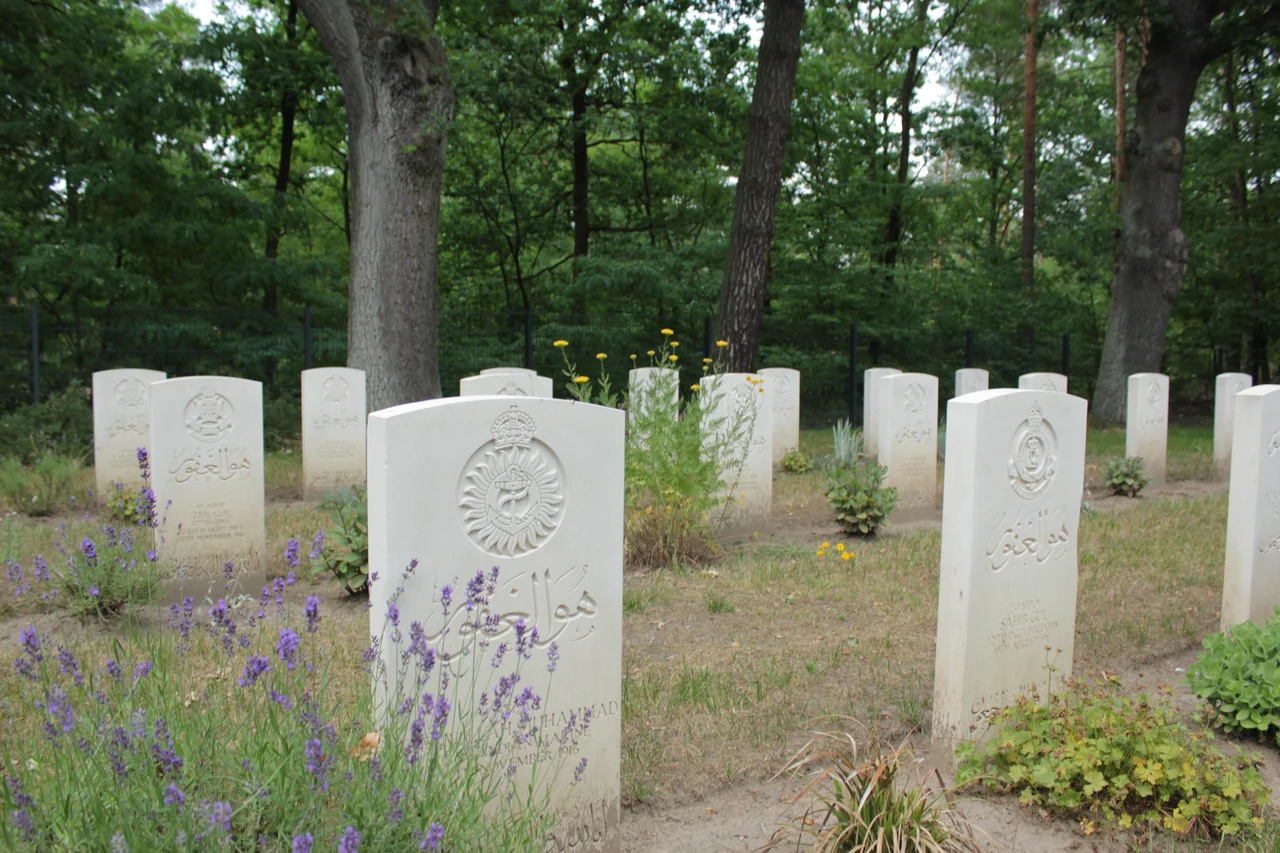
The mosque outlived the war by a decade, and in the early 1920s it was still in use — interned Soviet soldiers of Muslim faith, who had fled into East Prussia during the Polish-Soviet War, came to pray there. Built of wood and never meant to last, it fell into disrepair and was demolished in 1925 and 1926. A cemetery on the site remains, holding men who died a long way from the places they were born. Wünsdorf is now part of Zossen, and the ground has been overwritten several times since: the German Army, then the Soviet garrison, then abandonment. The camp itself was largely absent from English-language histories until nearly a century after the war, though German historians — Gerhard Höpp above all — had been writing about it for decades.
From the Air
The camp site lies at 52.167°N, 13.486°E at Wünsdorf, now part of Zossen, about 35 km south of central Berlin in the Brandenburg pine belt. The terrain is flat, forested and lake-scattered; the Autobahn 13 runs north-south a few kilometres west and is the clearest linear feature from the air. Berlin Brandenburg (EDDB) sits roughly 22 km north; Schönhagen (EDAZ) is about 15 km west and is the practical general-aviation field for this area. Recommended viewing altitude 1,500-2,500 ft — the former barracks grid and the Soviet-era garrison buildings read clearly against the forest. Watch for EDDB approach corridors overhead.
Nearby Stories
- Operation Gold 3.3 km away
- Wendish-German double church 8 km away
- Treuenbrietzen 9.6 km away
- E11 hiking trail 11 km away
- Falkenhagen Bunker 21 km away
- Lichtenburg Concentration Camp 22 km away
- Eisenhüttenstadt 39 km away
- 2001 American Memorial 45 km away