
Operation Gold
Moscow read the plans before a shovel touched Berlin sand. At planning meetings in a London townhouse at No. 2 Carlton Gardens, British and American intelligence officers worked out how to burrow beneath the most closely watched border on earth and splice into the Soviet Army's telephone cables. One of the men in the room was George Blake, a Secret Intelligence Service officer who had been reporting to the Soviets for years, and he told his handlers everything. Then the KGB did the thing that still unsettles anyone who studies this case: nothing at all. They let the Americans dig, tap, and listen for eleven months and eleven days. Rolling up the tunnel would have exposed Blake, and to the KGB, Blake was worth more than the secrets leaking out of it.
A Warehouse With an Impossible Basement
The cover story was radar. In the Rudow area of Neukölln, in the American sector, the US Army put up a warehouse with an ELINT station on the roof and a basement sunk to seven metres — far deeper than any warehouse needs, because it had to stage the dig and swallow the spoil. Digging began on 2 September 1954. William King Harvey, an ex-FBI man now with the CIA, ran the operation; Captain Williamson of the Army Corps of Engineers ran construction. The crews drove a tunnelling shield forward on hydraulic rams, lined the bore with sand and 1,700 cast-iron plates, and laid wooden track for rubber-wheeled carts. Three thousand tons of Berlin came out that way. At one point the diggers broke into an undocumented pre-war cesspool and flooded the works. The entire tunnel was wired with demolition charges that were never fired: Major General Charles Dasher would not approve an act that might start a third world war.
Forty-Seven Centimetres of Margin
At the far end, 450 metres out and beneath Altglienicke in the Soviet sector, the target cables ran less than 47 centimetres below a busy street. Cutting the vertical shaft up to them was the most delicate work of the project, and it fell to Peter Lunn, head of SIS in Berlin and a former Olympic alpine skier. His people — Royal Engineers, SIS officers, and engineers from the British Post Office research station at Dollis Hill — improvised a device they called the Mole to work the shaft up through soil so crumbly that the smallest subsidence would have announced them to the street above. The splicing itself went to three Post Office cable jointers: Blake Rymer, reckoned the best jointer they had, working with Les Sparks and Arthur Loomes. Three cables, tapped without a flicker. The project had been costed at $50,000. It finished above $6.5 million, roughly the procurement cost of two Lockheed U-2s.
Sixty-Seven Thousand Hours
Western codebreakers could not read Soviet encryption in 1955, so the tunnel went after something simpler: people speaking carelessly on lines they believed were safe. The cables carried traffic to and from Soviet military headquarters at Zossen, between Moscow and the Soviet embassy in East Berlin, and between Soviet and East German officials. Roughly 90,000 communications were recorded. Sixty-seven thousand hours of Russian and German went to London, where a special section of 317 Russian émigrés and German linguists transcribed it, while multiplexed teleprinter signals went on magnetic tape to Frank Rowlett's Staff D. The KGB, remarkably, told nobody — not the East Germans, not even the Soviet officers using the cables. A CIA assessment found no known attempt to feed the operation disinformation. British intelligence suspected otherwise, but the Agency's own report concluded that the Soviet military kept using the lines for traffic of genuine intelligence value.
The Discovery That Was Not a Discovery
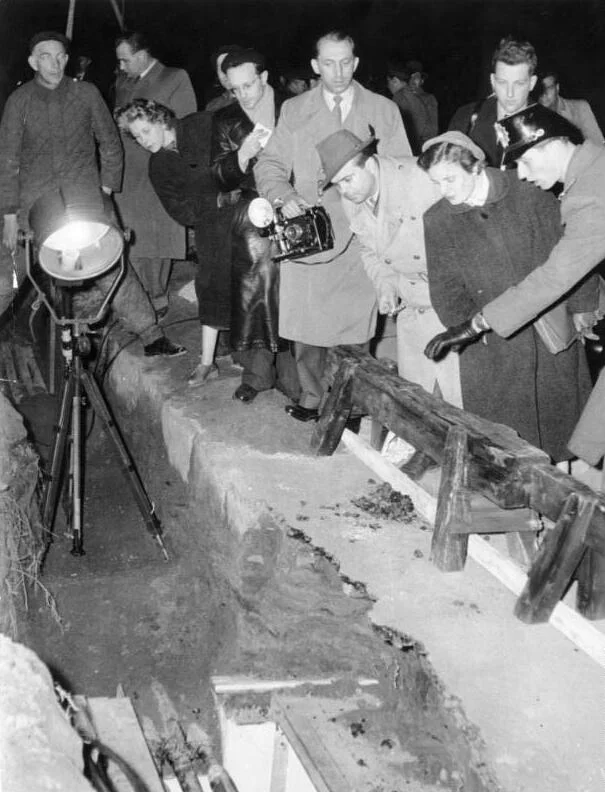
Blake transferred out of Berlin in 1955, and Moscow was finally free to act. On 21 April 1956, Soviet and East German soldiers broke into the eastern end. They called it a breach of the norms of international law and a gangster act, then invited the press underground to photograph the partition directly beneath the inter-German frontier, its sign lettered in German and Russian: entry forbidden by the commanding general. Western planners had assumed embarrassment would keep the Soviets quiet. Instead the world's newspapers ran the story as a triumph of engineering, and the CIA may well have gained more from the exposure than the Soviets did. Timing helped. Khrushchev was in Britain on a state visit, and the tunnel surfaced the day before his banquet with Queen Elizabeth II at Windsor Castle — which may explain why British participation went so lightly reported, even though most of the equipment in the photographs was British-built and clearly labelled.
What Is Left of It
Not until 1961, when Blake was arrested, tried and convicted, did Western officials grasp that the operation had been compromised before the first spade went in. Allen Dulles went on publicly celebrating what Operation Gold revealed about Soviet order of battle behind the Iron Curtain; a declassified NSA history is noticeably cooler about the take. The tunnel vanished under new construction. In 1996 the Berlin city government had roughly 83 metres dug out of the former American sector to clear ground for housing, and in 1997 a 12-metre section was recovered from the old Soviet side under the supervision of William Durie. That piece is displayed at the Allied Museum. Outer shell elements went to the CIA museum in 1999 and later to the International Spy Museum in Washington. Ian McEwan turned the affair into a novel, The Innocent; John Schlesinger filmed it.
From the Air
The tunnel ran from Rudow in Neukölln to Altglienicke in Treptow, crossing beneath what is now the Berlin–Brandenburg boundary near 52.412°N, 13.528°E. Berlin Brandenburg Airport (EDDB) sits about 5 km south-southeast, so traffic into and out of BER routinely passes overhead at low level; 2,000–3,000 ft AGL takes in the whole sector at once. There is nothing left to see on the ground — the American end lies under 1990s housing and the Soviet end under ordinary suburb — but the geometry the diggers exploited is still perfectly legible from the air, where Berlin's dense street grid stops abruptly and Brandenburg's open ground begins.
Nearby Stories
- E11 hiking trail 3.4 km away
- Bogensee 4.3 km away
- Maybach I and II 4.9 km away
- Treuenbrietzen 15 km away
- Battle of Fehrbellin 18 km away
- Falkenhagen Bunker 20 km away
- St. Mary's Church, Chojna 35 km away
- Eisenhüttenstadt 39 km away