
Battle of Fehrbellin
The Swedish officers holding Rathenow were drunk. A local official loyal to Brandenburg had thrown them a long, generous banquet on the evening of 14 June 1675, and the elector himself had paid for it — for exactly this purpose. Outside in the rain, Field Marshal Georg von Derfflinger rode toward the town gate with a lie ready on his tongue. He called up to the guards that he was a Swedish officer with a Brandenburg patrol on his heels. They opened the gate. Four days later, in a marsh near the village of Hakenberg, the reputation of the Swedish army — unbeaten within living memory — came apart.
The March Nobody Expected
Frederick William, Elector of Brandenburg, was encamped at Erstein in Alsace when the news reached him. He had joined Emperor Leopold I against Louis XIV, and the French had persuaded an isolated Sweden to attack Brandenburg from Pomerania while the electoral army was away. In December 1674 the Swedes occupied a large part of the margraviate.
He pulled out of the coalition at once but could get no further than winter quarters at Marktbreit in Franconia. On 26 May 1675 he set off. In two weeks his army covered 250 kilometres to Magdeburg — a feat still cited among the great marches in military history. He managed it by abandoning the supply wagons and leaving much of the infantry behind, buying food from villagers along the way and flatly forbidding his men to plunder. The Swedes had calculated on a slower enemy. They were still calculating when he arrived.
Hemmed In at the Rhin
The Swedish forces lay scattered across the swampy Havelland. Frederick William saw the weakness at once and sent Derfflinger to seize Rathenow in the middle, splitting the occupation in two. Count Waldemar von Wrangel pulled back toward Havelberg, but summer rain had turned the marshes treacherous and his columns crawled.
On 17 June the Brandenburgers reached Nauen, and Colonel Joachim Hennings, guided by locals who knew every causeway, closed the exits one by one. Wrangel's plan to cross the Elbe and link up with Brunswick troops evaporated. He found himself at Fehrbellin with a destroyed bridge over the Rhin at his back, impassable marsh on both flanks, and engineers frantically rebuilding the span.
Six to seven thousand Brandenburgers with thirteen cannons faced seven thousand Swedes with twenty-eight. On paper the Swedes had the guns. What they did not have was the high ground.
The Hills and the Bridge
Wrangel had neglected the low hills on his left. Frederick William and Derfflinger put their thirteen guns up there and opened fire around noon on 18 June, tearing into a Swedish right flank that had nothing behind it but water.
Wrangel threw men at the hills again and again through the afternoon; Brandenburg cavalry turned him back each time. When the elector finally pressed his main attack the Swedish horse broke, and Prince Frederick II of Hesse-Homburg wheeled onto the now-naked infantry of Generalmajor Henrik von Delwig. Of the 1,200 men in Delwig's brigade, all but twenty were killed or captured. They had held long enough, though — the bridge was repaired, and Wrangel got most of his army across before dark. Offered the chance to shell the town, Frederick William refused.
Around five hundred Brandenburgers died; Swedish losses in the battle itself ran to five or six hundred. The worst came afterward, on the road north, where villagers who still remembered what Swedish armies had done in the Thirty Years' War fell on the retreating columns — near Wittstock alone, some three hundred Swedish soldiers and their officers were killed by peasant raiders. Between the fighting, the raids, hunger and desertion, there was not a Swedish soldier left in the Mark by 2 July.
How an Inconclusive Day Became a Legend
Judged narrowly, Fehrbellin was not much of a victory. The Swedes wanted only to concentrate and withdraw, and they did; the Brandenburgers wanted to stop them, and failed. But by a convention as old as classical antiquity, the side left holding the field was the winner — and Brandenburg announced the fact to Europe in the loudest possible terms.
The announcement worked. The Holy Roman Empire and Denmark finally honoured their treaty obligations and declared war on Sweden. A second-rank German electorate had beaten the army everyone considered unbeatable, without Habsburg or Danish help. Frederick William, fifty-six years old, had fought in the line himself and reportedly had to be cut free from an encirclement by his own dragoons. He was the Great Elector from that day on, and the army he and Derfflinger built became the nucleus of the Prussian Army. In Sweden the humiliation became one of the chief charges against the Privy Council aristocrats at the Riksdag of 1680 — the assembly that made Charles XI an absolute monarch.
The Tower on the Hakenberg
Heinrich von Kleist set his drama The Prince of Homburg here in 1809–10, built around the prince's supposed insubordination — a story later popularised by Frederick the Great and quite possibly invented.
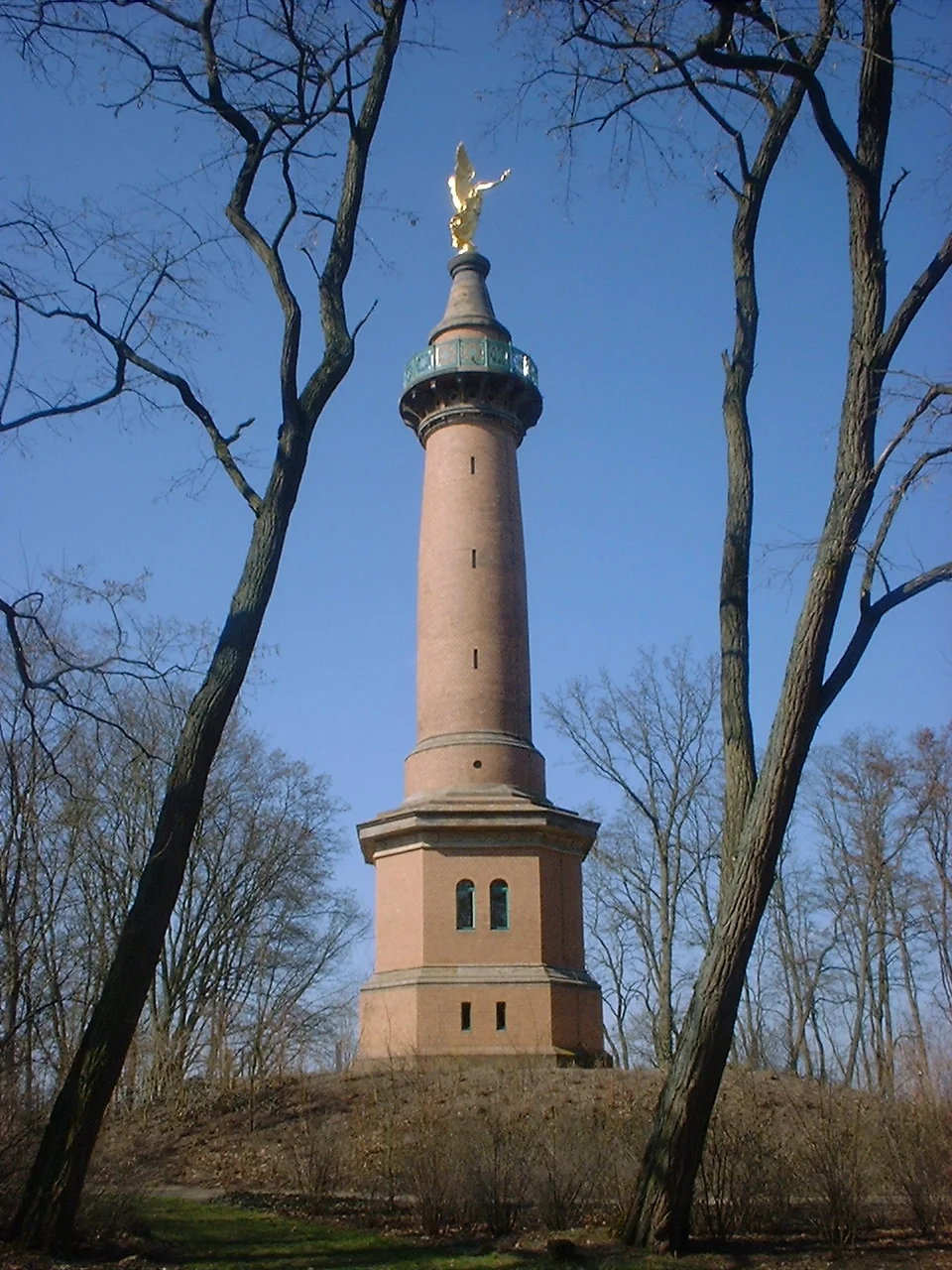
The battlefield itself is flat, wet and easy to miss. What marks it is a 36-metre monument on the Hakenberg hill, crowned by a bronze Victoria after a design by Christian Daniel Rauch, raised between 1875 and 1879 and inaugurated on 2 September 1879 — Sedantag, the anniversary of a very different German victory. For decades afterward 18 June was a national holiday, observed until 1914 and then quietly abandoned in a war that made older glories hard to celebrate. The march Richard Henrion wrote for the battle is still played by Bundeswehr units today.
From the Air
The battlefield lies at 52.80°N, 12.77°E in the Havelland of northern Brandenburg, roughly 60 km northwest of Berlin. The terrain reads from the air exactly as it did to Wrangel: a nearly featureless plain of drained fen — the Rhinluch — laced with straight drainage ditches and the Rhin river, with Fehrbellin's compact street grid on the north bank. The Hakenberg monument, a slim 36-metre column with a bronze Victoria, sits on a low rise about 3 km southeast of the town and is the only vertical landmark for miles; catch it in low sun and the statue flashes gold. Fly it at 2,000–3,000 ft AGL to read the ditch pattern and the old causeways. Ruppiner See is a long silver strip 20 km to the north. Nearest fields: EDBK (Kyritz) roughly 30 km northwest, EDAV (Eberswalde-Finow) about 60 km east, and EDDB (Berlin Brandenburg) around 70 km southeast. Brandenburg's flat light is best in late spring and early autumn; summer haze and low stratus can flatten the terrain into a featureless green wash.
Nearby Stories
- Bernauer Straße 3.3 km away
- Rheinsberg Palace 4.1 km away
- Paretz 10 km away
- Templin 11 km away
- Bogensee 13 km away
- Romanesque Road 19 km away
- Holy Blood of Wilsnack 28 km away
- Ludwigslust Palace 61 km away