
Romanesque Road
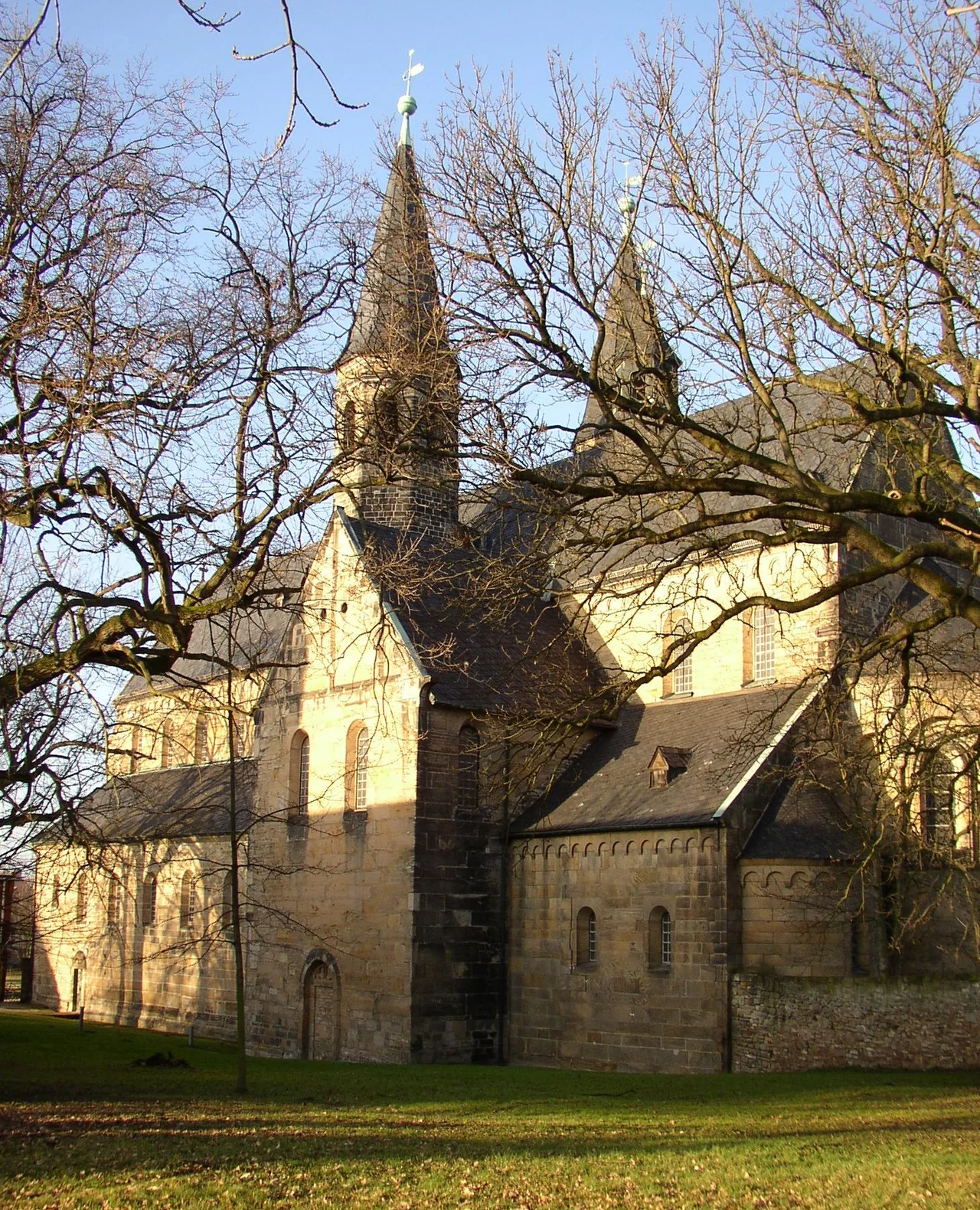
In a side aisle of the church at Gernrode, a village in the Harz foothills, stands a stone model of the tomb of Christ. It was made somewhere between 1080 and 1130, it is the oldest thing of its kind in Germany, and there is no queue to see it. That is the whole proposition of the Romanesque Road. Saxony-Anhalt is stacked with buildings from the tenth to the thirteenth centuries that would be famous anywhere else, and most of them stand in villages you would otherwise drive through without slowing down. The route was conceived in 1991, opened in 1993, and does nothing more complicated than string them together: 88 buildings in 65 places, roughly 1,200 kilometres of road, marked the whole way by a sign showing a round arch.
Why It All Ended Up Here
The concentration is not an accident of taste. This was the frontier. When Otto I was assembling his empire in the tenth century, the Elbe and the Saale marked the edge of Christian Germany, and the country beyond was contested with Slavic peoples who had their own gods and no interest in conversion. Frontiers get fortified and they get evangelised, and both arrive in stone. Abbeys, collegiate churches, imperial palaces and castles went up between roughly 950 and 1250 as an argument made in masonry. Then the centre of gravity moved — to Berlin, to the Rhine, to the industrial west — and these buildings were left largely alone. Poverty turns out to be an excellent conservator. What survives is Romanesque that was never remodelled into a later fashion, because nobody here could afford the later fashion.
The Shape of the Route
The road runs as a figure of eight with Magdeburg at the crossing point, which makes it unusually easy to plan around. Take the northern loop across the flat Altmark and the Elbe–Havel country, or the southern loop into the Harz and the Saale valley, or both — either way you come back through the middle. The signposts carry a stylised round arch, and that is genuinely the trick to reading the style: angular masses, semicircular arches over doors and windows, small deep-set openings. Once you have seen half a dozen you can pick a Romanesque church out of a village from a moving car. Since 2006 the route has been part of Transromanica, a European Cultural Route linking Romanesque regions across the continent, and its initiators reckon on around a million visits a year.
The Northern Loop
North of Magdeburg the land flattens and the buildings change material. Jerichow Monastery, founded in 1144 with its church begun in 1149, is one of the oldest brick buildings in northern Germany — the place where builders on a plain with no useful stone worked out what fired clay could do, and set a pattern that shaped north German architecture for centuries afterwards. Havelberg has its cathedral on a rise above the river. Arendsee and Diesdorf have abbey churches; Salzwedel has St Lawrence. And then there are the village churches — Wiepke, Engersen, Rohrberg, Melkow, Wulkow, Redekin, Schönhausen — small, thick-walled, barely altered, each sitting among a few dozen houses. These are the stops that reward patience rather than a checklist, and they are where the route earns its reputation.
The Southern Loop
South is where the famous names live. Quedlinburg's St Servatius crowns a sandstone crag above a town of timber-framed houses. Gernrode's St Cyriakus was founded in 959 by Margrave Gero; its first abbess, Hathui, served fifty-five years, and the building is Ottonian architecture caught in the act of becoming Romanesque. Memleben is where two rulers died — Henry the Fowler on 2 July 936, Otto the Great on 7 May 973 — and where Otto II founded an abbey from about 979 in his father's memory, now ruins and a crypt. Halberstadt and Merseburg have cathedrals. Naumburg has the twelve donor figures carved in the mid-thirteenth century by the anonymous sculptor known as the Naumburg Master, among them Uta, whose face is probably the most reproduced piece of medieval German sculpture; the cathedral was inscribed as a World Heritage Site on 1 July 2018. There are castles too: Querfurt, Falkenstein, Neuenburg, and the excavated imperial palace at Tilleda.
Doing It Properly
Nobody drives all 1,200 kilometres in a weekend, and the route was never designed for that. Pick a loop, pick a base — Magdeburg for the middle, Quedlinburg or Naumburg for the south, Havelberg or Tangermünde for the north — and treat the small churches as the point rather than the filler between cathedrals. The cathedrals and larger abbeys keep regular opening hours. Village churches frequently do not, and many open only around services or by arrangement, so it is worth a phone call ahead for anything you are driving specifically to see. Saxony-Anhalt awards an annual Romanesque Prize of €10,000 to keep the route's profile up and the local economy along it moving, which tells you the essential thing about these buildings: they survive on people choosing to stop.
From the Air
The route has no single point — its nominal centre is 52.467°N, 12.075°E, but it describes a figure of eight roughly 1,200 km long across Saxony-Anhalt, crossing itself at Magdeburg (52.13°N, 11.64°E). From the air the two loops occupy very different country. The northern loop crosses the flat Altmark and the Elbe–Havel lowland, where the landmarks are the Elbe itself, Havelberg cathedral on its rise, and Jerichow's brick monastery church standing alone above farmland. The southern loop climbs into the Harz, where Quedlinburg's castle crag, the Konradsburg and Falkenstein ridgetop castles, and the Saale valley at Naumburg and Bad Kösen give strong visual anchors. Best flown at 2,000–4,000 ft AGL; low sun brings out the isolated village churches as pale points in otherwise uniform fields. Nearest fields are Magdeburg City (EDBM) and Magdeburg-Cochstedt (EDBC) in the middle, Leipzig/Halle (EDDP) at the southern end, and Berlin Brandenburg (EDDB) to the east. Terrain is flat across the north and rises to around 1,100 m in the Harz, where low cloud and rime icing are common from October through March.
Nearby Stories
- Stork Farm Loburg 10 km away
- Battle of Fehrbellin 10 km away
- Gardelegen Massacre 14 km away
- Paretz 15 km away
- Treuenbrietzen 19 km away
- Holy Blood of Wilsnack 28 km away
- Free Republic of Wendland 36 km away
- Schöningen spears 43 km away