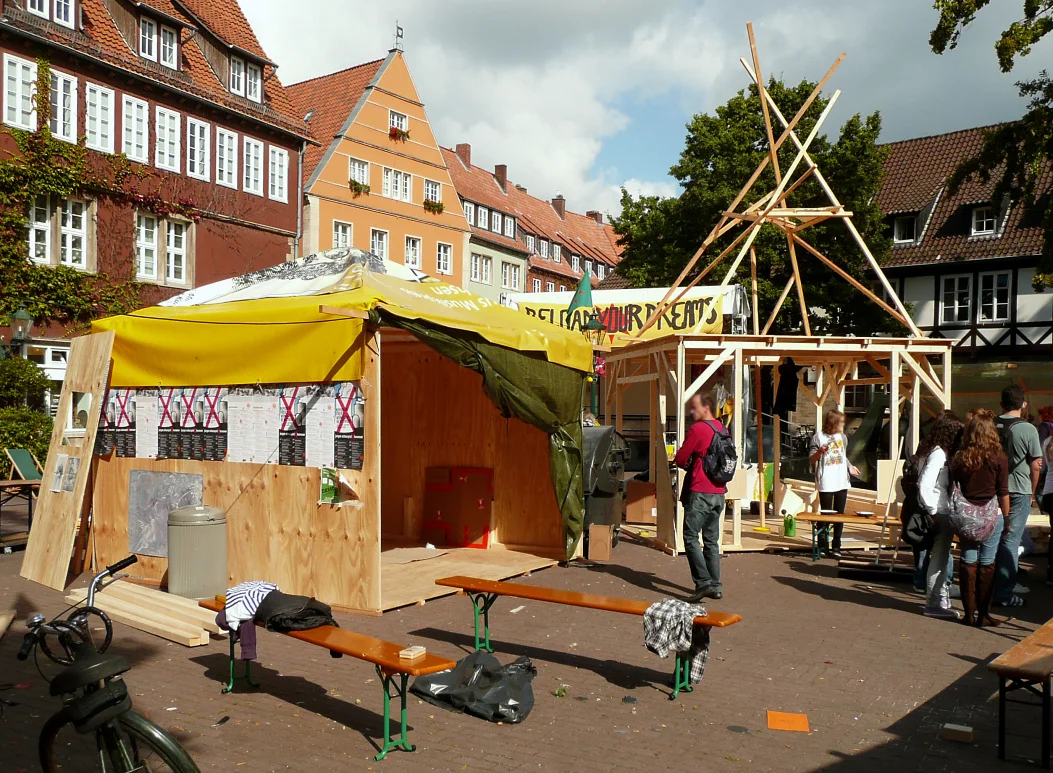

Free Republic of Wendland
For ten Deutsche Marks you could buy a passport at the information center. It came with an entry stamp, and the people who issued it declared it good "for the entire universe [...] so long as its owner could still laugh." The country it admitted you to was about a month old, occupied roughly the footprint of an exploratory drilling site in a Lower Saxon peat forest, and would be gone before midsummer. On 3 May 1980 some 5,000 anti-nuclear activists walked onto the ground around drill site 1004, between the villages of Gorleben and Trebel, and refused to leave. Within a week they had built a town. Within a month the state's interior minister was calling it high treason.
Sites 1002, 1003, 1004
The Physikalisch-Technische Bundesanstalt had begun drilling at Gorleben in 1979, testing the salt domes beneath the Wendland for their suitability as a permanent store for radioactive waste. Local activists occupied drill sites 1002 and 1003; both attempts fizzled. So the organizers went bigger, calling international anti-nuclear activists to a "Day of action for the Wends" — Kampftag der Wenden — on 3 May 1980. The corner of Lower Saxony they picked was among the most isolated in West Germany. The district of Lüchow-Dannenberg shared 144 kilometres of frontier with East Germany, hemmed in to the north, south and east by the most heavily fortified border in Europe. Declaring an independent republic in a place already surrounded by real ones was a joke with sharp edges, and everybody involved knew it.
A Village Built in a Week
The ground was sandy and scorched, burned over during the 1975 fire on the Lüneburg Heath, and on it the occupiers raised roughly 110 huts of wood and clay. Hut-building was the anti-nuclear movement's signature form of protest at the time, but this went well past gesture. There was a Friendship House that seated a hundred, greenhouses, an infirmary, a hairdressing salon, a designated area for waste disposal, a sauna and bathing facilities. Water arrived through a wind-powered well and was warmed by solar power. People from the surrounding villages kept the place supplied with food and timber, which is not a small thing in a conservative rural district. Whatever else the Free Republic of Wendland was, it was not carelessly improvised.
Valid for the Entire Universe
On the approach road the occupiers built a border checkpoint with a boom barrier and raised two flags over it: the arms of the Wends, and the anti-nuclear Smiling Sun. An outfit calling itself the Underground Office of Gorleben-Shall-Live — Untergrundamt Gorleben-Soll-leben — declared the occupied ground an independent nation. Visitors could buy the Wendenpass at the information center, get it stamped, and take it home. Egbert Möcklinghoff, Lower Saxony's Minister of the Interior, responded by declaring the proclamation high treason. It is worth pausing on that: a state minister reaching for the gravest charge in the statute book, aimed at a village of clay huts whose founding document promised the universe to anyone still capable of laughing.
Thirty-Three Days of Assembly
About a thousand people stayed on permanently, and they organized themselves around grassroots democracy — a spokespersons council, decisions taken in regular mass meetings. On the question of the eviction everyone expected, the broad consensus settled on passive resistance, over the objections of a militant few. Weekends brought thousands of sympathizers and sightseers. Among them was Gerhard Schröder, then head of the SPD's Young Socialists and eighteen years from the chancellorship. The resistance fighter Heinz Brandt came, and the musicians Walter Mossmann and Wolf Biermann, the photographer Günter Zint, the SPD politician Jo Leinen, the writer Klaus Schlesinger. Between the lectures and the readings there were rock concerts and puppet shows. On 18 May, Radio Free Wendland went on the air from a tower on the site, broadcasting without a licence and without apology.
The Morning of 4 June
Chancellor Helmut Schmidt gave the order, and on the morning of 4 June 1980 the Lower Saxony police and the Federal Border Guard cleared the site with roughly 3,500 officers. The legal grounds were almost comically mundane: forestry laws, building regulations, the Field and Forest Planning Act, the Registration Act. A republic undone by permit violations. By the time the police arrived, about 2,000 occupiers had gathered in the central square for a sit-in, and officers carried them off one at a time. Radio Free Wendland reported from its tower throughout the day, narrating its own dismantling. When it was finished, the police thanked the demonstrators over a loudspeaker for their nonviolent approach.
What the Salt Never Held
The Wendland flag is still a standard of the German anti-nuclear movement, sold in a hundred places, and stamped Wendenpässe still turn up at protest camps. In 2006 a five-page advertisement ran in a local paper under the republic's name. On the thirtieth anniversary of the eviction in June 2010, about 800 people gathered near Gorleben while members of the Rural Emergency Association Lüchow-Dannenberg raised a "hut sanctuary" in the forest; that September the director Florian Fiedler and the Playhouse Hannover rebuilt a hut village on Ballhof Square with fifty students and twenty-five adults, and afterwards sent two of the huts back to the Wendland. Then, on 28 September 2020, Germany's federal repository agency struck the Gorleben salt dome from its list of candidate sites on geological grounds. The mine is being closed and backfilled. The protesters lost the field in a single morning and the argument over forty years.
From the Air
Site 1004 lay at 53.01°N, 11.34°E, in the Wendland of far northeastern Lower Saxony, on the west bank of the Elbe. Best viewed at 2,000-4,000 ft AGL. The navigational anchor is the Elbe itself, whose broad meanders and floodplain marked the inner-German border until 1990 and now form part of the Green Belt nature corridor; the forested salt-dome country around Gorleben lies just west of it, with Dannenberg to the southwest. Nearest major airports: Hamburg (EDDH) about 115 km northwest, Hannover (EDDV) about 125 km southwest, Berlin Brandenburg (EDDB) about 160 km southeast. Terrain is flat with no significant obstacles, but low cloud and river haze are common over the Elbe valley in autumn and winter.
Nearby Stories
- Ludwigslust Palace 8.1 km away
- Tangermünde 22 km away
- Gardelegen Massacre 22 km away
- Scharnebeck Twin Ship Lift 28 km away
- Ebstorf Abbey 33 km away
- Autostadt 35 km away
- Battle of Wittstock 40 km away
- Fusion Festival 52 km away