
Autostadt
The odometer reads zero. Not almost zero, not the eleven or twelve kilometres a car normally accumulates being shuffled between a factory and a transporter and a dealership forecourt - actually zero. That is the trick the Autostadt was built around. Buyers of a new Volkswagen in certain European countries can choose to come to Wolfsburg instead of having the car delivered, and if they do, their car travels the last stretch of its journey underground and then vertically, inside a glass tower, before being set down in front of them. The site opened in May 2000 on the north bank of the Mittelland Canal, directly across the water from the plant that has been building cars here since 1938. It now draws around two million visitors a year, which makes it one of the most-visited attractions in Germany and an unusual thing for a car company to have built.
Two Glass Silos Full of Cars
The AutoTürme are the reason people photograph the place. Two cylindrical towers of glass, each 60 metres tall, stand at the water's edge holding finished cars on stacked circular racks - visible from outside, lit at night, more aquarium than warehouse. A 700-metre tunnel runs beneath the canal from the factory, so a car reaching a tower has still never touched a public road. An automated lift rides up the central column at 1.5 metres per second to pluck out the right vehicle. Customers who choose to collect in person get free entry to the park, meal tickets and a build-up of small ceremonies, ending with a screen on which they watch the mechanism find their car and bring it down. The car is then handed over having never driven a single metre outside the works.
Four Hundred Architects and a Fuel Depot
The idea started in 1994, out of a plan to document how Volkswagen vehicles are made and to show the company off at Expo 2000 in Hanover. Ground was broken in 1998 on the former site of a fuel company bordering the plant, and the finished complex is credited to more than 400 architects working under the Munich practice Henn GmbH. The investment came to roughly 850 million Deutsche Mark. What they produced is not a museum with a car park but something closer to a small district: pavilions scattered across landscaped ground, lagoons and channels of water threading between them, grassed earth mounds shaping the sightlines, and benches and chairs designed with the same seriousness as the buildings. It was conceived as a new urban centre for a city that had never been given one.
Seven Pavilions, Seven Arguments
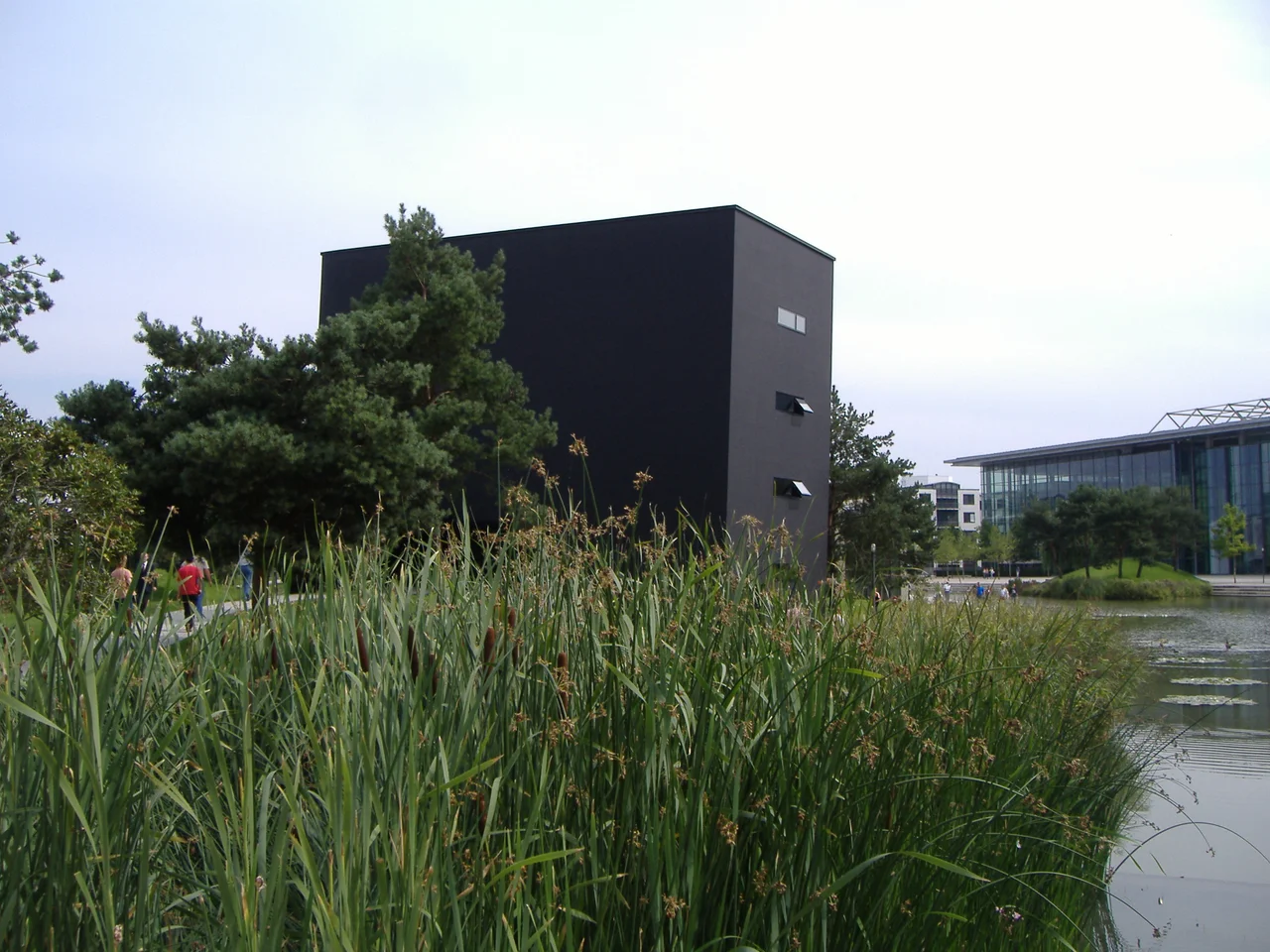
Each brand in the group gets a building that argues its case in architecture. Volkswagen has two - a large circular pavilion covering more ground than any other, showing the current range across two floors, and a much smaller production pavilion added late. The Porsche pavilion is entered down a curving descending corridor into a single quiet hall holding a Boxster, a 911 and a Panamera, with scale models of earlier generations ranked behind them. The Premium Clubhouse, renamed in 2008 from the Bentley pavilion and now shared with Bugatti, is buried in a grass mound under a marble roof, its displays including a chrome-finished Bugatti Veyron. Škoda's pavilion is built around metal sculpture. The Lamborghini building is entirely black, and its show begins with an orange Aventador fixed to the wall, which vanishes into dry ice and reappears, upside down in effect, mounted on the outside of the building.
Spheres, Mirrors and Castanets
The Audi pavilion hands each visitor a small plastic sphere, activated at the entrance with a name and a photograph. As you move through the building the sphere glows in the colour of whichever section you are standing in, and pressing it into hemispherical depressions on the walls triggers things: a technical film, a real headlight illuminating behind glass, floor lights that mime an electric car charging. Drop the sphere in a collecting pit at the end and your photograph can be emailed on. The SEAT pavilion, one of the largest, sits in water and planting, reached across a bridge under a glass roof, with one entire wall built from red wing mirrors. The exit bridge rests on metal tubes containing speakers, and every footstep across it fires off a castanet click - a nod, in a German industrial park, to the Spanish marque's home.
Driving, Not Just Looking
Under the bridge that carries visitors over the canal from the town, the Autostadt keeps an off-road course for the Volkswagen Touareg. Show a driving licence and a guide will first take you round it, narrating what the vehicle can do, then swap seats and let you drive with the guide beside you and any passengers in the back. The course includes a 21-degree climb, a hill cambered hard to one side, a water hazard, a sand pit tucked beneath a road bridge, a log road and a scatter of mounds designed to lift one wheel clear of the ground. Children get their own circuit and small electric cars shaped like Beetles. Elsewhere there is a room comparing what different fuels do to a car's performance, design software that lets visitors build their own vehicles, two cinemas showing short films in German - one of them inside a large sphere - and a museum holding some genuinely important machines, including early petrol vehicles and the Beetle that started all of it a few hundred metres away.
From the Air
The Autostadt lies at 52.43 degrees N, 10.79 degrees E, immediately north of the Mittelland Canal in Wolfsburg, Lower Saxony. From the air the two 60-metre glass car towers are the giveaway - a matched pair of bright cylinders at the water's edge, distinct from the four tall chimneys of the Volkswagen power station just to the west and the vast grey roofs of the plant beyond. The canal runs arrow-straight east to west through the city and is the easiest navigation reference in the area; the Allersee lake sits a short distance east. Nearest airports: EDVE (Braunschweig-Wolfsburg) about 20 km southwest, without scheduled passenger service; EDDV (Hannover) about 75 km west; EDDB (Berlin Brandenburg) about 185 km east. Recommended viewing altitude 2,000 to 4,000 feet, with the towers most striking at dusk when they are lit from within.
Nearby Stories
- Asse II mine 9.4 km away
- Gardelegen Massacre 14 km away
- M'era Luna Festival 17 km away
- Celle State Stud 18 km away
- Bergen-Belsen concentration camp 20 km away
- Sack of Magdeburg 26 km away
- Free Republic of Wendland 31 km away
- Eschede train disaster 34 km away