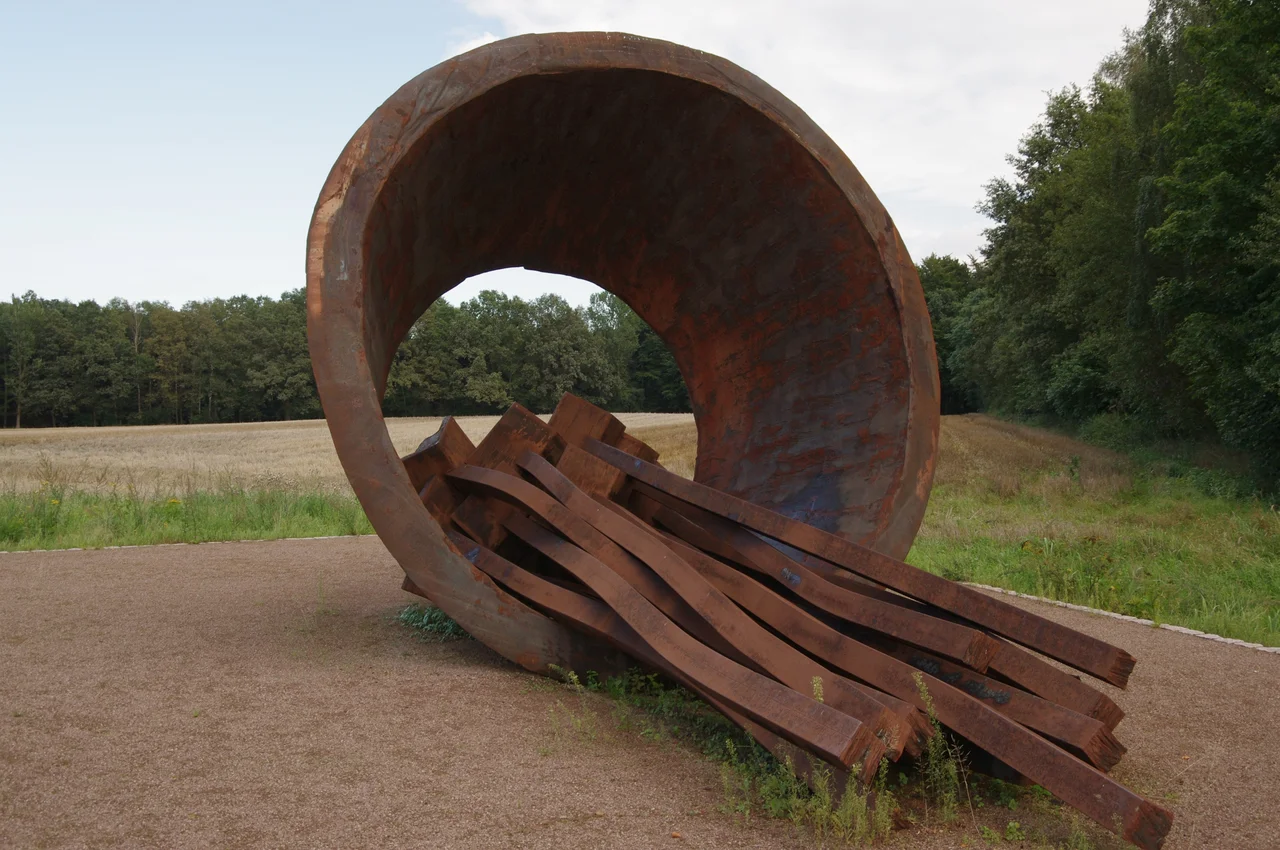

Bergen-Belsen concentration camp
The markers in the heath are almost identical. Each is a low stone at the head of a long grassy rectangle, and each carries a single line: Here lie 5,000 dead. April 1945. There are several, spread through birch scrub and heather southwest of the town of Bergen in Lower Saxony. Nothing here looks like a camp. The British burned the huts to stop the typhus, and grass took the ground back. The mounds are what is left.
A Camp for Bargaining
Belsen did not begin as a place for killing. Belgian and French prisoners of war were housed here in June 1940, and from June 1941 the site was expanded into Stalag XI-C (311), built for up to 20,000 Soviet prisoners. By the end of March 1942, some 41,000 Soviet prisoners had died here and at two neighbouring camps.
In June 1943 part of the site was redesignated Aufenthaltslager, which the SS translated as "holding camp." The change was paperwork with a purpose: the earlier designation obliged the camp to accept international inspection under the Geneva Conventions. The new one did not. What was held there were Jewish hostages, to be traded for German civilians interned abroad or for hard currency. The SS divided the compound by nationality — a "Star camp" for Dutch Jews, a "Hungarian camp," a "special camp" for Polish Jews, a "neutrals camp." At least 14,600 Jews were brought there between the summer of 1943 and December 1944, including 2,750 children.
The Winter the Camp Filled
In July 1944 Belsen held 7,300 people. By December there were 15,000; by February 1945, 22,000; by 15 April, around 60,000. Camps in the east were being emptied ahead of the Red Army. Josef Kramer arrived from Auschwitz-Birkenau in December 1944 as commandant. A women's camp had opened that August and held roughly 9,000 women and girls by November, first Poles arrested after the failed Warsaw Uprising, then Jewish women from Auschwitz.
There was not food, water, shelter or sanitation for a fraction of that number. Typhus, tuberculosis, typhoid and dysentery went through the barracks. Around 3,100 people died at Belsen between 1943 and the end of 1944. Between January and mid-April 1945, roughly 35,000 did.
Anne Frank and her sister Margot were among them, dead of typhus, most likely in February. Hélène Berr, who had kept a diary of her life under the occupation of Paris, died here. So did Josef Čapek, the Czech painter who gave the world the word robot, probably in April. So did the Dutch jazz duo Johnny & Jones. Most of the dead left no diary and no recording; where their names survive at all, they survive on lists.
The Fifteenth of April
As British and Canadian forces advanced in April 1945, the German army negotiated a truce and an exclusion zone around the camp to keep the typhus inside it. Himmler agreed on 11 April to hand Belsen over without a fight, and an agreement signed early on 13 April created a neutral zone of 48 square kilometres. Most of the SS were allowed to leave.
The first two men to reach the camp got there by accident: an SAS officer, Lieutenant John Randall, and his jeep driver, on reconnaissance. Troops entered on the afternoon of 15 April and found roughly 60,000 prisoners, most of them acutely ill, and more than 13,000 bodies lying unburied. People had been days without food or water and were dying at about 500 a day. The BBC's Richard Dimbleby walked in with the soldiers and recorded a despatch his own corporation sat on for days. Leonard Berney, one of the senior officers handed the problem, had turned twenty-five the week before.
What Medicine Could Not Undo
Liberation did not stop the dying. Another 14,000 people died between 15 April and the end of June. Months of starvation had wrecked digestive systems past the point where ordinary food helped, and army bully beef killed people who ate it. The Medical Research Council sent a team under Janet Vaughan to work out what the starved could be fed.
Among the supplies was a consignment nobody had asked for. Lieutenant Colonel Mervin Willett Gonin recorded it in his diary: a very large quantity of lipstick, which he called sheer unadulterated brilliance. "Women lay in bed with no sheets and no nightie but with scarlet red lips," he wrote. "At last someone had done something to make them individuals again, they were someone, no longer merely the number tattooed on the arm."
The British made the surviving SS staff bury the dead; seventeen of them caught typhus and died.
The Ground Itself
A British military tribunal at Lüneburg tried forty-five people between September and November 1945: Kramer, sixteen other SS men, sixteen female SS guards and twelve former kapos, several also charged with crimes at Auschwitz. No German soldier was ever tried for what was done to the prisoners of war here.
Memorials began going up at once and have never stopped: wood in September 1945, stone for the first anniversary, a wooden cross that November for the murdered Polish prisoners, a Soviet memorial at the POW cemetery, and in December 2012 one to eight Turkish citizens killed here. A House of Silence stands for anyone who needs to sit down, and a Documentation Centre opened in October 2007 beside a site whose layout can now be traced on the ground.
Nearly 20,000 Soviet prisoners of war and some 50,000 other prisoners died here. The memorial names the ones it can.
From the Air
The Bergen-Belsen memorial sits at 52.7589°N, 9.9071°E on the Lüneburg Heath, about 20 km northwest of Celle and 45 km north of Hannover. From 3,000-5,000 ft the site reads as a pale clearing in dark pine and birch forest, with the straight access road from Bergen running in from the northwest; the mass graves are low rectangular mounds visible in raking light. The Bergen-Hohne military training area lies immediately north and generates active restricted airspace and live-fire activity — check NOTAMs before routing overhead. Nearest airfields are Faßberg (ETHS) 25 km northeast, Celle (ETHC) 20 km southeast, Hannover (EDDV) 36 km southwest and Hamburg (EDDH) 95 km north. Heath haze is common in summer; visibility is usually best after a frontal passage in spring or autumn.
Nearby Stories
- International Wind- and Watermill Museum 7.2 km away
- Lüneburg Heath 11 km away
- Bad Nenndorf Interrogation Centre 26 km away
- Roter Faden 28 km away
- Worpswede 41 km away
- Stones Fan Museum 44 km away
- Schnoor 54 km away
- Ludwigslust Palace 68 km away