
International Wind- and Watermill Museum
On a walk along the Elm ridge in 1965, Horst Wrobel came across a post mill at Abbenrode that was still turning. He went home and built it again at one twenty-fifth scale. That could have been the end of it: a shelf, a hobby, a man who knew a lot about millstones. Instead it became an open-air site outside Gifhorn holding a Hungarian mill that floats, a Korean mill that pounds, a Taiwanese machine worked by foot, and a Russian Orthodox church twenty-seven metres tall.
A Field, a Dredger, and Two Years
Wrobel opened a small private museum at Suhlendorf in 1974 with the models he had made. To build anything bigger he needed land, and in 1977 he approached the district of Gifhorn, which took the idea seriously enough to sign a leasehold agreement that year.
Then came the earthmoving. For two years the Aller-Ohre-Verband reshaped the site with bulldozers and flushing dredgers, cutting ditches and ponds and excavating a five-hectare mill lake that doubles as a flood retention basin for the River Ise. Mills need water, and if the landscape will not supply it at the right scale, you build the landscape first. The museum opened on 8 May 1980 with an exhibition hall and three mills. By 2009 the site covered around sixteen hectares and held sixteen full-size mills from twelve countries, each set in ground made to resemble its homeland.
Mills With Papers
Several arrived with better stories than the buildings around them. The post mill Viktoria carries 1816 as its year of construction and was re-erected at nearby Osloß in 1882 by a miller who had bought it in the Neuhaldensleben district. It stopped work in 1940 and fell apart quietly until the district bought the wreck in 1977 and handed it to Wrobel; donations rebuilt it, and it was turning by 1980.
A legal curiosity attaches to the type. A Bockwindmühle hangs its whole body from a trestle and is swung into the wind, which under the Prussian Civil Code of 1794 made it a machine rather than a building — so its owner paid no house-interest tax on his workplace. The tower mill Immanuel, built at Westdorf in Dithmarschen in 1848, came by an odder route: in 1969 its last miller advertised it free in a newspaper on the sole condition that somebody rebuild it. The publisher Axel Springer bought it, had it restored, and gave it to the museum, where it went up in 1979.
A Boat That Grinds
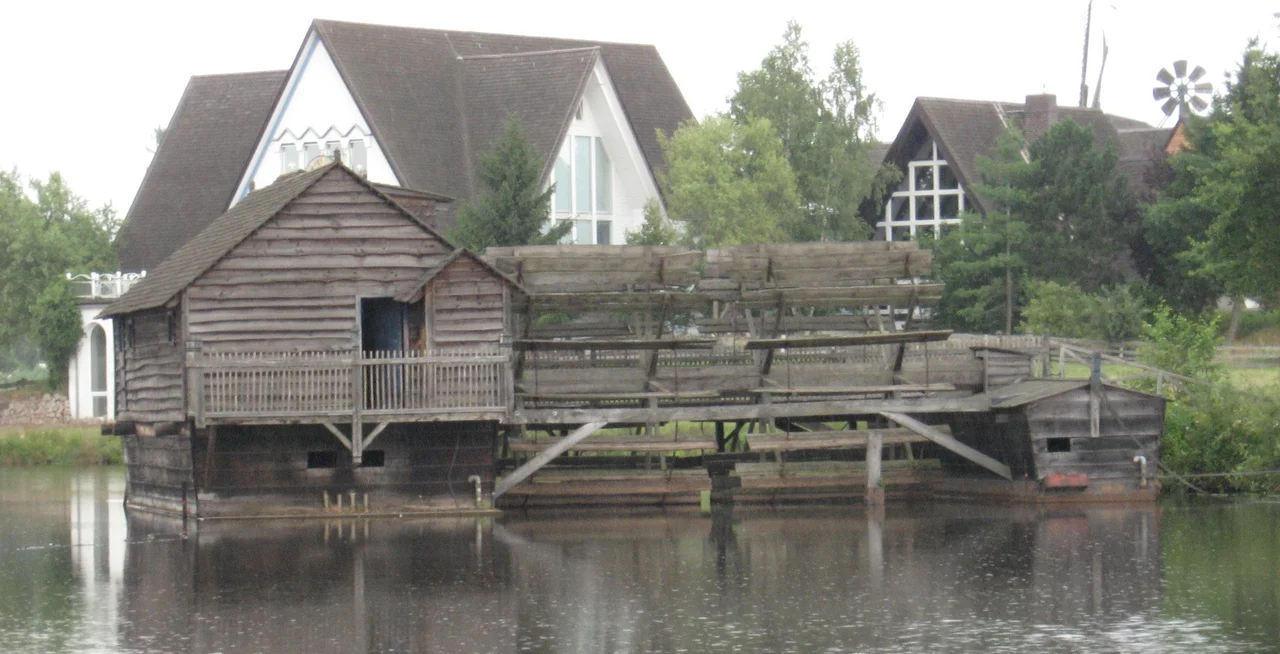
The strangest object on the site is the Julischka, a Danube ship mill launched onto the Ise in 1989 after a single year of construction. It took four groups to build: shipyard workers from Mohács, specialists from the open-air museum at Szentendre near Budapest, carpenters from Lower Saxony, and a Belgian mill-building firm.
It is two wooden hulls with a paddle wheel turning between them, the larger carrying the gearing and the miller's room. The owner is both miller and captain, free to hunt for the fastest water in the river — an enviable arrangement for him and an obstruction for everybody else, which is why regulations closed in during the nineteenth century. Ship mills were banned on the Rhine in 1861 and the last was gone by 1926. The type itself is ancient: floating mills were improvised as early as 536, during the Ostrogothic siege of Rome.
Twelve Countries in a Bog
The rest reads like an atlas. A smock mill after the one beside Sanssouci in Potsdam — the 1788 original that legend says annoyed Frederick the Great with its clattering, prompting the miller to take his king to the Supreme Court in Berlin. A white Greek tower mill with twelve sails on an artificial island. A Mallorcan corn mill with six cloth-covered sails. A Provençal mill copying the one at Fontvieille that Alphonse Daudet immortalised in Letters From My Mill.
The Ukrainian mill Natalka opened in 1988 in the presence of the Soviet consul general; its prototype stands in Gifhorn's twin town of Korsun-Shevchenkivskyi, near Kyiv, where it now serves as a restaurant. A Russian farmer's post mill was built near Arkhangelsk in 2001 and driven here by lorry. A Korean stamp mill came by ship in 2003, made from Korean fir and birch and erected by three specialists who travelled with it. A Serbian horizontal-wheel mill arrived in 2005. Across the water at the edge of town stands Lady Devorgilla, a copy of a Scottish mill from Dumfries, Gifhorn's other twin town.
Eight Gilded Domes
The wooden church comes last in the logic of the place and first in most people's memory of it. Twenty-seven metres high, with eight gilded cupolas, it reproduces a Russian Orthodox church of 1765 from the village of Kozlyatyevo — now Polyany — in Vladimir Oblast. Patriarch Alexy II consecrated it on 24 November 1995, and it holds icons, lamps and vestments from the Moscow patriarchate.
Around it the village square is a Rundling of three timber-framed houses, added between 1983 and 1990, where bread is still baked in wood-fired ovens. A thirty-metre pole carries the arms of every country on the site. The museum's later life has been less romantic than its founding — the town of Gifhorn bought it in 2021 for €2.6 million and reopened it after renovation in 2023. But the thing itself is still what one man built by refusing to stop at a model: a field where you can walk from Mykonos to Arkhangelsk in twenty minutes.
From the Air
The museum lies at 52.4936°N, 10.5478°E, on the southern edge of Gifhorn in Lower Saxony, roughly 20 km north of Braunschweig and 25 km west of Wolfsburg. It is one of the easiest small targets in the region to identify from 1,500–3,000 ft: a five-hectare lake with individual windmills spaced around its shore, plus a small artificial island carrying the white Greek mill, and the eight gilded domes of the wooden church throwing hard highlights in sunlight. The B4 and B188 federal highways cross just north of the site and frame it neatly. Braunschweig-Wolfsburg (EDVE) is about 20 km south-southeast at 52.319°N, 10.556°E and its control zone covers the approach — coordinate before descending. Hannover (EDDV) is roughly 65 km west-southwest. Terrain is flat heath and moor with no obstacles of consequence; the best light for the gilding is a low sun morning or evening, and ground fog is common over the Ise valley on calm autumn dawns.
Nearby Stories
- Asse II mine 9.4 km away
- Gardelegen Massacre 14 km away
- M'era Luna Festival 17 km away
- Celle State Stud 18 km away
- Bergen-Belsen concentration camp 20 km away
- Sack of Magdeburg 26 km away
- Free Republic of Wendland 31 km away
- Eschede train disaster 34 km away