
Celle State Stud
Hanover's problem in the 1730s was that its horses were not good enough. A noble who wanted a decent riding horse or a matched carriage pair had to buy abroad, and the money went with him. The solution was signed on 27 July 1735 by George II — king in London, elector in Hanover, duke of Brunswick-Lüneburg — and executed by his minister Gerlach Adolph von Münchhausen: put excellent stallions within reach of ordinary local breeders, let the mares of the region do the rest, and wait. It worked so thoroughly that the breed which came out of it is simply called the Hanoverian.
A Stud Without a Palace
Celle is unusual among the German state studs in not having grown out of a royal stable or a court mews. It was not built to supply the elector's carriages. It was built as agricultural policy — an instrument for improving the horses of everyone else, aimed squarely at the farmers and small breeders of the surrounding countryside.
That design decision shaped everything after it. The stud owned stallions; the region owned the mares. Quality moved outward from Celle in a slow annual pulse rather than being hoarded behind a palace wall. By around 1800 roughly a hundred stallions were standing at some fifty breeding stations spread across the land, and the horses of Lower Saxony were no longer something a gentleman apologised for.
English Blood
War nearly undid it. The Napoleonic Wars between 1803 and 1815 stripped horses out of northern Europe wholesale, and Celle's own stock went with them. Rebuilding meant importing, and the source was England: in 1829 George IV bought twenty-six first-rate stallions for the stud.
The decisive infusion came a generation later. From 1866 the state equerries of Hanover were the brothers August and Frederick von Spörken, who brought in more than a hundred Thoroughbred-influenced stallions from across the Channel. The point was not to make racehorses. It was to lighten and sharpen a solid, workmanlike local animal — to breed something larger, more refined, quicker off the mark and able to keep going. What the Spörkens started is still legible in every Hanoverian alive.
The Horse the Century Kept Redesigning
For most of the stud's history its customer was the army. Cavalry prestige kept nations buying horses long after tanks had made the charge obsolete, but the market finally collapsed, and the breeders around Celle had to decide what a horse was for.
The answer between the wars was agriculture. Horses pulled ploughs and machinery, so Celle supplied heavier, stronger stallions to match — a genuine redesign of an entire population within a couple of generations. Then tractors arrived and the question came round again, and the answer this time was sport. The Stallion Performance Test Centre at Adelheidsdorf, the best known of the stud's outposts, has changed its demands each time the market has turned: versatile driving and cavalry horse, then farm horse, then riding horse. Very few livestock institutions have had to reinvent their product three times and survived it.
Letters in the Bloodline
Hanoverian breeders name a colt for his sire line, which turns the studbook into something close to an alphabet. Zernebog, foaled in Pomerania in 1845 and standing at Celle from 1848 until his death in 1871, founded a family so large it had to be split in two — the F-line and the W-line, whose descendants include the Olympic dressage horses Wansuela Suerte, Weltall and Farbenfroh. The Mecklenburg stallion Norfolk, at Celle from 1849 to 1871, counts as a foundation sire through his daughters rather than his sons.
The Thoroughbred Adeptus stood at Celle and its outposts from 1884 to 1904. His male descendants carried the letter A for several generations before switching to E, which is how the line arrives at Eiger, 1996 Hanoverian Stallion of the Year, and through him at Espri, Escudo I and Escudo II. Devil's Own, foaled in 1887 and standing from 1894 to 1906, sits behind the show jumper Deister and the dressage sire Donnerhall. Goldschaum, born 1891, leads to Grande, Gotthard and Grannus — and Grannus was written off early by breeders who thought his foals too small, until those foals started clearing the biggest fences in the world. From that family came Isabell Werth's Gigolo.
Three Weekends in Autumn
The stud keeps around 130 active breeding stallions and serves roughly 7,000 mares a year through some forty breeding and insemination stations across Lower Saxony. For most of the year that is a quiet, administrative sort of business. For three weekends it is not.
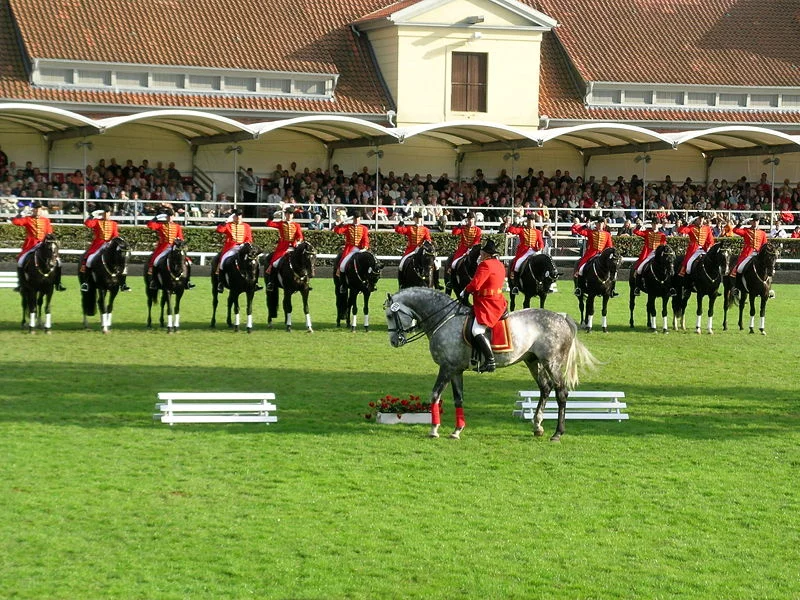
On the last two weekends of September and the first of October, Celle puts on the Hengstparade. The tradition of showing every state-owned sire to the public goes back to 1908, and the modern version runs to dressage sets, jumping demonstrations, and colour-matched drill teams that are the reliable crowd favourite. Stallions are driven in hitches of up to thirteen at once. There is Roman riding, with a rider standing across the backs of a pair. For years the solid black Escudo II performed his tricks on voice command alone, with no saddle and no bridle — a stallion doing exactly what he was asked, in front of several thousand people, wearing nothing at all.
From the Air
The Lower Saxon State Stud lies at 52.6150°N, 10.0733°E, on the southern edge of Celle just under a kilometre south of the castle. From 1,500–3,000 ft it shows as a formal cluster of long ranges around courtyards and paddocks, with the parade ground as a bare oval — during the September and October parade weekends it is ringed by grandstands, marquees and a very large car park, which makes it far easier to spot than the rest of the year. The River Aller loops north of town; the castle and its moated island sit between the two. Celle Air Base (ETHC) is about 3 km west-southwest at Wietzenbruch, an active army aviation training field with regular rotary traffic — coordinate before transiting and give the parade ground a wide berth on event days, when low overflight will not be welcome. Hannover (EDDV) is roughly 35 km southwest. Check NOTAMs for the Bergen-Hohne ranges to the north-northwest.
Nearby Stories
- Bad Nenndorf Interrogation Centre 9.6 km away
- German Tank Museum 11 km away
- Expo 2000 16 km away
- International Wind- and Watermill Museum 17 km away
- Asse II mine 30 km away
- Stones Fan Museum 41 km away
- Schnoor 49 km away
- Minden 54 km away