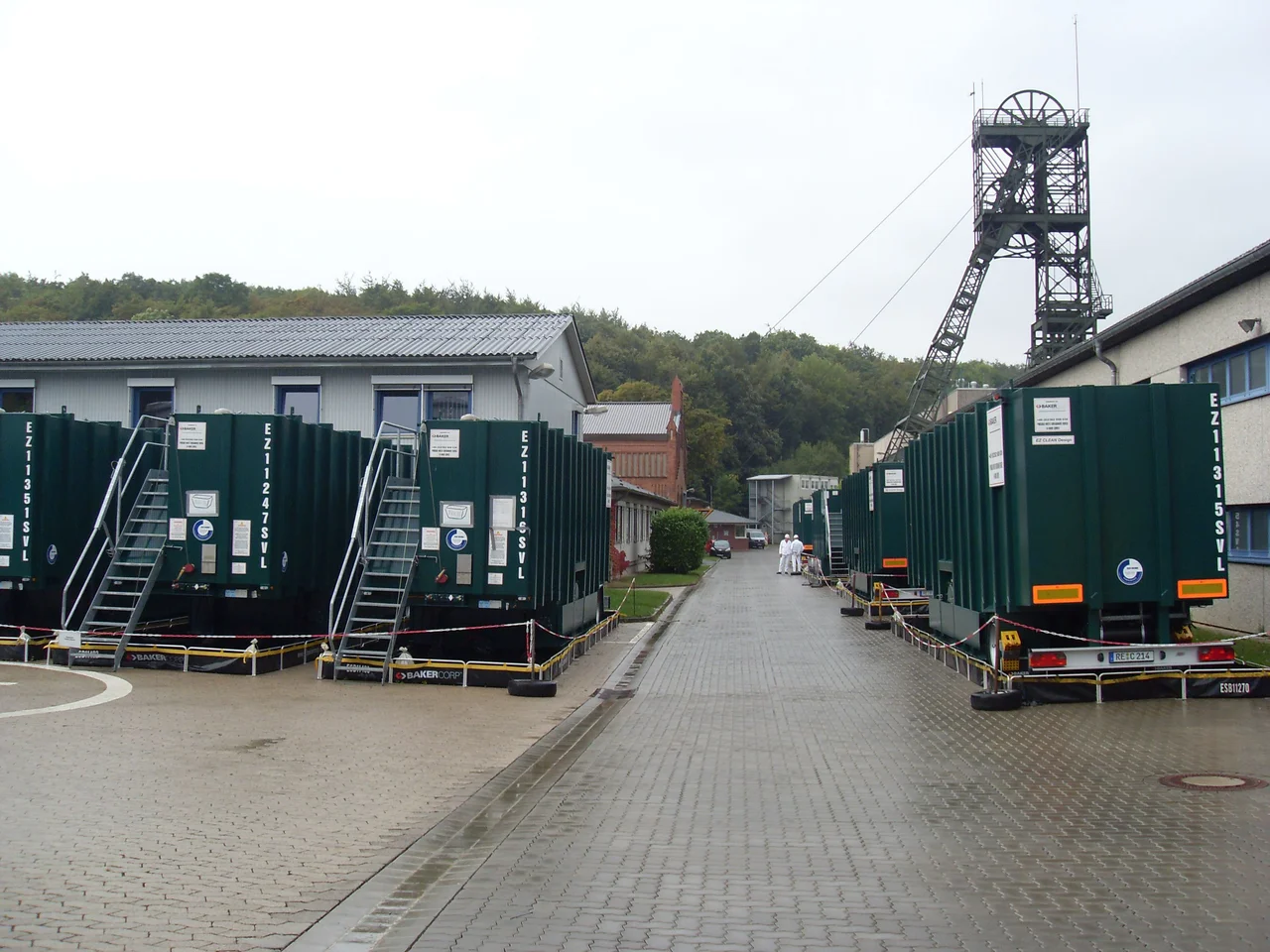

Asse II mine
The barrels were not meant to come back out. That was the design, not an accident. Between 1967 and 1978, more than 125,000 drums of radioactive waste went down a shaft in a wooded ridge southeast of Wolfenbüttel, and the salt around them was supposed to do the rest: creep shut, seal them in, hold them for longer than any steel container could. The drums were only ever certified safe for the journey there. Germany now intends to bring every one of them back to the surface, starting in 2033.
Why Salt Seemed Like the Answer
Asse II was sunk between 1906 and 1908 to a depth of 765 metres, working potash first and then rock salt until 1964. What remained was a large, dry, worked-out void in a salt dome, and in 1965 the state-owned Helmholtz Zentrum München took it over for the Federal Ministry of Research to test how radioactive waste might be stored underground.
Rock salt is dry, it excludes water, and under pressure it behaves plastically: it flows, slowly, and closes its own cavities. In principle a salt dome is a container that repairs itself on a geological schedule. The salt was intended to be the only containment the waste would ever have.
What Went Down the Shaft
The inventory was reviewed again in August 2008, after public speculation about what was down there: 125,787 drums of low-level waste emplaced between 1967 and 1978, mostly at the 750-metre level, with a declared total activity of 1.8 × 10¹⁵ becquerels. Around half came from the Karlsruhe reprocessing plant, a fifth from power stations, a tenth from the Jülich research centre — mixed and laboratory waste, rubble, scrap, filter and combustion residues. Liquids were supposed to be solidified first, though former employees say drums of liquid were accepted early on.
A separate 1,293 containers of medium-level waste went into Chamber 8a at the 511-metre level between 1972 and 1977, some of them holding fissile material. Also in the mine: 497 kilograms of arsenic, mercury, tons of lead, and animal carcasses from radiation experiments.
There is a catch in the numbers. Waste was classified by the radiation measurable outside a container rather than by its contents, so concrete-shielded vessels must be assumed to hold medium-level waste too, which lifts that count from 1,293 to nearer 16,100.
Rolled Off the Embankment
In the early years the barrels were set down in orderly rows with space between them, so inspection remained at least theoretically possible. That is not how most of the waste arrived.
Once the volumes grew, drums were rolled off a salt embankment into the chambers and each layer covered with salt. The method cut the workers' radiation dose and saved time. It also meant a large share of the containers were damaged on the day they were emplaced. They were not built for permanence — rated for transport, and steel rusts, faster in salt than almost anywhere. Nobody expected to need them intact, because nobody planned to open the chambers again.
The Mountain Is Moving
At Asse II the overlying rock mass moves 15 centimetres a year, and decades of tunnelling left so many voids that the pressurised salt is losing stability — softening, in the engineering reports' language, through creep deformation, plasticity effects and fracture under ground pressure.
A working group under H. H. Juergens described exactly this in 1979: uncontrolled plastic flow on the southern flank, then loss of load-carrying capacity. The mine's manager and his advisers dismissed the report as unscientific and said there were no stability problems. In 2007 the Institut für Gebirgsmechanik in Leipzig, monitoring since 1996, predicted that displacement would accelerate and water inflow become uncontrollable.
Water had been the other problem all along: 29 documented breaches between 1906 and 1988, then 32 new entry points between 1988 and 2008. In 1996 the Federal Office for Radiation Protection warned the environment ministry that flooding would risk severe contamination. By 2008 brine was entering at 11.8 cubic metres a day, intercepted before it can reach the drums and trucked away to abandoned mines elsewhere in Lower Saxony.
Getting It Back Out
In 2008 press reports revealed brine contaminated with caesium-137, plutonium and strontium, and politicians accused the operator of failing to inform the authorities. On 8 September, Lower Saxony and the federal government replaced Helmholtz Zentrum München with the Federal Office for Radiation Protection.
Earlier closure plans, drawn up between 1992 and 2007, had assumed retrieval was not feasible. Cavities were backfilled with salt, and the intention was to flood the mine with magnesium chloride solution — abandoned once it became clear the solution would dissolve the waste, could carry it into groundwater, and might react with cement to produce explosions and blowouts. Most chambers had been sealed behind thick walls by then, so the state of what is inside is unknown.
The 2010 plan reversed everything. Remote-controlled robots are to collect the waste, repack it and move it to a new interim store above ground, once a shaft wide enough has been sunk. Chamber 7 goes first; test drillings there in 2017 returned the first images from inside in decades, showing damaged and rusted drums. Closure is costed at around 4.7 billion euros, funded from taxes rather than by the utilities that made most of the waste.
Salt was chosen because it works on a timescale measured in geological epochs. The waste went in between 1967 and 1978, and by 2008 the argument had already moved on to how to get it out.
From the Air
Asse II lies at 52.1289°N, 10.6708°E on the Asse, a narrow wooded ridge running northwest to southeast about 8 km southeast of Wolfenbüttel and rising clearly above open farmland on both sides. From 2,000-3,500 ft the surface installation is easy to identify: cleared ground and shaft buildings on the ridge flank, with the brine tanker yard and access road beside them, and forest closing in immediately around. The Harz foothills rise to the south, and the Salzgitter steelworks make a large landmark to the west. Nearest airfields: Braunschweig-Wolfsburg (EDVE) 22 km north, Magdeburg-Cochstedt (EDBC) 59 km southeast, Hannover (EDDV) 76 km northwest. Terrain is easy, though winter inversions in the Börde lowlands can hold fog well into the day.
Nearby Stories
- Wernigerode Castle 5.7 km away
- Wolfsburg 6.3 km away
- Battle at the Harzhorn 6.7 km away
- Hildesheim Cathedral 17 km away
- Gardelegen Massacre 21 km away
- Sack of Magdeburg 25 km away
- Celle State Stud 27 km away
- Eisleben 43 km away