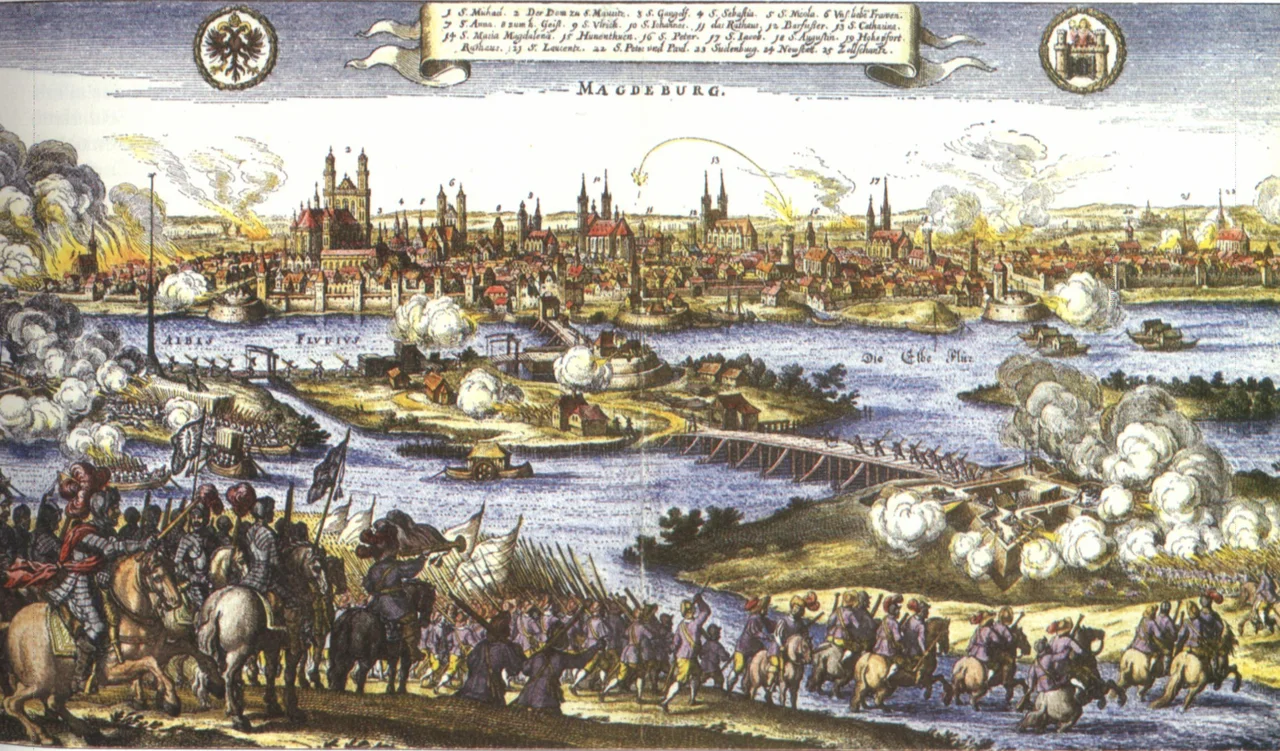

Sack of Magdeburg
A census taken in Magdeburg in 1632 counted 449 inhabitants. The year before there had been more than 25,000 — one of the largest cities in what is now Germany, prosperous on Elbe river trade, Lutheran since 1524, and confident enough to refuse a tribute demanded by a Holy Roman Emperor. Then, on the morning of 20 May 1631, imperial soldiers forced the Kröcken Gate, and by ten o'clock most of Magdeburg was burning. Parts of the city lay in rubble until at least 1720. Soldiers gave the day a nickname with the black humour of men who were there: Magdeburger Hochzeit, Magdeburg's Wedding. The city's own name for it was Magdeburgs Opfergang — Magdeburg's Sacrifice.
The City That Picked a Side
Magdeburg had been choosing this fight for a century. Its citizens turned Protestant in 1524 and joined the Schmalkaldic League against Charles V in 1531; when war followed, the city sheltered Protestant scholars and earned an imperial ban that stood until 1562. It had already withstood one siege, in 1550–51. So when Emperor Ferdinand II issued the Edict of Restitution in March 1629, demanding church territories back under Catholic rule, Magdeburg was among the largest prizes on the list and among the least likely to comply. Hope arrived by sea. King Gustavus Adolphus of Sweden, a Lutheran, landed in Pomerania on 6 July 1630, and many in Magdeburg were certain he would come for them. In November he sent Dietrich von Falkenberg to run the city's defences. Falkenberg fortified the suburbs and recruited troops, and the councillors, emboldened, refused the emperor's tribute.
Two Months at the Walls
The siege opened on 20 March 1631 under Johann Tserclaes, Count of Tilly, a Flemish mercenary in imperial service, who left his field marshal Gottfried Heinrich Graf zu Pappenheim in command while he campaigned elsewhere. Twenty-four thousand imperial soldiers sat outside the walls — very nearly one for every person inside them. Through hard fighting they took several of the city's outer sconces, and Tilly demanded surrender. Magdeburg waited for the Swedes. The Swedes did not come; Gustavus Adolphus was winning at Frankfurt an der Oder on 13 April, but he did not march on Magdeburg. Tilly returned with reinforcements, and Pappenheim finally talked him into storming the place on 20 May with 40,000 men. There is one detail in the record that is hard to read without wincing. On the last day of the siege, the city councillors decided to sue for peace. Word of their decision did not reach Tilly in time.
The Morning of 20 May
It began at dawn with heavy artillery, then infantry. The fortifications were breached, the defenders overrun, and the Kröcken Gate thrown open so the whole army could get in. Falkenberg was shot dead during the fighting, and whatever coordination the defence still had died with him. Attackers set fire to individual houses to flush out men who would not stop shooting; the written reports suggest that the general conflagration which followed was nobody's plan. It made no difference. Wind carried the flames from street to street, and 1,700 of the city's 1,900 buildings burned. Tilly sent soldiers to save the cathedral, where a thousand people had taken refuge; six hundred more sheltered in the Premonstratensian monastery. Those two buildings account for most of the survivors. The majority of the dead were not killed by soldiers at all. They suffocated, or they burned.
Counting People, Not Numbers
The figure usually given is around 20,000 dead, defenders and civilians together, and the event is commonly described as the worst massacre of the Thirty Years' War. Estimates of a seventeenth-century fire are never exact, and historians have argued over the arithmetic ever since — a survivor's poem mourned thirty thousand souls. What is not in dispute is the proportion: of roughly 25,000 people, about 5,000 lived. These were families in a working river city — weavers, bargemen, brewers, the households the imperial soldiers went door to door through demanding valuables, because the army had not been paid. There are contemporary reports of rape and of torture. Tilly ordered the looting stopped on 24 May and had a Catholic mass celebrated in the cathedral the following day. For fourteen days after that, work parties dumped charred bodies into the Elbe to keep disease from finishing what the fire had started.
A New Verb, and a Letter From Rome
The destruction was so complete that German acquired a word for it. To magdeburgise — magdeburgisieren — meant to wipe a place out entirely, and it stayed in use for decades. Protestants coined companion phrases of their own: "Magdeburg justice," "Magdeburg mercy," "Magdeburg quarter," said aloud while executing Catholics who begged to be spared. The victors were pleased. Duke Maximilian of Bavaria congratulated Tilly on 1 June, and on 18 June Pope Urban VIII wrote with a line that has outlived nearly everything else about him: "You have washed your victorious hands in the blood of sinners." Gustavus Adolphus, who had not marched, told anyone who would listen that the citizens had failed to pay properly for their own defence. In the end Magdeburg did more damage as a ruin than it ever had as a fortress — the sack pushed wavering rulers into arms against the emperor. Schiller wrote it up in 1792, Goethe put it in a poem, and Brecht set a scene of Mother Courage against it in 1939, by which time Europe was preparing to do the whole thing again.
From the Air
Magdeburg sits at 52.133°N, 11.617°E on the west bank of the Elbe in Saxony-Anhalt, about 130 km west of Berlin. The unmistakable landmark is Magdeburg Cathedral — the twin-towered Gothic mass that survived 20 May 1631 and sheltered a thousand people while the city burned around it — standing close to the river on the southern edge of the old town. Approach from the south along the Elbe at 2,000–3,000 ft AGL for the best view of the cathedral against the water; the medieval street grid was largely rebuilt after 1631 and again after 1945, so the historic outline reads best in the riverfront and the fortification lines rather than the buildings. Nearest fields are Magdeburg City (EDBM) just north-east of the centre, Magdeburg-Cochstedt (EDBC) to the south-west, Leipzig/Halle (EDDP) about 100 km south-east, and Berlin Brandenburg (EDDB). Terrain is flat; expect river fog along the Elbe on calm autumn mornings and low ceilings through the winter.
Nearby Stories
- Quedlinburg 10 km away
- Inner German Border 13 km away
- Helmstedt–Marienborn border crossing 16 km away
- Jerichow Monastery 21 km away
- Bauhaus Dessau 31 km away
- Autostadt 32 km away
- All Saints' Church, Wittenberg 36 km away
- Lichtenburg Concentration Camp 48 km away