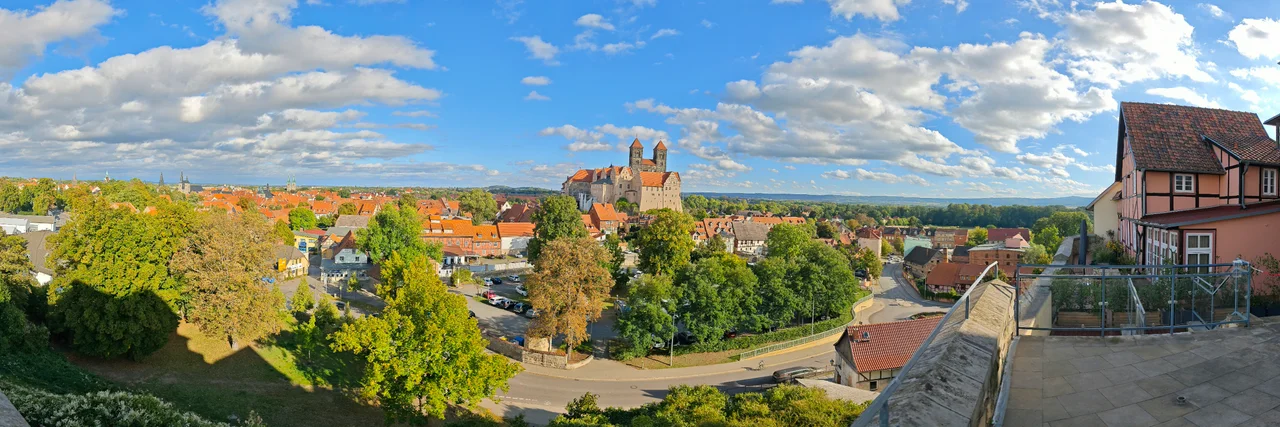

Quedlinburg
The stone coffin in the crypt of St Servatius is empty. Henry the Fowler — the Saxon duke who became the first king of a German realm — was buried on this hill in 936, and at some point in the eleven centuries since, his remains left the grave. Nobody knows when they went, or where, or who moved them. The coffin is battered and it is unoccupied, and that vacancy turned out to be extremely convenient for people who came looking for him a thousand years later. Everything else about Quedlinburg is unusually well preserved. This one thing is missing.
A Town Handed Over in 922
Quedlinburg first appears in the record in 922, in a donation by Henry the Fowler. He built a castle on the sandstone outcrop above the valley; Otto I extended it in 936, the year his father died. In that same year Henry's widow Matilda — later canonised — founded a religious community for women on the hill, at her son's request, as a memorial to her husband. The first abbess was another Matilda, Henry's granddaughter.
What followed was one of the more remarkable arrangements in medieval Europe. Quedlinburg Abbey held imperial immediacy: its abbess sat and voted at the Imperial Diet, stood exempt from the jurisdiction of her diocesan bishop at Halberstadt, and answered to nobody below the Pope. For roughly nine hundred years, a woman ruled this town and its territory as a small sovereign state. The arrangement ended only with the German mediatisation of 1802–03, when Prussia absorbed the lot.
Two Thousand Houses, Six Centuries
Walk out of the abbey precinct and down into the town and you are in something close to an open-air archive of German carpentry. Around 2,100 timber-framed buildings stand in the old town, and they were not all built in one flourish — they span roughly six centuries, and the methods change as you walk.
The oldest is the Ständerbau on the Wordgasse, dated to 1347 and now the Fachwerkmuseum, built with continuous posts running the full height of the frame. Later builders stacked storeys instead, jettying each one out over the street below, and later ones still filled the sill beams with carved rosettes and fan patterns and painted the whole front. Around the edges of the old town the sequence keeps going into Jugendstil villas of the late nineteenth and early twentieth centuries. The Second World War left the centre largely alone; preservation orders were placed on a great many of the buildings, and UNESCO inscribed the collegiate church, castle and old town in 1994.
The Shrine on the Hill
In 1936, the thousandth anniversary of Henry's death, Heinrich Himmler began holding annual SS ceremonies at Quedlinburg. He had decided that Henry the Fowler was the first German king and the most German of German rulers, and he declared the tomb a place of pilgrimage.
The problem was the empty coffin. Excavations in 1937 duly produced remains announced as the king's, and they were reinterred with ceremony in a new sarcophagus; the identification was later shown to be a rather clumsy fake. In 1938 the collegiate church of St Servatius was closed to its congregation and refitted as an SS Weihestätte, a consecration site for a manufactured cult. A Romanesque church that had held services for eight hundred years was taken from the people who used it and dressed up as a stage set for someone else's mythology. It was rededicated to Protestant worship in 1945. The stone coffin in the crypt is empty again, and honestly so.
The Castle Above
The Schlossberg still does what a castle hill is supposed to do: it holds the eye from anywhere in the town, and from the top the roofs below resolve into a dense field of red tile broken by the occasional church tower. What stands there now is largely Renaissance, built over the medieval foundations by later abbesses who had money and taste and no particular obligation to anyone.
The centrepiece inside is the restored baroque Blue Hall, and the abbey treasury and church repay the climb on their own terms — the Romanesque interior of St Servatius is one of the clearest surviving statements of the style anywhere in Germany, all thick round arches and heavy alternating piers. Quedlinburg still plays up its Ottonian past with a certain relish: the Kaiserfrühling at Pentecost stages a medieval spring assembly of the emperor, and Spring Awakening fills the castle hill the weekend before Easter.
Steam and Courtyards
The Harz begins immediately behind the town, and the most enjoyable way into it leaves from Quedlinburg's own platform. The Harzer Schmalspurbahnen narrow-gauge steam network opened in 1898 and carries more than a million passengers a year, but it only reached Quedlinburg in 2006, when the Selke valley branch was extended in from Gernrode. From there the network climbs to Alexisbad and eventually to the Brocken, whose line resumed public service in July 1992 — a haul from Schierke at 685 m to the summit at 1,141 m that leaves the locomotives working audibly hard.
Back down in the town, the best time to be here may be the second and third weekends of Advent, when private courtyards behind the timber fronts are opened to visitors. The old town is not a museum quarter; people live in these houses. For a few December evenings they let you walk through the back of them, which is a rarer thing to be offered than any of the monuments on the hill.
From the Air
Quedlinburg lies at 51.7917°N, 11.1472°E on the northern apron of the Harz, where the wooded range breaks down into open farmland. From 2,000–4,000 ft the town shows as a tight, roughly circular mass of red roofs on otherwise flat, heavily cultivated ground, with one clear high point: the Schlossberg outcrop on the south-western side carrying the pale bulk of the castle and the twin towers of St Servatius above everything else. The Bode river runs past the town from the gorge to the south-west, and the dark wall of the Harz fills the horizon in that direction. The Brocken (1,141 m) stands about 36 km west and is the region's most reliable large-scale reference. Nearest airfields: Ballenstedt (EDCB) about 10 km south-east, Magdeburg-Cochstedt (EDBC) about 20 km east-north-east, Braunschweig-Wolfsburg (EDVE) about 70 km north-west, Leipzig/Halle (EDDP) about 100 km south-east. The Harz edge produces mechanical turbulence and wave in southerly and south-westerly flow, and the range frequently sits under orographic cloud while the plain around Quedlinburg stays clear.
Nearby Stories
- Domfelsen 10 km away
- Kyffhäuser Monument 10 km away
- Schöningen spears 13 km away
- Herzog August Library 15 km away
- Upper Harz Water Regale 15 km away
- German National Academy of Sciences Leopoldina 25 km away
- 1st German Bratwurst Museum 36 km away
- Magdeburg Cathedral 40 km away