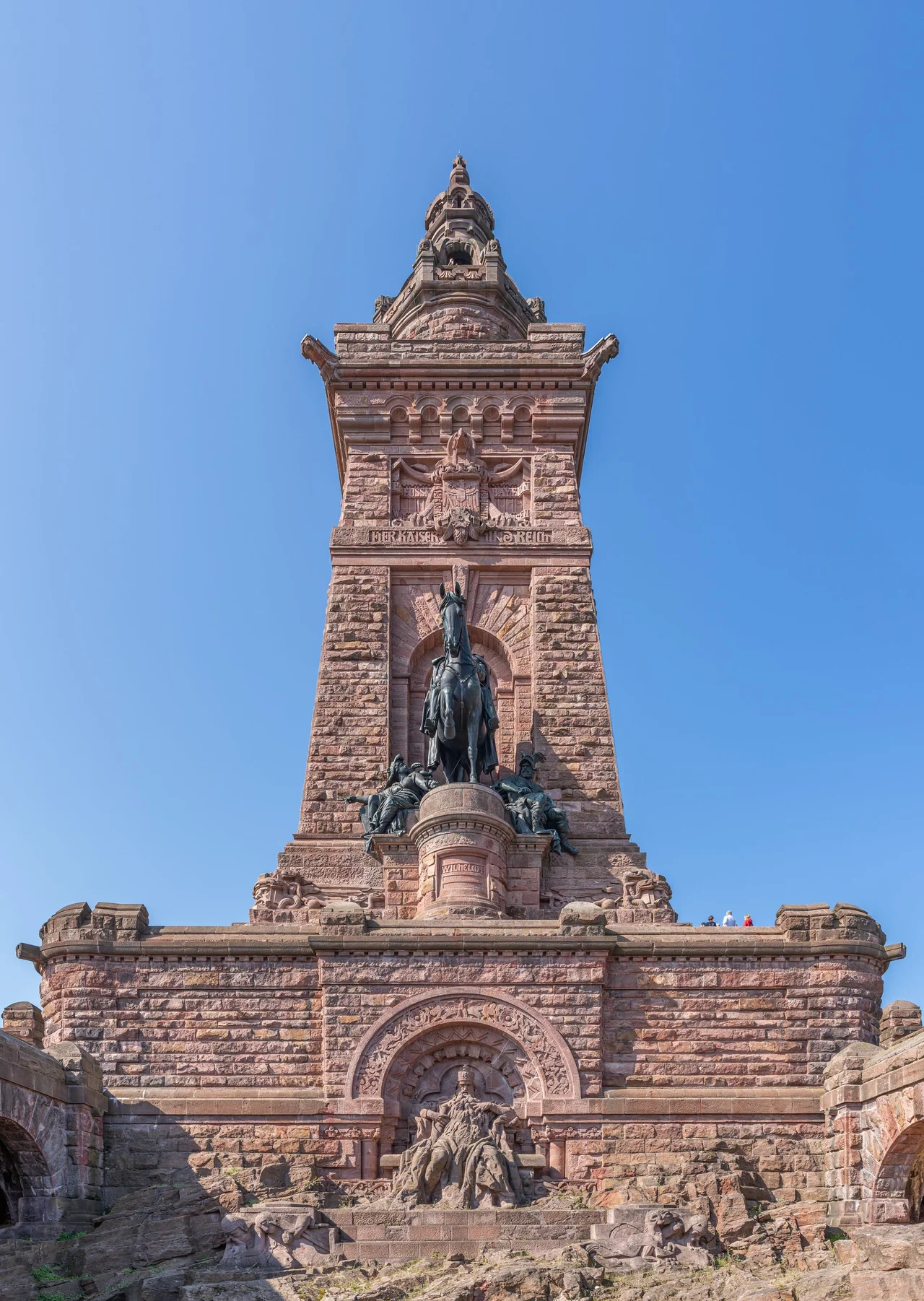

Kyffhäuser Monument
The legend is one of the oldest in Germany: the Emperor Frederick Barbarossa is not dead but asleep inside the Kyffhäuser hills, his red beard growing through the stone table in front of him, waiting for the hour when the country needs him and he will come back. It is a story about absence — about a nation that did not exist, consoling itself with a king who might return. Then in 1871 a German empire was declared, and the story became inconvenient. If the sleeper's job was to unify Germany, and Germany was now unified, someone had to have done the waking. The monument that went up here between 1890 and 1896 is a very large, very literal answer to that question.
The Hill Under the Monument
Long before the masonry, the Kyffhäuser had a castle. Building began around the year 1000 on the ridge above the Goldene Aue, and Kyffhausen became a major imperial fortress under the Hohenstaufen — which is why the Barbarossa legend attached itself to this hill rather than any other.
What survives is fragmentary but startling in one respect. The castle well was sunk 176 metres through the rock, reckoned the deepest castle well in the world, and it still holds water. The keep, seventeen metres of it, stands beside the monument and can be climbed. The medieval ruins and the imperial-era monument occupy the same ridge, which is precisely what Bruno Schmitz intended when he sited it: the new empire physically standing on the old one.
Eighty-One Metres of Argument
Bruno Schmitz was the architect of choice for German nationalism in stone — he also designed the vast Monument to the Battle of the Nations at Leipzig and the Emperor William Monument at the Porta Westfalica. Here he worked in red sandstone at a scale meant to overwhelm: 81 metres in total, a 57-metre tower, the whole thing planted at 420 metres on an outcrop below the 439-metre summit. Two hundred and forty-seven steps take you to the viewing platform.
The detailing is an argument rather than a decoration. Schmitz borrowed the rough bossed masonry of twelfth- and thirteenth-century Hohenstaufen castles, so that a building finished in 1896 would read as continuous with the Middle Ages. The claim was explicit: the Prussian-led empire of 1871 was the rightful successor to the Holy Roman Empire, and the intervening centuries were an interruption. Decline and rebirth — that was the theme, hammered into every visible surface.
Two Emperors, Stacked
The composition puts the whole thesis in a vertical line. At the base, in a small terraced quarry, sits Nikolaus Geiger's Barbarossa: six and a half metres of sandstone, carved on site from several blocks, surrounded at his feet by knights, courtiers and mythical creatures, caught at the exact moment of waking. Geiger set the imperial crown into the emperor's beard, since the actual crown of the Holy Roman Empire has long been in the Hofburg in Vienna and was not available to be borrowed.
Above him, high on the tower, rides Emperor William I — an equestrian group by Emil Hundrieser, neo-baroque, some eleven metres tall and around sixteen tons of copper sheet just two to three millimetres thick over an iron frame. Wilhelm appears as a general in Pickelhaube and Grand Cross of the Iron Cross, flanked by allegories: a Germanic warrior for defence, and a woman with a pen and an oak-leaf wreath for history. The old emperor stirs below; the new one is already mounted and awake above him. Nobody was expected to miss the point.
The Federation That Built It
The monument came from the veterans. It was first proposed by the Deutscher Kriegerbund, and around 1900 a new body, the Kyffhäuserbund, took over its management and took the hill's name for its own. Its scale is easy to underestimate: by 1913 it counted 2.8 million former soldiers as members, making it one of the largest organisations in Germany.
What followed is the century in miniature. Membership collapsed after the First World War; the federation centralised in 1921 and renamed itself; after 1933 it was absorbed into the Nazi state like everything else, becoming the sole veterans' body in the Third Reich and taking a National Socialist name in 1938. Then in March 1943, in the weeks after Stalingrad, the regime disbanded it without ceremony — a federation built on the idea that soldiering ended in honoured retirement had become an embarrassment in a war that was no longer producing veterans. It was formally outlawed in 1945 and re-established in West Germany in 1952.
Standing Anyway
It is still here, and it is still the third-largest monument in Germany, which is a slightly awkward thing for a country to have. Since 2014 the site has been run by a tourism company from Bad Frankenhausen, six and a half kilometres south, after the previous operator ran into money trouble. People come for the view.
And the view is genuinely worth the 247 steps. From the platform the Goldene Aue opens out to the north-east, the Harz stands along the northern horizon, and the ridge falls away into beech woods where the Barbarossa Cave — a gypsum cavern with underground lakes — draws its own visitors on the strength of the same legend. The monument was built to make an argument that history has since dismantled. What is left is a red sandstone tower on a good hill, and a stone emperor down in the quarry, still not quite awake.
From the Air
The Kyffhäuser Monument stands at 51.4131°N, 11.1097°E, at 420 m on the eastern end of the wooded Kyffhäuser ridge in northern Thuringia, and it is one of the easiest landmarks in the region to identify: an 81 m red sandstone tower rising clear of the treeline on a narrow 800 m outcrop, with the medieval keep of Kyffhausen Castle alongside. Best appreciated from 2,000–3,500 ft, offset to the north-east so the tower stands against the flat Goldene Aue plain behind it. Bad Frankenhausen and the white rotunda of the Panorama Museum lie 6 km south, Tilleda sits below to the north-east, Nordhausen is 24 km north-west, and the Harz massif with the Brocken 55 km north closes the horizon. Nearest airfields: Ballenstedt (EDCB) about 38 km north-east, Erfurt-Weimar (EDDE) about 49 km south, Magdeburg-Cochstedt (EDBC) about 54 km north-east, Eisenach-Kindel (EDGE) about 64 km west, Leipzig/Halle (EDDP) about 78 km east. The ridge rises only some 300 m above the plain, but it catches cloud base ahead of the surrounding country in moist northerly flow.
Nearby Stories
- Bode Gorge 7.6 km away
- Buchenwald concentration camp 19 km away
- Upper Harz Water Regale 21 km away
- Dejudaization Institute Memorial 25 km away
- Unicorn Cave 26 km away
- German National Academy of Sciences Leopoldina 26 km away
- Bauhaus Dessau 47 km away
- Horch 77 km away