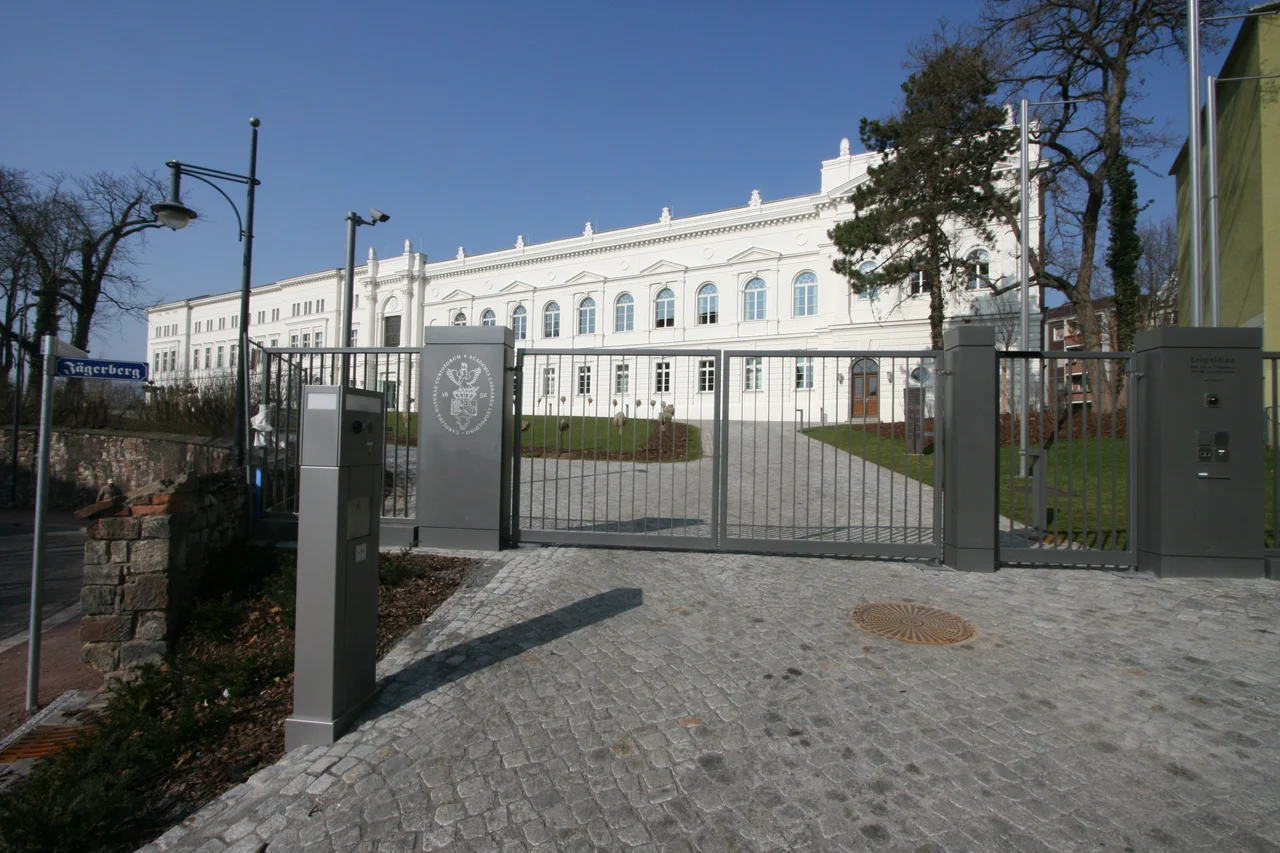

German National Academy of Sciences Leopoldina
For its first two hundred and twenty-six years, the oldest scientific academy in Germany had no building. It had no city either. The Leopoldina conducted its affairs by letter, and its headquarters was wherever the current president happened to keep his consulting rooms - so the institution migrated from Schweinfurt to Nuremberg to Augsburg to Altdorf to Erfurt, then to Halle, back to Nuremberg, on to Erlangen, Bonn, Breslau, Jena, Dresden, and at last, in 1878, to Halle for good. An academy that existed as a correspondence network rather than a place turned out to be remarkably hard to kill, which mattered more than anyone founding it could have foreseen.
Four Physicians and an Emperor's Vanity
It began on 1 January 1652 in the imperial city of Schweinfurt, where four local doctors - Johann Laurentius Bausch, Johann Michael Fehr, Georg Balthasar Metzger and Georg Balthasar Wohlfarth - agreed to constitute themselves the Academia Naturae Curiosorum, the Academy of Those Curious About Nature. Bausch took the presidency. They were following Italian models, and for a while they were the only body of their kind in the German lands. From 1670 they published the Ephemerides, also known as the Miscellanea Curiosa, one of the earliest scientific journals anywhere, weighted towards medicine, botany and physiology; it survives today as the Nova Acta Leopoldina. Emperor Leopold I raised the society to an academy in 1677 and made it an imperial academy in 1687, granting it the mouthful Sacri Romani Imperii Academia Caesareo-Leopoldina Naturae Curiosorum and, more usefully, the right to carry his name. Everyone has called it the Leopoldina ever since.
Curtain
The academy's worst chapter is also its most ambiguous. From 1933 the Leopoldina began removing its Jewish members; Albert Einstein was the first, excluded under public pressure. By 1938 its officers were assuring the Nazi government that every Jewish member had been expelled. That assurance was not quite true. Around seventy members' index cards had been taken out of the file and hidden behind a curtain, the published membership lists simply stopped appearing, and expelled members went on quietly receiving the academy's publications with no public announcement of their removal. When Germany surrendered, the cards went straight back into the drawer. None of this saved anybody. Eight of the academy's Jewish members were murdered in the Holocaust - men whose names had been on those cards, whose colleagues had voted to elect them and then acquiesced in erasing them. The president through those years, Emil Abderhalden, held office from 1932 until 1950, and the historical judgement on him remains divided between the harm he permitted and the harm he obstructed.
An Academy on the Wrong Side of the Wall
Halle ended the war in the Soviet zone, and the German Democratic Republic dissolved societies as a matter of policy, so members met privately for several years. The academy pushed back the way a scholarly body can: an edition of Goethe's scientific writings began appearing under its name in 1947, lectures resumed in 1948, and official reopening followed in 1952 - just in time for the tercentenary. What came after took more nerve. East Berlin wanted the Leopoldina reconstituted as a specifically East German institution, and the Leopoldina declined, insisting on membership across the whole of Germany and beyond. The Berlin Wall in August 1961 made that position expensive; a meeting planned for the West had to be cancelled because members living in the GDR would not be permitted to travel. For thirty years the academy remained one of the few institutions with a foot on each side of the line.
Becoming the National Academy
After reunification the Leopoldina became a non-profit body funded jointly by the federal government and the state of Saxony-Anhalt. Then, in November 2007, the science minister Annette Schavan announced its elevation, and in February 2008 it was formally declared Germany's National Academy of Sciences - the country's equivalent of the Royal Society or the American National Academy, charged with giving independent scientific advice to government. It was, on one reading, an odd choice: a body headquartered in a mid-sized city in the former East rather than in Berlin or Munich. On another reading it was the obvious one, since the Leopoldina had spent the Cold War proving it could be national when the nation itself was not. Around 1,600 members are elected today, roughly three quarters of them from German-speaking countries and the rest from about thirty others.
The Register of Names
The membership roll is the real artefact. Goethe is on it - the poet was a serious enough naturalist to be elected, and the academy later edited his scientific works. So are Ernst Haeckel, Max Planck, Otto Hahn, Carl Friedrich von Weizsacker, and Einstein, whose name went back on. The presidents' list reads as a map of German intellectual geography drifting slowly eastward and then stopping: Schweinfurt, Nuremberg, Augsburg, Altdorf, Erfurt, Erlangen, Bonn, Breslau, Jena, Dresden, and from 1878 Halle without interruption. Jorg Hacker held the chair from 2010, Gerald Haug from 2020, and since 2025 the president has been Bettina Rockenbach - the first woman to lead the academy in three hundred and seventy-three years.
From the Air
The Leopoldina's headquarters stands at 51.487 N, 11.963 E on the Jaegerberg, a low rise about 700 m north-west of Halle's market square in Saxony-Anhalt, at roughly 95 m elevation. From 2,000-3,000 ft AGL the reference points are all close by: the four towers of the Market Church and the freestanding Red Tower just south-east, the Saale and the wooded Peissnitz island immediately west, and Giebichenstein Castle on the river cliffs 1.5 km north. The Francke Foundations campus lies 1.5 km south-south-east. Leipzig/Halle (EDDP) is about 20 km north-east, and Halle sits inside its airspace, so expect controlled-airspace handling on any approach. Saale valley fog is frequent from October to March; the city photographs best from the north-west in late afternoon, with the river in the foreground.
Nearby Stories
- Colditz Cock 11 km away
- Eisleben 12 km away
- Bauhaus Dessau 19 km away
- Battle of Jena-Auerstedt 23 km away
- Torgau 29 km away
- Quedlinburg 34 km away
- Jena 45 km away
- Treuenbrietzen 49 km away