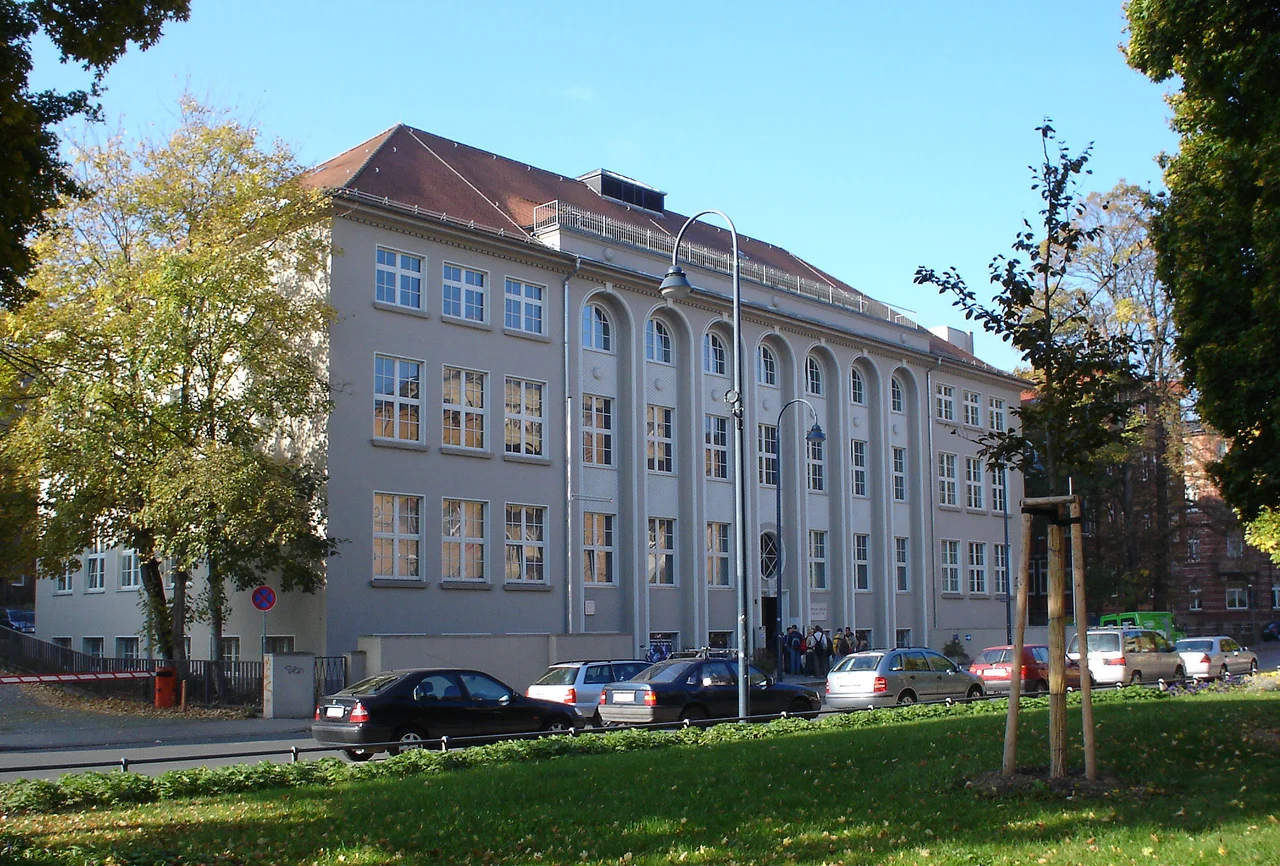

Jena
To prove you had really studied at Jena, you had to be able to name the seven wonders in the correct order. Not the wonders of the ancient world - the wonders of Jena, a fixed local canon that every student was expected to have visited and memorised: Ara, Caput, Draco, Mons, Pons, Vulpecula Turris, Weigeliana Domus. Reciting them in sequence counted as evidence of a Jena education. One of the seven was a dragon with seven heads, assembled from animal bones and papier-mâché as a student prank. That combination - real intellectual seriousness and outright absurdity, held together without any apparent strain - is still more or less what the city is like.
Ara, Caput, Draco
The list is worth having. Ara, the arch, is the underpass beneath the altar of St Michael's church. Caput, the head, is the mechanically moving figurehead above the astronomical clock on the town hall. Draco is the fabricated dragon, which survives in the Göhre museum of local history. Mons is the Jenzig, the 385-metre hill northeast of town. Pons was the nine-arched Camsdorfer Brücke over the Saale. Vulpecula Turris is the Fuchsturm, a high-medieval keep on a hilltop to the east. And Weigeliana Domus was the house built for a seventeenth-century professor of mathematics, fitted out with a wine conduit running from the cellar to the dining room, a mechanical lift, and long tubes for observing the stars. Five of the seven still exist. The bridge and the professor's house are gone, which is a pity, since the wine conduit sounds like the best of them.
Idealists, Romantics and a Doctorate by Post
Around 1800 this small town was briefly one of the most consequential intellectual addresses in Europe. German idealist philosophy was worked out here by Johann Gottlieb Fichte and Friedrich Wilhelm Joseph Schelling. Early Romantic literature was invented in the same streets by Novalis and the brothers Friedrich and Wilhelm Schlegel, which is why literary historians still speak of Jena Romanticism as a distinct thing. Goethe and Schiller both lived here for years, though Weimar has always taken the credit. The university, founded in 1558 and named after Schiller in 1934, also issued the occasional degree at a distance: Karl Marx submitted his dissertation on Democritus and Epicurus to Jena in 1841 rather than to Berlin, whose conservative faculty had taken against it, and was awarded his doctorate without ever attending a lecture in the city. Ernst Haeckel taught biology here for decades. And in October 1806, on the plateau just west of town, Napoleon destroyed the Prussian army in a single day - a victory the French still carry on their maps, in the Pont d'Iéna and the Avenue d'Iéna.
Abbe's Eight Hours
Carl Zeiss opened a workshop for optical instruments in 1846. The physicist Ernst Abbe joined him and turned a trade into a science, deriving the sine condition that governs how a lens must behave to form a sharp image, and the resolution limit that says no microscope can outrun the wavelength of its own light. Otto Schott arrived with a glassworks in 1884 and developed Jenaer Glas in 1887 - heat-resistant, chemically resistant, and the reason the city's name still appears on laboratory shelves worldwide. What Abbe did next is less famous and more remarkable. He founded the Carl Zeiss Foundation in 1889 to own the company outright, reorganised the works in 1896 into a cooperative with profit-sharing, set up a pension fund and severance provision, and in 1900 introduced the eight-hour working day - in memory, he said, of the fourteen-hour days his own father had worked. The result was a workforce that identified with its employer to a degree that made Jena a forerunner of what Germany would later call the social market economy.
Nationalised, Split, Reassembled
After 1945 both Zeiss and Schott were nationalised in the Soviet zone while their corporate identities moved west, setting up under the same names in Mainz and the Swabian Mountains - two companies, one set of names, on opposite sides of a border. Reunification put the halves back together, but incompletely: the headquarters stayed in the southwest, and the Jena workforce collapsed. What the city did instead was spin things out. Jenoptik, hived off from Carl Zeiss Jena, is headquartered here and builds lasers and optical instruments. Analytik Jena makes bioanalytical instruments. Carl Zeiss Meditec, which produces surgical microscopes and eye-examination equipment, has been based in the city since 2002 and is one of four listed companies here. For a city in the former East, that is an unusual balance sheet, and Jena is generally counted among the region's genuine post-1990 successes.
A Bowl of Hills and a Swiss Roll
Jena sits in a bowl. The Saale runs through it and steep wooded slopes climb on both sides, so the town is small on a map and considerably larger in the legs, and the standard local advice is to climb something and look down - the Fuchsturm, the Jenzig, or one of the hillside restaurants. What you see first is the JenTower: 144.5 metres, 159.6 with the antenna, thirty-one floors, a concrete cylinder thirty-three metres across, built between 1970 and 1972 and known locally as the Keksrolle, the Swiss roll. It was designed as a research building for the Zeiss combine and handed to the university instead. Below it the medieval centre is mostly absent; bombing in 1945 killed 709 people and destroyed most of the old town. Around 110,000 people live here now, roughly a quarter of them students. They eat Thüringer Rostbratwurst from the Grillteufel stalls and drink the region's black beer, which is better than it looks.
From the Air
Jena lies at 50.927 degrees N, 11.586 degrees E, in the Saale valley in eastern Thuringia. From the air the valley is the feature - a steep-sided trench cut into a limestone plateau, running roughly north to south, with the river and the railway threading along the floor at about 155 metres and wooded slopes rising several hundred metres either side. The JenTower is the unmistakable marker: a lone concrete cylinder standing well clear of everything around it, visible for a long way down the valley. The Jenzig hill (385 m) sits northeast, the Fuchsturm on its hilltop to the east. The A4 and A9 autobahns cross at the Hermsdorfer Kreuz northeast of the city. Nearest airports: EDBJ (Jena-Schöngleina, elevation 374 m, 1,170 m asphalt) 10 km east on the plateau, EDDE (Erfurt-Weimar) about 45 km west, EDDP (Leipzig/Halle) about 70 km northeast. Recommended viewing altitude 3,000 to 5,000 feet. Note the valley floor and plateau differ by well over 200 metres - the airfield sits on top of the high ground, not down at town level.
Nearby Stories
- Memleben Abbey 14 km away
- Bad Dürrenberg burial 18 km away
- Opfermoor Vogtei 32 km away
- Horch 41 km away
- Dejudaization Institute Memorial 41 km away
- The Defenestration of Prague: The Thrown Men Who Started a Thirty Years' War 184 km away
- Zwingenberg Castle 189 km away
- The Anschluss: When Austria Vanished Overnight 320 km away