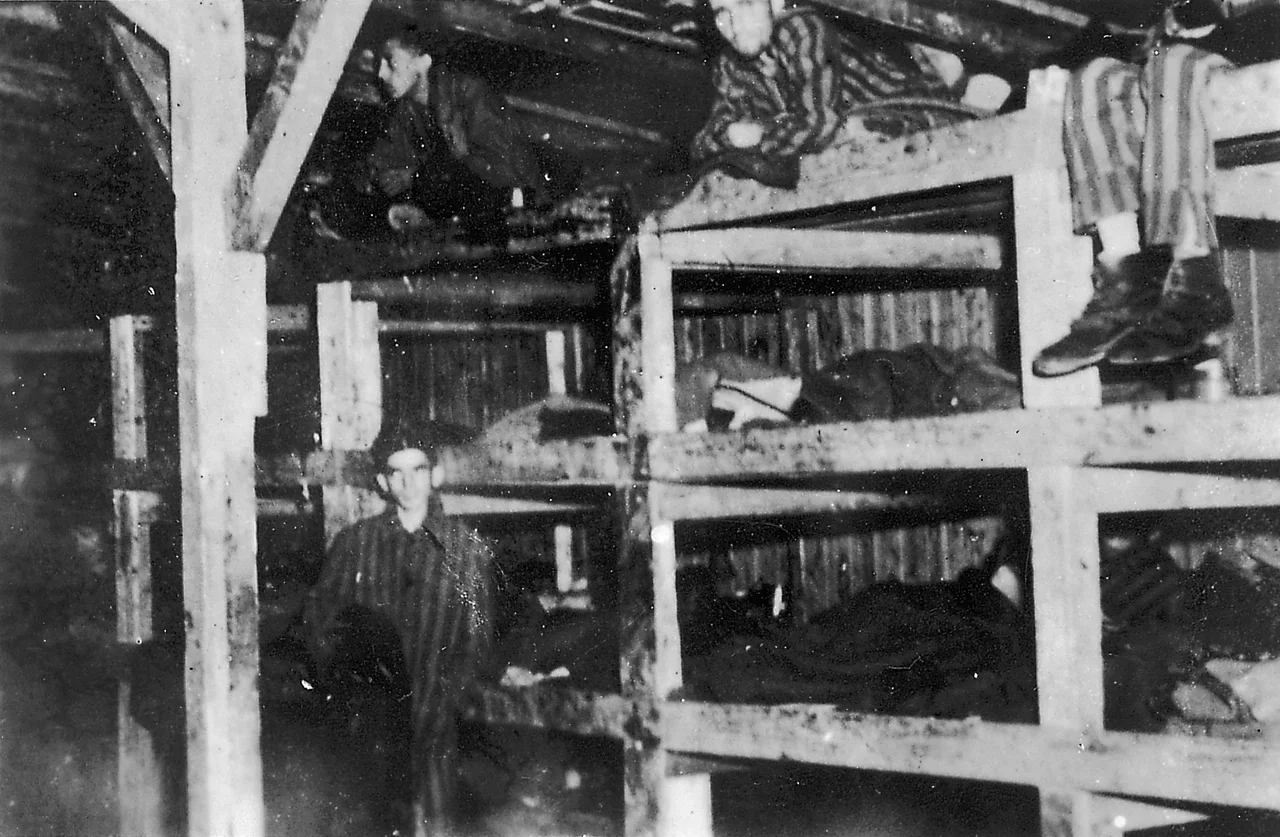

Buchenwald concentration camp
The clock over the gatehouse reads a quarter past three. It has read a quarter past three since 11 April 1945, when American troops of the 6th Armored Division reached the top of the Ettersberg and found what was behind the wire. Weimar lies below the ridge, less than ten kilometres off — Goethe's town, Schiller's town, the town where the German republic was drafted in 1919. The drive takes about twenty minutes. The camp opened on 15 July 1937 and ran for seven years and nine months, and roughly 280,000 people passed through it and its 139 subcamps.
The Camp the Prisoners Built
The first arrivals built the place themselves. They cleared the beech wood on the ridge that gave the camp its name, felling the trees and levelling the ground under guard, in the summer of 1937. One oak was left standing inside the compound, and prisoners called it the Goethe Oak — the writer had walked on this hill, and the coincidence was lost on nobody.
Many of the earliest inmates were communists. Over the following years the SS sent almost every category of person its ideology condemned: Jews, Poles and other Slavs, Roma, disabled people, political opponents, Freemasons, prisoners of war, men imprisoned for homosexuality, people classed as habitual criminals. Women were brought in during 1944 and 1945, mostly transferred from Auschwitz, Ravensbrück and Bergen-Belsen. They came from across occupied Europe and they arrived by the trainload.
What the Work Was
Prisoners were worked in a quarry cut into the hillside, in clay pits and brickworks, and in armaments factories built alongside the camp. Labour was not incidental to the system here; it was the system.
At the northern end of the compound lay the Little Camp, a quarantine section where conditions were worse than in the main camp and where new arrivals were held in barracks meant for a fraction of the numbers crammed into them. Elie Wiesel and Bertrand Herz were both sent there as sixteen-year-old boys. Wiesel's father died at Buchenwald.
SS doctors also used prisoners as material. In vaccine trials against epidemic typhus in 1942 and 1943, 729 people were used as test subjects and 154 of them died. Other experiments involved poisons and white phosphorus burns.
Jedem das Seine
The lettering set into the camp gate reads Jedem das Seine — to each what he is due. It was designed by Franz Ehrlich, a Bauhaus-trained architect who was himself a prisoner, and it was mounted so that it read from the inside. Every man who walked through that gate had the motto addressed to him.
The recorded death toll is 56,545. The figure is assembled from parts: 33,462 deaths appear in the SS's own registers, 8,483 people were shot, roughly 1,100 were hanged, and around 13,500 died on the evacuation transports as the camp was emptied in the final weeks. Every one of those categories was administered — written down, filed, totalled. What the arithmetic cannot hold is that each entry was a person with a name, a language and a family, and that the last thing the system did for most of them was count them.
April 1945
American forces reached the camp at 3:15 in the afternoon on 11 April 1945. The 89th Infantry Division had already overrun Ohrdruf, one of Buchenwald's satellite camps, a week earlier on 4 April.
What followed was deliberate. General Patton ordered the mayor of Weimar to produce a thousand citizens — chiefly men of military age from the middle and upper classes — and they walked a twenty-five-kilometre round trip under armed American guard to be shown the crematorium and the rest of it. General Eisenhower invited two further groups: journalists and editors from the principal American publications, then a dozen members of Congress led by Senate Majority Leader Alben W. Barkley. The reasoning was blunt and it was correct: evidence gathered by soldiers and reporters standing on the ground would be far harder to dismiss as atrocity propaganda. The Australian war correspondent Osmar White recorded the verse fixed above the crematorium door, which began: 'Worms shall not devour me, but flames consume this body. I always loved the heat and light...'
The Ground Afterwards
The site did not close in 1945. Between August 1945 and 1 March 1950 the Soviet secret police ran NKVD special camp Nr. 2 here, holding former Nazis and anti-communist dissidents; Soviet records list 28,455 people detained and more than seven thousand deaths. When the camp shut, the authorities razed much of what was left and concealed the mass graves.
Justice for the original crimes was partial. Thirty SS men were tried by a US military tribunal in 1947, among them the Higher SS and Police Leader for the district and several of the camp doctors. Twenty-two were sentenced to death; nine were executed. By the mid-1950s every defendant had been released except Ilse Koch.
The first memorial went up days after liberation, built of wood by the prisoners themselves and meant to be temporary. A larger East German monument followed in 1958, inaugurated near the mass graves by Prime Minister Otto Grotewohl and put to work in the GDR's own politics of remembrance. On the spot where the prisoners' wooden marker stood, there is now a plate of stainless steel set into the ground. Its surface is held, year-round, at 37 degrees Celsius — the temperature of a living body. In a Thuringian January it is the only warm thing on the hill.
From the Air
Buchenwald lies at 51.0212°N, 11.2490°E on the Ettersberg, a long wooded ridge rising a little under 500 m immediately north-west of Weimar, which sits about 8 km to the south-east. From 2,500–4,000 ft the site reads as a large rectangular clearing cut into an otherwise continuous canopy of beech, with the straight camp road climbing to it from the south and the belltower of the East German memorial standing on the southern slope above the mass graves. Weimar's compact old town and the Ilm valley make the obvious approach reference; the Thuringian Forest ridge runs along the south-western horizon. Nearest airfields: Erfurt-Weimar (EDDE) about 20 km west, Jena-Schöngleina (EDBJ) about 35 km south-east, Leipzig/Halle (EDDP) about 85 km north-east. The Ettersberg holds low cloud and fog when the Thuringian Basin below is clear, which is one reason the ridge is often visible only as a line of treetops above a grey deck. The site is a memorial and a burial ground, and the airspace over it should be treated accordingly.
Nearby Stories
- Battle of Frankenhausen 3.6 km away
- Opfermoor Vogtei 13 km away
- Naumburg Cathedral 17 km away
- Saalfeld Fairy Grottoes 26 km away
- Francke Foundations 31 km away
- Unicorn Cave 36 km away
- Observation Post Alpha 44 km away
- Horch 62 km away