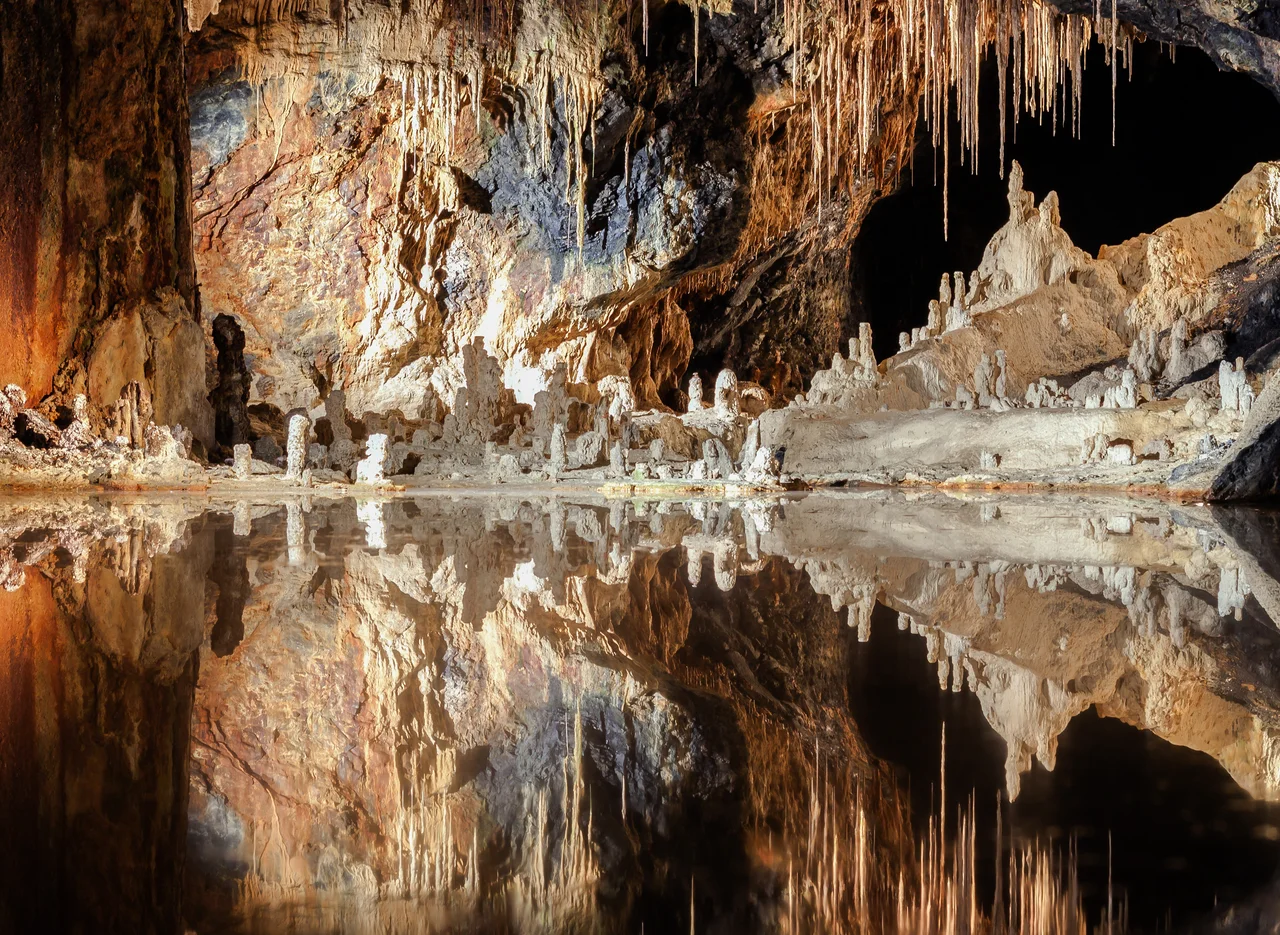

Saalfeld Fairy Grottoes
The stalactites here are younger than the United States. Everything that makes the Saalfelder Feengrotten famous - the rusts and reds and improbable greens, the dripping curtains, the mass of interlocked formations people call the Grail Castle - has grown since the miners stopped coming, which is to say in roughly three hundred years. Caves are meant to take geological time. This one took about the span of a long family tree, because the rock is soft, the water arrives loaded with metals, and the men who hollowed the place out left behind precisely the right conditions without meaning to. They were not looking for beauty. They were looking for alum.
Jeremias Glück
The mine was called Jeremias Glück - Jeremiah's Luck - and it worked alum shale from around 1544 until 1850. Alum was one of the indispensable substances of the pre-industrial world. It went into medicines, preserved food, clarified water, and above all fixed dye into cloth, which made it strategically valuable to anyone weaving anything they wanted to stay a colour. Then nineteenth-century chemistry produced better and cheaper compounds, alum stopped paying, and the workings were closed and left. Within two generations the mine was largely forgotten: a set of galleries in a hillside above the Saale that nobody had any reason to enter.
Three Centuries of Dripping
Water kept going in. Percolating through soft, metal-rich shale, it picked up its load and set it down again drop by drop in the galleries below - stalactites, stalagmites, sheets, columns - at a rate no limestone cave could approach. More than forty-five minerals have been identified in the grottoes: sulphides and oxides, carbonates and sulphates, phosphates, vanadates, arsenates, silicates. Iron does most of the visible work, laying down browns and rusts in dozens of distinct shades, with other metals supplying the greens and whites and near-blacks between them. Since 1993 Guinness has recorded the Feengrotten as the most colourful show grottoes in the world. The formations that earned the title are, by the reckoning of the people who study them, about 250 to 300 years old - which is to say they began forming while the mine was still working.
22 December 1913
Otto Wohlfahrt inherited the old mine and, in 1910, went back in with scientists to see what was down there. What they found was worth reopening. On 22 December 1913 they broke through into the third level and the chamber that would be named the Märchendom, the fairytale cathedral, where the formation called the Gralsburg stands above a pool so still that it doubles everything above it. Lit theatrically, the deposits read as turrets and roofs and battlements, which is where the fairies in the name came from. The grottoes opened to visitors on 31 May 1914, four weeks before the assassination in Sarajevo. Their first season was the last season of the old Europe.
The Emanatorium
In 1937 the site added something stranger. A therapy gallery opened on 10 September, called the Emanatorium, built around the naturally radon-bearing air of the workings. The underground climate is genuinely unusual: a constant ten degrees, humidity around 98 per cent, and air effectively free of dust, germs, allergens and ozone. Whether the radioactivity that comes with all that helps anybody remains contested - the English-language account of the grottoes describes such environmental radiation treatments as having been found hazardous, while at Saalfeld a therapy gallery for respiratory complaints continues to operate. The exhibition in the first chamber sets out this history alongside the mining that preceded it, which is the right order to take it in. A show cave that explains itself is more interesting than one that only performs.
Twenty Million Through the Door
A pavilion with a café went up alongside the first tours in 1914 and stayed in service through everything that followed. East Germany listed the Feengrotten as an official Sehenswürdigkeit, one of the sights foreign visitors were encouraged to see, and the pavilion kept working straight through. After reunification the buildings were renovated from 1998 and new facilities added. Between 1914 and 2007 more than twenty million people went underground here; the rate now runs at around 160,000 a year. The route is three chambers linked by galleries - first the mine's own history, then the source of the mineral-laden water that made everything else, and finally the Märchendom, which people tend to walk into without saying anything at all.
From the Air
The grottoes lie at 50.635 degrees N, 11.341 degrees E, in a hillside on the edge of Saalfeld, Thuringia, where the Saale valley meets the northern rim of the Thuringian Slate Mountains. From the air the navigation features are the Saale itself, running north out of the wooded uplands towards Jena, and the string of dammed reservoirs upstream to the south, whose long branching arms of water are unmistakable from altitude. Saalfeld sits where the river leaves the hills and the valley opens. Terrain rises sharply either side of the town, so this is not flat-country flying. Nearest airports: EDBJ (Jena-Schöngleina, elevation 374 m, 1,170 m asphalt) about 40 km north-northeast, EDDE (Erfurt-Weimar) about 50 km northwest. Recommended viewing altitude 3,000 to 5,000 feet above the valley floor. Autumn colour on the surrounding slopes is the best time; the attraction itself is entirely underground.
Nearby Stories
- Duchess Anna Amalia Library 6.6 km away
- Battle of Lutzen 35 km away
- Horch 37 km away
- Opfermoor Vogtei 38 km away
- Dejudaization Institute Memorial 49 km away
- Zwingenberg Castle 176 km away
- The Defenestration of Prague: The Thrown Men Who Started a Thirty Years' War 179 km away
- The Anschluss: When Austria Vanished Overnight 303 km away