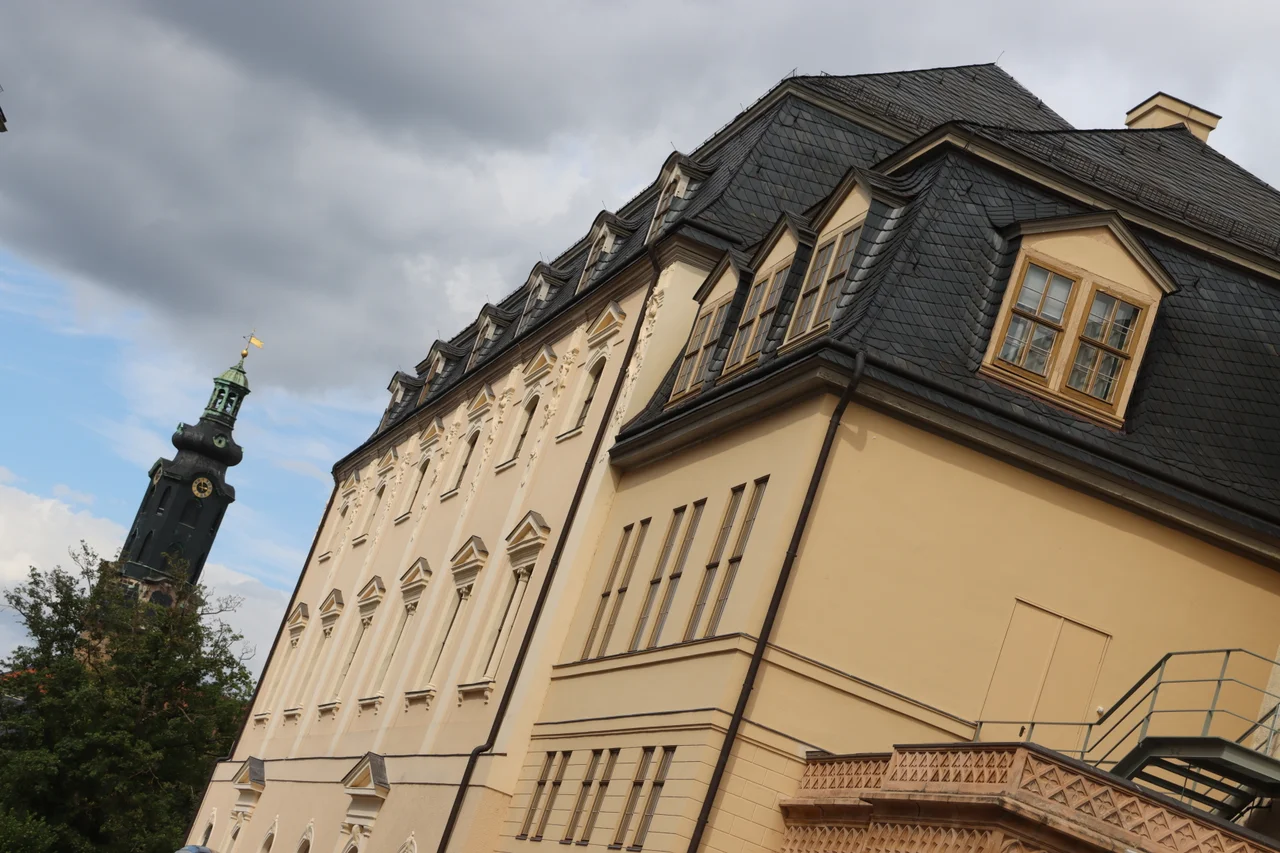

Duchess Anna Amalia Library
On the evening of 2 September 2004, people stood in a line down the stairs of a small Weimar library and passed books hand to hand into the dark. Some were librarians. Most were not - students, neighbours, firefighters, anyone who had heard and come. A corroded joint where an aluminium cable met a copper one had been smouldering behind a wall panel in the attic, and by the time anyone smelled it the roof was gone and the flames were working down into the oval rococo hall below. They got around 28,000 volumes out that way, including a Luther Bible printed in 1534. Fifty thousand did not come out at all.
A Duchess and a Green Castle
The building was never meant to hold books. Duke Johann Wilhelm had it put up in the 1560s as a residence, and Weimar called it the Grünes Schloss - the Green Castle - for the patina on its copper roof. In 1761 Anna Amalia, Duchess of Saxe-Weimar-Eisenach, widowed at eighteen and governing as regent for her small son, ordered it converted. The ducal book collection moved in during 1766, and the architects hollowed the interior into an oval gallery three storeys high, balconies stacked on slender white columns, every surface between them shelved. It is a room that makes readers behave differently. People lower their voices without being asked. The library had already been open to the public since 1691, which by the standards of eighteenth-century princely collections was an extraordinary thing to do with your books.
The Librarian Who Wrote Faust
Johann Wolfgang von Goethe took charge of the collection in 1797 and kept the job until he died in 1832 - thirty-five years of ordering, cataloguing, arguing over budgets, and chasing acquisitions across Europe. Under him the holdings roughly doubled, to around 80,000 volumes. The Weimar bookseller Hoffmann supplied him, and so did the Strasbourg house of Treuttel and Würtz, which fed French and pan-European publishing into a Thuringian town of a few thousand people. It is easy to picture Goethe as a monument. Harder, and truer, is the image of a busy minister of state spending decades on shelf lists. The result is a research library that still specialises in exactly what he cared about: German literature of the Classical and late Romantic periods, the world's largest Faust collection, roughly 10,000 volumes of Shakespeare, and Anna Amalia's own music library of some 13,000 items.
What the Fire Took
Fifty thousand volumes were destroyed outright, of which around 12,500 are considered irreplaceable - not rare, but gone, with no other copy known. Another 62,000 were badly damaged by flame or by the water used to fight it. Thirty-five oil paintings from the sixteenth to eighteenth centuries burned. Schiller's death mask was damaged. The loss was later reckoned at about 67 million euros, a figure that means very little when applied to objects that cannot be bought. Restoration of the building itself took just under three years. Federal President Horst Köhler reopened it on 24 October 2007 - Anna Amalia's birthday - with roughly 60,000 volumes back on the shelves and the rococo hall restored to something a visitor from 1800 would recognise.
The Ash Books
The harder work is still going on. Conservators call the salvaged wreckage the Aschebücher, the ash books: charred, waterlogged, fused blocks of paper that had to be frozen before they rotted, then thawed, separated and rebuilt page by page. The team in Weimar invented a technique for it - a compression cassette that washes a leaf and reinforces it with Japanese tissue in a single pass - because nothing existing could handle the volume. By 2021 they had brought back roughly a million pages, with another million and a half scheduled to be finished by 2028. Alongside this runs a quieter effort: an online register of every title the library lost, published so that dealers, other libraries and private owners can match copies against it. Books trickle back that way, by purchase and by donation, and the register slowly shortens.
Underground, and Around the Square
The fire arrived in the middle of a rescue that had already begun for other reasons. The old building had structural problems and no room, and in 2001 excavation started for a new store beneath the Platz der Demokratie, the square outside. Two subterranean floors, 6,300 square metres, roughly 24 million euros, connected by tunnel to reading rooms in the restored Red and Yellow Castle across the way; it opened in February 2005, five months after the fire, and it is where most of the million-plus items now live. The historic hall holds the treasures and the visitors, capped at a small number per hour to protect the interior. UNESCO inscribed the library in 1998 as part of the Classical Weimar site, which lists the buildings where a very small German duchy briefly became the centre of European letters.
From the Air
The library stands at 50.979 N, 11.332 E in central Weimar, Thuringia, at roughly 210 m elevation in the Ilm valley. From 2,000-3,000 ft AGL the Green Castle reads as a pale rectangular block on the east side of the Platz der Demokratie, immediately south of the Stadtschloss and its distinctive round tower, with the wooded Park an der Ilm running south-east. The Ettersberg ridge rises 8 km to the north-west. Erfurt-Weimar Airport (EDDE) lies about 26 km west; Leipzig/Halle (EDDP) is roughly 80 km north-east. Thuringian basin weather brings frequent low stratus and valley fog from October through March; summer afternoons offer the cleanest light on the old town roofs.
Nearby Stories
- Walpersberg 9.2 km away
- Francke Foundations 17 km away
- Eisleben 23 km away
- Mittelbau-Dora Concentration Camp 25 km away
- Bad Dürrenberg burial 27 km away
- Opfermoor Vogtei 34 km away
- Horch 38 km away
- Observation Post Alpha 69 km away