
Francke Foundations
The sum was four thalers and sixteen groschen. August Hermann Francke had gone to the alms box in his parish at Easter 1695 expecting the usual coppers, and what he found there was enough to make a man reckless. His own account of the moment reads like someone talking himself into something: here is a goodly capital to work with, I must do a great work with this, I will found a school for the poor with it. Within a generation the school had become a walled complex of half-timbered buildings on the edge of Halle housing more than two thousand children, a printing house, a pharmacy, a natural history collection and a missionary network reaching India. It is still there, still full of children, and the money that started it would not now buy lunch.
The Preacher Nobody Would Keep
Francke was born in Lubeck in 1663 and had a talent for getting thrown out of places. His Pietist teaching - personal conversion, close Bible study, a Christianity of felt experience rather than doctrinal correctness - drew crowds and infuriated the Lutheran establishment. Leipzig banned him from lecturing in 1689. Erfurt made him a deacon in 1690 and gave him fifteen months before the civil authorities ordered him out of the city within forty-eight hours, on 27 September 1691. What saved him was a new university. Halle was being organised from scratch, Philipp Jakob Spener spoke for him, and in December 1691 Francke arrived with a chair at the university and the pastorate of Glaucha, a poor suburb outside the town wall. He began giving to the poor on Thursdays, the town's alms day, and quickly concluded that charity without schooling changed nothing.
Building on Nothing
The poor school opened in 1695, taught by university students. It worked well enough that paying families started asking to send their children too, so Francke added the Paedagogium for the sons of the nobility and merchant class, then a Latin school in 1697. In 1698 he began the orphanage, finished around 1701 and startlingly grand for its purpose - a huge half-timbered block whose tympanum carries two eagles rising towards the sun and a line from Isaiah about those who wait on the Lord rising up with eagles' wings. He built it with no capital and no state patronage, on money that arrived as fast as the workmen had to be paid and never faster. Baron von Canstein visited in 1706 and described the place to a Prussian official as a kind of little world, all in harmony and in a state of great efficiency. By 1698 there were a hundred orphans and five hundred day pupils. By Francke's death in 1727, more than 2,300.
The Businesses That Paid for It
Faith kept the accounts, but enterprise kept the doors open. A chemist left Francke a medicine recipe, and the resulting apothecary became a substantial and long-running income. In 1711, with Carl Hildebrand von Canstein, he founded the Cansteinsche Bibelanstalt - the oldest Bible institute in Germany and effectively the first modern Bible society - which used standing type to print scripture in enormous runs at prices ordinary people could afford, and went on producing them into the twentieth century. The Foundations also became the hub of the Danish-Halle Mission, sending the first Protestant missionaries to India and building a correspondence network that carried Halle's ideas about schooling to Russia, North America and the Indian coast. Contemporaries started calling the place the New Jerusalem, which was meant admiringly and does convey the ambition.
The Cabinet and the Library
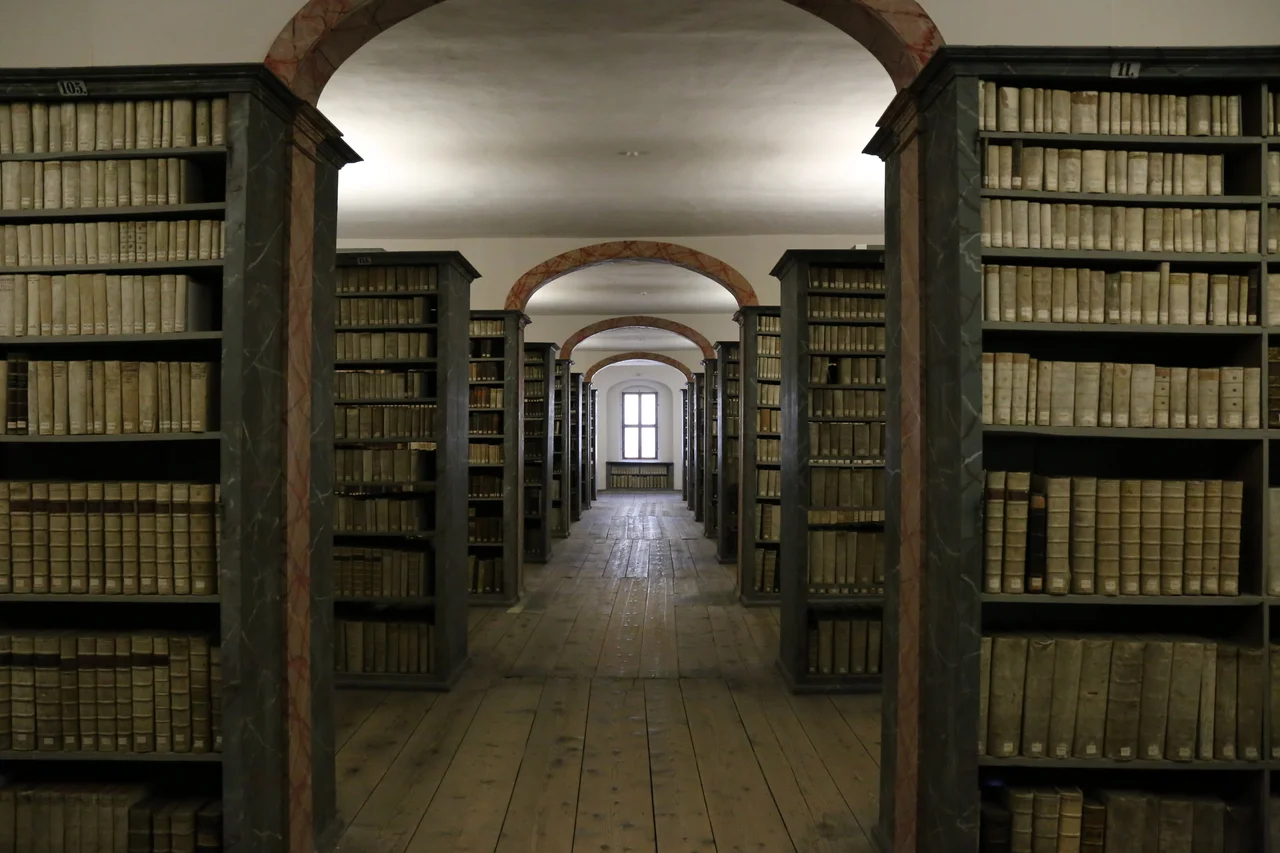
Two rooms explain the intellectual project better than any description of it. Up in the attic of the orphanage sits the Kunst- und Naturalienkammer, a cabinet of artefacts and curiosities that is among the oldest teaching collections in Germany, restored to its eighteenth-century arrangement: eighteen carved cabinets holding about 3,000 objects, the natural specimens sorted into stones, plants and animals, the made things into fine art, writing, coins, dress and daily life. Children were meant to learn from looking. The historic library, in its own purpose-built house from 1728, holds around 50,000 volumes and keeps its original fittings entirely - shelving arranged like stage scenery, restored between 1996 and 1998 to its appearance of 1746. Standing in it is the closest most people will come to seeing what a working Enlightenment library actually looked like.
Nationalised, Neglected, Returned
The twentieth century nearly finished it. In 1946 the provincial authorities abolished the Foundations and transferred the assets to Martin Luther University; the complex became state property, and in the 1970s part of the orphanage's northern wall was pulled down for a road. Buildings rotted quietly for four decades. Restoration began in 1991 and the Foundations were re-established as a public-law foundation in 1992, and what has come back is not a museum. More than 4,000 people now learn, teach, work and live inside the walls: three kindergartens, four schools including the Latina that descends directly from Francke's 1697 foundation, a children's creative centre, a house that puts a Montessori primary school and a care home under one roof, research institutes on Pietism and the Enlightenment, and the German Federal Cultural Foundation. It has been on Germany's UNESCO nomination list since 1999.
From the Air
The Francke Foundations occupy a large walled campus at 51.478 N, 11.972 E, immediately south of Halle's old town in Saxony-Anhalt, at roughly 90 m elevation above the Saale. From 2,000-3,000 ft AGL the complex is unmistakable: two long parallel ranks of tall gabled buildings enclosing a broad open green rectangle, a form nothing else in the city repeats. The four towers of the Market Church and the freestanding Red Tower stand 1 km north; the Saale and the wooded Peissnitz island lie west, with Giebichenstein Castle on the cliffs beyond. Leipzig/Halle (EDDP) is about 20 km north-east - the campus sits under its approach corridor. Winter fog is common along the Saale; the flat light of an overcast day flattens the campus into the surrounding roofscape, so pick a low sun for the shadows.
Nearby Stories
- Colditz Cock 11 km away
- Eisleben 12 km away
- Bauhaus Dessau 19 km away
- Battle of Jena-Auerstedt 23 km away
- Torgau 29 km away
- Quedlinburg 34 km away
- Jena 45 km away
- Treuenbrietzen 49 km away