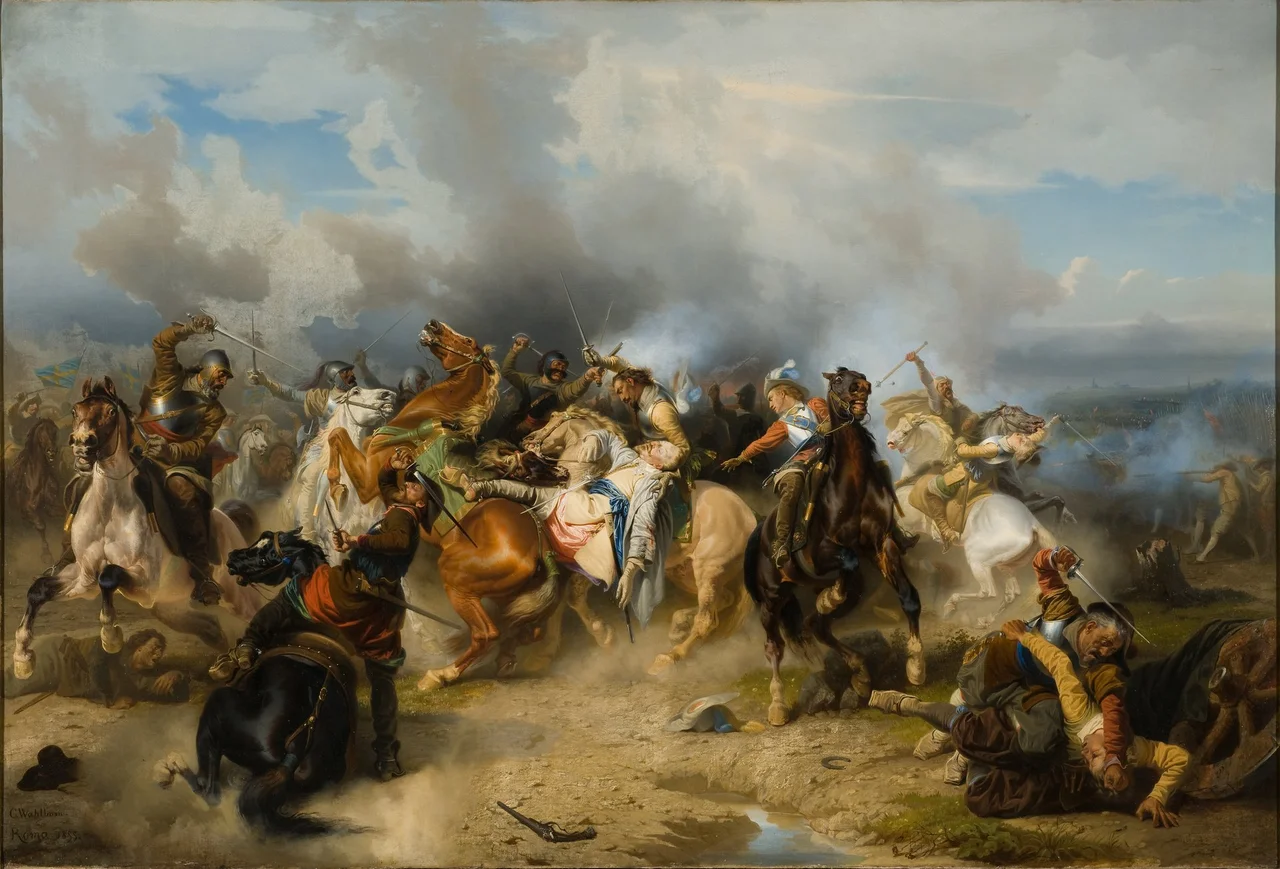
Battle of Lutzen
His body was not found until after the fighting ended. The Swedes had to dig him out from under a heap of corpses on the Imperial side of the muddy ditch that ran beside the Lutzen-Leipzig road, where the worst killing of the day had taken place. He had been shot three times. Gustavus II Adolphus, king of Sweden at sixteen, soldier-king of the Protestant cause, the man Cardinal Richelieu had been paying to keep Habsburg armies out of the Baltic, had ridden into a wall of Imperial cavalry in the November fog and not come out. He was thirty-seven years old. His army won the battle anyway, more or less, although nobody in Sweden quite knew how to feel about a victory that left their king dead in a German ditch.
The King from the North
Gustavus Adolphus had landed 18,000 Swedish soldiers in Pomerania in 1630, declaring his intention to defend the Protestant cause in Germany after a decade of Catholic Imperial victories. Many in Europe had thought it a quixotic gesture by a small northern kingdom. He had then proceeded, in the next two years, to win one of the most astonishing campaigns in early modern military history. Backed by French money and supported by Protestant German allies, he had crushed the Imperial army at Breitenfeld in 1631 and again at Rain in April 1632. He had marched his army the length of Germany, drilling it into something Europe had not seen before: an army that fought in flexible combined-arms formations, with light field artillery that could keep pace with infantry, and disciplined musketeers who could fire and reload faster than anyone else. His enemies began calling him the Lion of the North. By the autumn of 1632 he had drawn deep into southern Germany, and the Imperial general Albrecht von Wallenstein had moved north into Saxony to threaten his communications. The two of them spent six weeks circling each other warily before Wallenstein settled into winter quarters at Leipzig. When Gustavus learned that Wallenstein had detached a third of his army under Pappenheim and sent it off toward Halle, he saw his chance and marched.
The Fog at Eleven O'Clock
On the morning of 16 November 1632 (Gregorian calendar; Sweden, still using the Julian, knew it as 6 November), the Swedish army of about 19,000 men formed up two kilometers outside the village of Lutzen. A heavy fog hung over the field. Wallenstein had spent the night digging his troops in along the Lutzen-Leipzig road, the old Via Regia, with his strongest position anchored on a low hill by three windmills. The Swedish attack did not begin until eleven o'clock because of the fog and the difficulty of crossing a canal. By the time the assault went in, Pappenheim's cavalry had ridden hard from Halle and arrived on the Imperial left, just in time to charge into the Swedish infantry that had punched across the road. The Swedish elite Yellow and Blue Brigades were nearly wiped out. Pappenheim himself was mortally wounded by a small-bore Swedish cannonball; he died being carried away in a coach. By midday both armies were losing cohesion in the smoke and the fog, the village of Lutzen was on fire and the wind was blowing the smoke across the battlefield, and individual units were fighting their own private wars in visibility of a few yards.
Where the King Fell
Somewhere in this confusion, Gustavus Adolphus and his small entourage of staff officers got separated from the Swedish line and rode into a unit of Imperial cuirassiers. He was nearsighted; he had refused to wear armor that day because of an old wound. He was shot in the arm, then the back, then the head. His horse bolted. His men found his body hours later under other dead. By the time the news began to spread along the Swedish line, his deputies had already taken control: the German general Bernhard of Saxe-Weimar pressed the attack on the Imperial left, and Knyphausen reorganized the broken brigades and brought them forward again. By four in the afternoon they had taken the village of Lutzen and the Imperial battery on the windmill hill. Wallenstein, with his own troops in equally bad shape, ordered the retreat at dusk and abandoned his guns and supply wagons. Pappenheim's infantry, arriving on the field after dark, asked permission to counter-attack. Wallenstein told them no. The Swedish army held the field, but at a terrible cost: about 6,000 of its soldiers killed or wounded, including their king. Perhaps 5,160 men on the Imperial side were killed or wounded too - Bohemians, Croats, Italians, Walloons and Germans fighting for pay and for a cause most of them had not chosen, and lying in the same mud when the fog lifted.
The Aftermath
Gustavus Adolphus was succeeded by his six-year-old daughter, Christina. The actual direction of Swedish policy fell to his old chancellor, Axel Oxenstierna, who decided that the only way to recoup Sweden's enormous investment in the German war was to keep fighting. The following spring, Oxenstierna formed the Heilbronn League with Sweden's German Protestant allies, and the war went on for another sixteen years before the Peace of Westphalia in 1648 finally ended it. Wallenstein, the Imperial general who had let the Swedes hold the field at Lutzen, came under suspicion in Vienna of plotting to switch sides; he was assassinated by his own officers in February 1634. Gustavus Adolphus was brought home and buried in the Riddarholm Church in Stockholm, where Swedish kings had always been buried. Sweden has commemorated his death every year on 6 November ever since, even after switching to the Gregorian calendar in 1753. They could not quite let go of the day.
The Mass Grave and the Stone
In 2011, archaeologists working in a field outside Lutzen uncovered a mass grave containing the skeletal remains of forty-seven men. The bones told a clear story. The average age was twenty-eight. Many showed evidence of healed injuries from previous campaigns; these were veterans, not raw recruits. More than half had been killed by gunfire, a strikingly high proportion for an era when most infantry casualties came from edged weapons. They were almost certainly Swedish soldiers from one of Gustavus's brigades, run down and shot by Pappenheim's cavalry as they fell back across the road. They had marched a long way from Sweden to die in this Saxon field. Above ground, near the spot where their king fell, a granite boulder was placed the day after the battle. An iron canopy went up over it in 1832. A small chapel was built nearby in 1907. The Swedes still come, every November, to a village few outside Saxony and Sweden have ever heard of, to remember a king who died young and the thousands of soldiers who died with him.
From the Air
Located at 51.27N, 12.16E in Saxony-Anhalt, central Germany, about 25km southwest of Leipzig near the small town of Lutzen. The battlefield is flat to gently rolling agricultural country, crossed by the old Via Regia road and several drainage canals. Visible from cruising altitude as patchwork farmland on the plain between Leipzig and Naumburg. Nearest major airport is Leipzig/Halle (EDDP) about 30km northeast.
Nearby Stories
- Battle of Jena-Auerstedt 3.5 km away
- Eisleben 3.8 km away
- Nebra sky disc 7.5 km away
- Colditz Cock 16 km away
- Chemnitz 24 km away
- Torgau 25 km away
- Horch 37 km away
- Bauhaus Dessau 38 km away