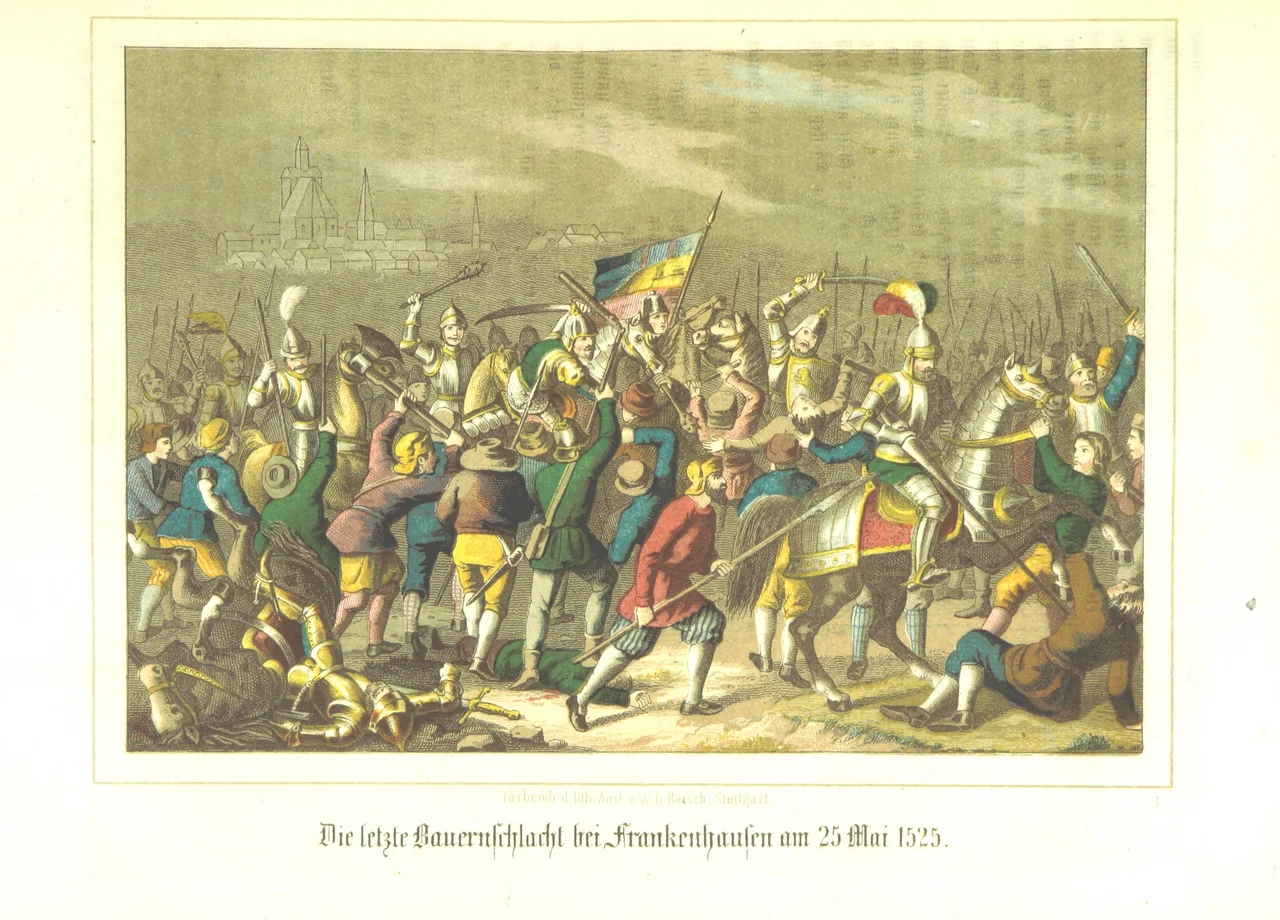

Battle of Frankenhausen
They saw a rainbow over the hill and took it as a sign, because a rainbow was on their banner. The flag Thomas Müntzer's people carried was a Regenbogenfahne, stitched with the words Verbum domini maneat in aeternum — the word of the Lord endures forever — and when a bow of coloured light appeared in the sky above the camp on the morning of 15 May 1525, thousands of frightened, badly armed people read it as heaven declaring itself. What they were almost certainly looking at was a sun halo — light bending through ice crystals in high cloud. Within a few hours most of them were dead.
Who Was Standing on That Hill
They were farmers, day labourers, small-town craftsmen and their families' menfolk, from villages across Thuringia and the Saxon estates. What they wanted had been printed that spring in the Twelve Articles and was circulating across Germany in cheap editions: the right of a parish to choose its own pastor, an end to serfdom, access to the woods and waters that lords had enclosed, an end to the death duty that took a household's best animal when the head of the family died. It was not a utopian document. It was a list of grievances that had accumulated for generations.
Frankenhausen went over on 29 April 1525. Much of the citizenry joined, took the town hall, and stormed the castle of the Counts of Schwarzburg. Insurgents kept arriving through early May, camping in the fields and pastures. Thomas Müntzer reached the town on 11 May with three hundred fighters from Mühlhausen, bringing a theology in which the poor were God's chosen instrument and the princes' hour had come.
The Wagon Fort
The two armies were not comparable. Around eight thousand peasants faced at least six thousand professional soldiers under Landgrave Philip I of Hesse and his father-in-law George, Duke of Saxony — Landsknecht mercenaries with cavalry and field artillery. The peasants had polearms, farm implements pressed into service, a scattering of breastplates, and the handguns some owned from service in local militia bands.
They were not helpless. On 14 May they drove off a scouting party and its reinforcements, and then made the disciplined choice not to chase it. Late that day they pulled back into a wagon fort on the hill above the town, the standard defence of the period, and someone — it is not known who — opened a truce. The pause was fatal. It gave the princes the hours they needed to link up with George's column coming from the east and close a ring around the hill instead of besieging the town.
Fifteenth of May
Around midday it became clear that the peasants would not hand Müntzer over, and the truce ended. The artillery opened first, into a mass of people packed behind a barricade of carts, and then the horse and foot went in. The formation broke almost at once, and what followed was not a battle but a pursuit — down off the hill, through the streets of Frankenhausen, with mercenaries cutting down people who were running.
At least six thousand of them were killed. On the other side, six men died. A place on the slope is still called the Blutrinne, the blood channel, where a group turned and tried to make a stand. Six hundred were taken prisoner; three hundred of those were executed the following day. The villages that had sent men were then assessed reparations that ran to many times the damage the rising had actually done, so the households that had lost fathers and sons paid for the privilege.
Müntzer at Heldrungen
Müntzer was found in the town, hiding. He was handed to Count Ernst von Mansfeld and taken to the moated castle at Heldrungen, where he was tortured, and on 27 May 1525 he was executed in the princes' field camp near Mühlhausen. He was somewhere in his mid-thirties.
He has been argued over ever since, which is what happens to a man who left sermons and led an army and lost. Luther, who had encouraged the princes to strike hard, wanted him remembered as a fanatic. Later revolutionaries wanted him remembered as a prophet of the coming order. Both readings need him to be larger than life, and both quietly do the same thing to the people who followed him: turn them into a crowd, a movement, a casualty figure. They were none of those things until the fifteenth of May made them so.
Three Thousand Faces
The East German state commissioned Werner Tübke to paint the battle on the hill where it happened, and he began work in 1976. The leadership wanted something heroic and monumental — Müntzer as revolutionary forebear, the peasants as the first act of a story ending in the GDR itself.
Tübke worked until 1987 with fifteen assisting artists and delivered something else entirely: a canvas 123 metres around and 14 metres high, 1,722 square metres, with more than three thousand individual figures and no simple message anywhere in it. He painted in a dense, jewel-toned late-Gothic manner that had nothing to do with socialist realism, set the battle inside a whole disintegrating world of Reformation Germany, and put Müntzer at the centre as a tired and broken man beside a fallen banner. The purpose-built rotunda opened on 14 September 1989, weeks before the state that ordered it began to come apart. Visitors stand in the middle and turn slowly, looking for a face.
From the Air
The battlefield is the Schlachtberg, a low hill immediately north-west of Bad Frankenhausen at 51.3558°N, 11.1011°E, on the southern edge of the Kyffhäuser range in northern Thuringia. The unmistakable marker from the air is the Panorama Museum on the hilltop — a white cylindrical rotunda about 18 m high and 44 m across, unlike anything else in the landscape. Best seen from 1,500–2,500 ft AGL, with the town and its leaning church tower below to the south-east and the flat Goldene Aue plain running north-east. The Kyffhäuser Monument stands 6 km north on the wooded ridge; Nordhausen is 27 km north-west and the Harz massif fills the horizon beyond, with the Brocken 60 km north. Nearest airfields: Erfurt-Weimar (EDDE) about 43 km south, Ballenstedt (EDCB) about 45 km north-east, Eisenach-Kindel (EDGE) about 59 km west-south-west, Magdeburg-Cochstedt (EDBC) about 60 km north-east, Leipzig/Halle (EDDP) about 79 km east. Terrain is easy; the Kyffhäuser ridge to the north rises only about 300 m above the plain.
Nearby Stories
- Bode Gorge 7.6 km away
- Buchenwald concentration camp 19 km away
- Upper Harz Water Regale 21 km away
- Dejudaization Institute Memorial 25 km away
- Unicorn Cave 26 km away
- German National Academy of Sciences Leopoldina 26 km away
- Bauhaus Dessau 47 km away
- Horch 77 km away