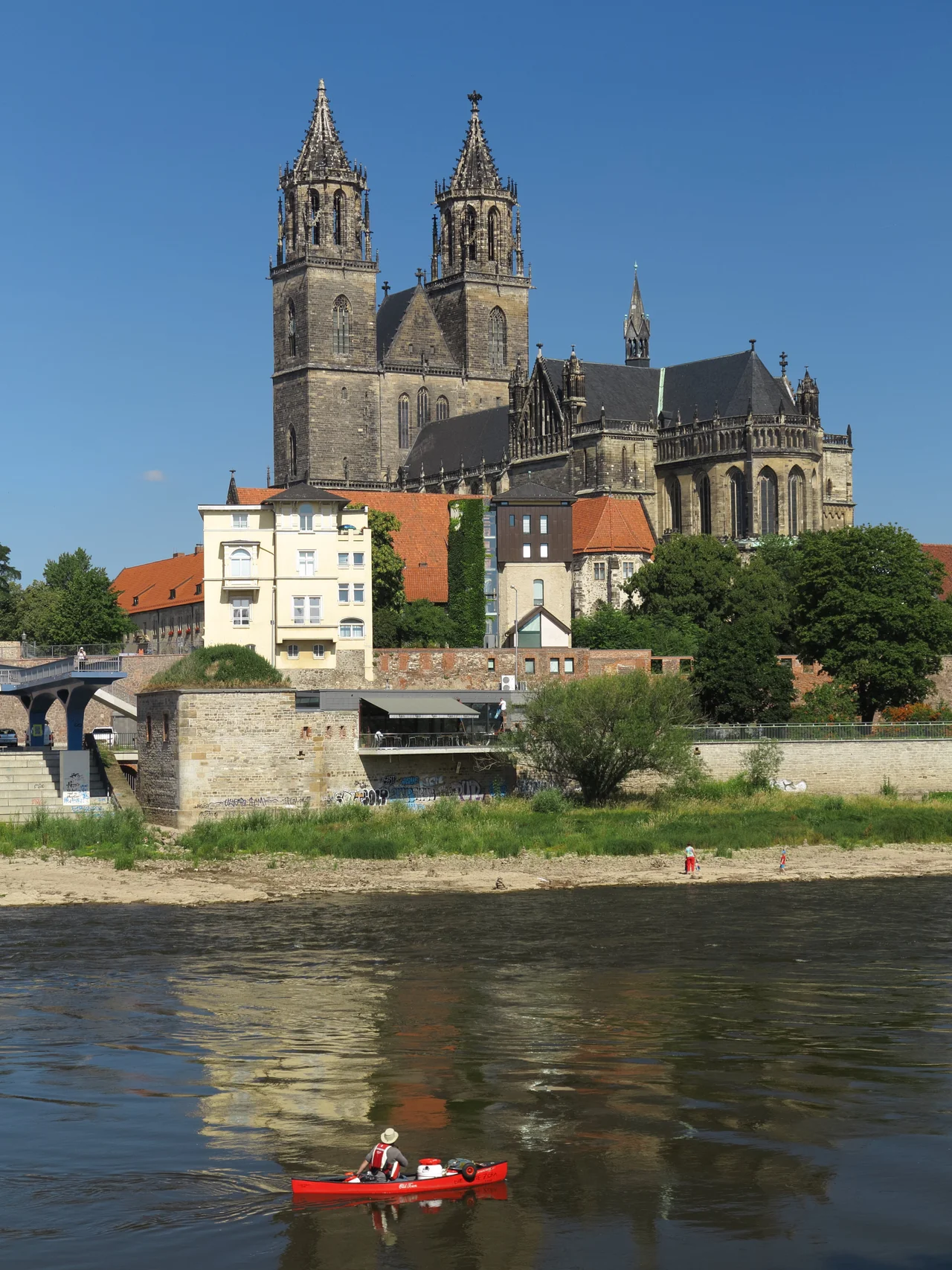

Magdeburg Cathedral
On Good Friday in 1207, a fire burning through the streets of Magdeburg reached the old church of St. Maurice and consumed it. The cloister wall on the south side was the only thing left standing. Two years later, Archbishop Albert I of Kafernburg, fresh from travels in France, decided not to rebuild what had been there. He had seen the new pointed arches rising at Reims and Chartres, and he wanted them on the banks of the Elbe. The cathedral that grew out of that decision took 311 years to finish. The masons who set the first stones in 1209 had great-great-grandchildren who would never see the cross placed atop the north tower in 1520.
The Emperor in the Choir
Walk into the sanctuary today and you stand a few paces from a sarcophagus that holds the remains of Otto I, the first Holy Roman Emperor of his line. Otto died in nearby Memleben in May of 973 and was carried here to be laid beside his English wife Eadgyth, granddaughter of Alfred the Great, who had been buried in the original church in 946. When Eadgyth's lead coffin was opened in 2008, isotope analysis of her teeth confirmed she had grown up in Wessex, exactly as the chronicles claimed. Otto's tomb was opened in 1844; the skeleton was there, but the grave goods were gone, almost certainly carried off by Tilly's soldiers in 1631. The Latin inscription on the bronze plaque is modern. The bones beneath it are not.
The Sack of 1631
On 20 May 1631, after a long siege, the Catholic Imperial army under Johan t'Serclaes, Count of Tilly, broke into the city. What followed is still remembered in German as Magdeburgs Hochzeit, Magdeburg's wedding, an ironic name for one of the worst civilian massacres of the Thirty Years' War. Around 20,000 of the city's roughly 25,000 inhabitants were killed in the days that followed. Of the citizens who reached the cathedral and barred its doors, about 1,000 survived. The head priest Reinhard Bakes knelt before Tilly and begged for their lives. Tilly let them live, then his troops looted the building, smashed the colored windows, and stripped the treasury. By the war's end, Magdeburg had a population of 400. The cathedral, somehow, still stood.
Saint Maurice's Face
Around 1250, an unknown sculptor working in the new cathedral carved a statue of Saint Maurice, the Theban legionary martyred for refusing to worship Roman gods. What he produced is one of the earliest realistic depictions of a Black African face in European art. The statue shows a knight in chainmail, alert, dignified, individual rather than typed. The same workshop carved the famous five wise and five foolish virgins outside the north transept, faces caught between expectation and dawning regret. The figures have Slavic features, drawn from the people the masons saw every day in the streets of a city perched at the eastern edge of Christian Europe. These were not symbols. They were portraits of a place.
Napoleon's Stable, Schinkel's Restoration
When Napoleon took Magdeburg in 1806, his army used the cathedral as a warehouse, then as a stable for cavalry horses, and finally as a sheep pen. The occupation ended in 1814. A decade later, Frederick William III of Prussia handed restoration to Karl Friedrich Schinkel, the architect rebuilding much of Berlin in those years, and between 1826 and 1834 the building was patched and cleaned and given a future. The RAF raid of 16 January 1945 destroyed the windows again and cracked the vaults, and a firebomb tore into the west facade between the towers. Fire crews working on the roof saved the timbers. The cathedral reopened in 1955.
The Monday Demonstrations
Inside the south transept stands Ernst Barlach's Magdeburger Ehrenmal, commissioned in 1929 as a heroic war memorial and delivered as something else entirely. Barlach, who had volunteered for the trenches and come back changed, sculpted gaunt soldiers and grieving figures instead of triumphal warriors. The Nazis hated it and almost destroyed it. In 1983, weekly peace prayers began in front of the sculpture. Six years later, those prayers fed into the Monday demonstrations across East Germany that helped bring down the regime. The Bachert foundry is still casting new bells for the towers: the 6,525-kilogram Amemus went into the south tower in September 2022 and the smaller Benedicamus into the north a month later. A 15-tonne Credamus is to follow, filling the place in the south tower left empty since the medieval Maxima crashed down in the 1540s.
From the Air
Located at 52.12 N, 11.63 E on the west bank of the Elbe in central Magdeburg. The twin towers, 99 and 101 meters, are the city's tallest landmarks and are visible from cruise altitude on clear days. Nearest major airports are Berlin Brandenburg (EDDB) about 130 km east and Leipzig/Halle (EDDP) about 100 km southeast. Best views are from the south or west, with the cathedral rising directly from the Domplatz above the river.
Nearby Stories
- Quedlinburg 10 km away
- Inner German Border 13 km away
- Helmstedt–Marienborn border crossing 16 km away
- Jerichow Monastery 21 km away
- Bauhaus Dessau 31 km away
- Autostadt 32 km away
- All Saints' Church, Wittenberg 36 km away
- Lichtenburg Concentration Camp 48 km away