
Jerichow Monastery
There is no stone here. Walk the Elbe lowland around Jerichow and you find sand, clay, meadow and more sand — nothing a mason could quarry, dress and stack. Everywhere else in twelfth-century Europe, a great church began at a quarry face. Here the builders had to invent their way around the absence, and what they did was fire the ground itself. The canons who arrived in 1149 raised a three-aisled basilica out of baked clay, and in doing so helped establish a technique that would define north German architecture for the next four hundred years. The building is still standing. More surprisingly, it is still recognisably the building they finished.
Baked Ground
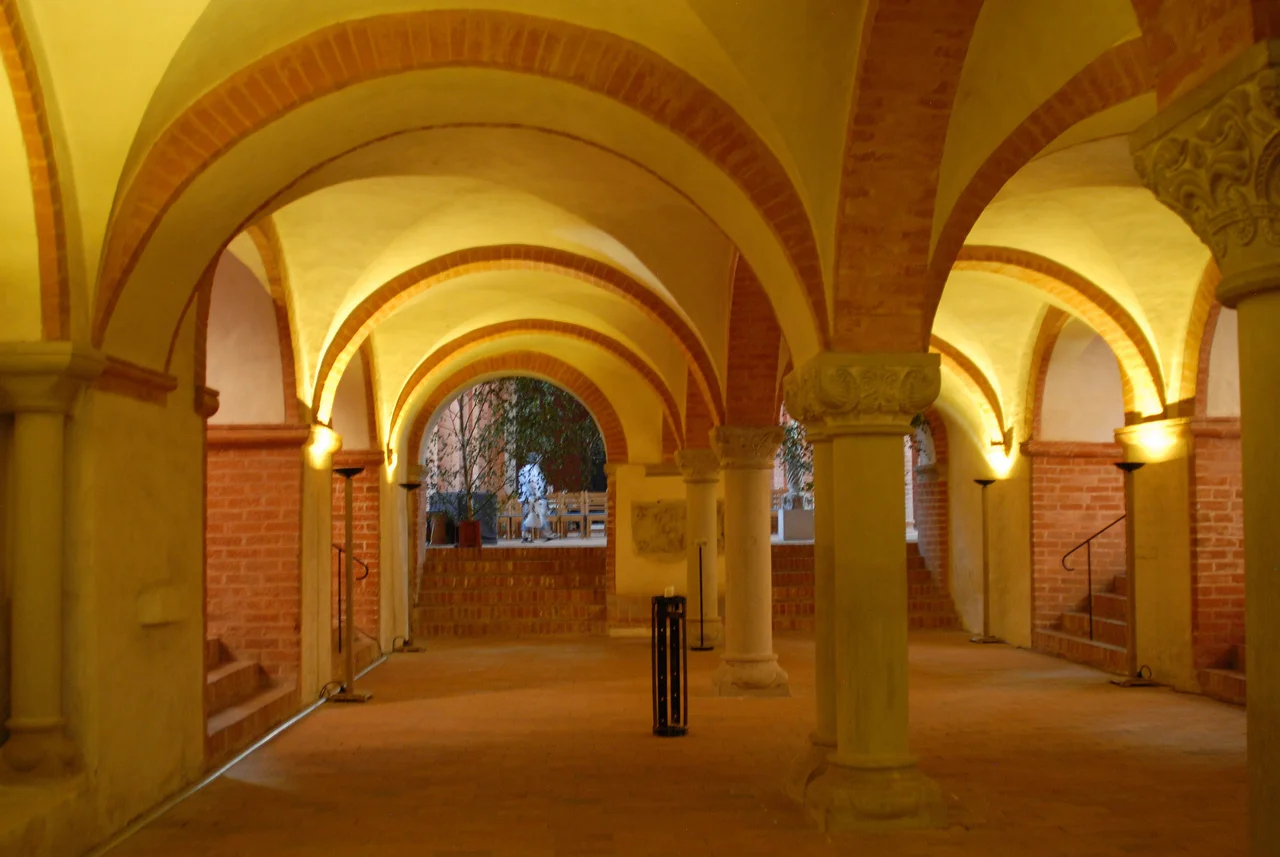
Brick was not new — the Romans had used it, and it had never quite vanished from Italy — but on the north German plain it was close to unknown. The evidence suggests Italian builders worked at Jerichow in the early years, which would explain how the method arrived. Whatever the route, it took. The bricks are large, deep red, laid with a plainness that reads as confidence rather than poverty, and the church they compose is counted among the oldest brick buildings in northern Germany and a founding example of the Brandenburg brick style. There is no carved tympanum to look up at, no stone figures in the arcades. The interest is all in rhythm: round arch after round arch, pier after pier, the same shapes repeating down the nave until the repetition becomes the effect.
Not Monks, and Not a Monastery
It is called a monastery and it never was one. The founders and first occupants were Premonstratensian canons — priests who took vows but went out into the parishes, preached, and did pastoral work rather than withdrawing behind walls. What stands at Jerichow is a collegiate church, dedicated to St Mary and St Nicholas, with a dormitory attached. The confusion is entirely the building's fault: it has a cloister, a refectory, a crypt and a dormitory, so it looks like a cloister and gets called one. The comparison that settles it is close at hand. The structurally near-identical Premonstratensian foundations beside the cathedrals of Magdeburg, Havelberg and Brandenburg an der Havel are all described, correctly, as collegiate churches. Only Jerichow, standing alone in a field, got promoted to abbey by popular assumption.
A Century of Building, Then Silence
Hartwig von Stade founded the house in 1144, when he was a canon of Magdeburg Cathedral; four years later he became Archbishop of Bremen, and the Emperor Conrad III confirmed the foundation. The first canons came from the Liebfrauenstift in Magdeburg. The original site sat in the middle of the village, and the noise of the marketplace drove them out — in 1148 they moved north of Jerichow to the present ground, and construction of the church began the following year. The nave, transept, choir and east cloister wing were finished by 1172. The crypt followed between 1180 and 1200, the summer refectory from 1220, the cloister from 1230. Last came the western bay, the façade and the two towers, built from 1256 to 1262 and rising 59 metres; by then taste had moved on, and their pointed windows are early Gothic. After that, almost nothing. Few Romanesque buildings anywhere were altered so little by the centuries that followed.
Brewery, Barracks, Artillery
The Reformation emptied it. The house was secularised in the sixteenth century and the remaining canons left. In 1631 Imperial and Swedish armies wrecked the village and its churches during the Thirty Years' War. In 1680 the whole district passed from the Archbishopric of Magdeburg to Brandenburg-Prussia, and five years later the Great Elector, Frederick William, designated the collegiate church a Reformed church for Huguenot refugees — a fine gesture undercut by the fact that the repairs it needed were not made for another two hundred years. Frederick William IV finally ordered a proper restoration between 1853 and 1856. Around 1870 the buildings were turned into a brewery and a distillery. In the last weeks of the Second World War American artillery hit the west front during a firefight with German troops, and in 1946 fire took the roofs of the east and south wings.
Condemned, Then Rescued
Between 1955 and 1960 the East German state paid for repairs that stripped the interior back towards its original Romanesque state, and in 1977 a museum opened in the west wing. It was not enough. The summer refectory was restored in 1985 and 1986, but the rest had deteriorated so far that in 1998 the building inspectorate closed the whole complex as unsafe. Work in 1999 got the order lifted; the repairs ran on for years afterwards. On 13 December 2004 six parties — the state of Saxony-Anhalt, the Evangelical Church in Central Germany, the district of Jerichower Land, the town, the local parish and a preservation society — founded the Stiftung Kloster Jerichow, which gathered the scattered buildings, documents and possessions back into single ownership for the first time since the dissolution. Two bells hang in the wooden belfry. The smaller, cast soon after 1300 in the tapering shape German founders called a sugarloaf, still carries its maker's name in the inscription.
From the Air
Jerichow Monastery stands at 52.502°N, 12.016°E, just north of the town of Jerichow in Jerichower Land, Saxony-Anhalt, on the east bank of the Elbe. Best viewed at 1,500-3,000 ft AGL. The two west towers rise 59 metres and are the only vertical feature for miles — from the air the complex reads as a long red-brick rectangle isolated in flat farmland north of the village, with the Elbe's meanders and floodplain forest a few kilometres west. Navigational anchors: the Elbe itself, Tangermünde on the far bank to the northwest, and Genthin to the southeast. Nearest airports: Magdeburg-Cochstedt (EDBC) about 80 km southwest, Berlin Brandenburg (EDDB) about 90 km east-southeast, Hannover (EDDV) about 140 km west. Terrain is flat and unobstructed; river fog and low stratus are frequent over the Elbe valley from autumn through early spring.
Nearby Stories
- Stork Farm Loburg 10 km away
- Battle of Fehrbellin 10 km away
- Gardelegen Massacre 14 km away
- Paretz 15 km away
- Treuenbrietzen 19 km away
- Holy Blood of Wilsnack 28 km away
- Free Republic of Wendland 36 km away
- Schöningen spears 43 km away